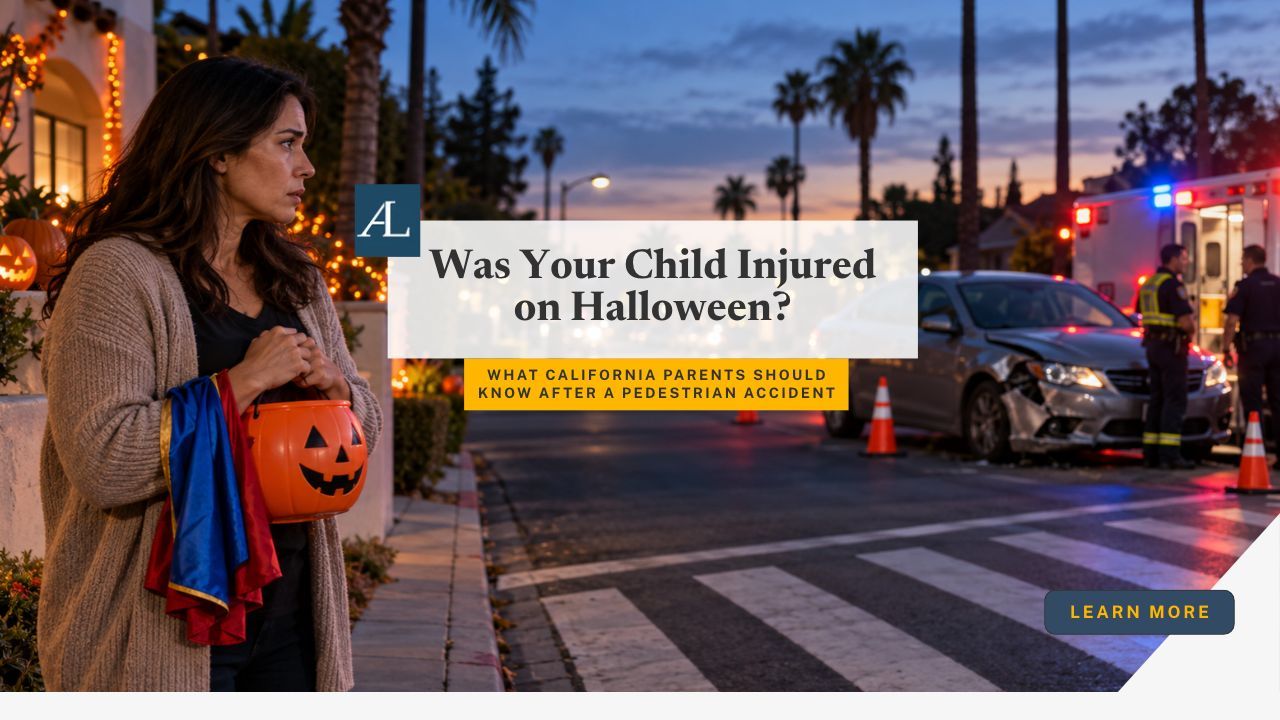
Halloween pedestrian accidents can leave parents trying to manage a child’s care while replaying the moment a driver failed to stop. If your son or daughter was hit by a car while trick-or-treating, walking home, or crossing near a Halloween gathering, the questions may continue long after the weekend ends. You may need to understand the medical plan, arrange time away from work, and respond to an insurance company asking for a statement about your child.
Your child’s health comes first. Families affected by Halloween pedestrian accidents also deserve a careful explanation of their legal options. Avrek Law Firm’s pedestrian accident attorneys can review what happened, identify evidence that should be preserved, and discuss the steps involved in a California child injury claim. Call 866-598-5548, start a chat, or request a free consultation.

Why Halloween pedestrian accidents need a careful investigation
Investigating Halloween pedestrian accidents may require accounting for parked cars, groups of children, turning traffic, decorations, and changing light at a crossing. A driver’s statement that a child appeared suddenly is one account to investigate, not a complete explanation of responsibility. The questions include how fast the driver was moving, where the child entered the roadway, what the driver could see, and whether reasonable attention would have allowed the collision to be avoided.
Historical research supports taking the risk seriously. A JAMA Pediatrics study of 1975–2016 U.S. data found pedestrian fatality risk was 43% higher on Halloween evenings than during comparable hours one week earlier and later. That population finding does not prove fault in individual Halloween pedestrian accidents. A family’s claim still needs evidence connecting the driver’s conduct to the child’s injuries.
Reconstruct the movements in Halloween pedestrian accidents
The first task in investigating Halloween pedestrian accidents is to reconstruct the movement of the people and vehicle. Identify where the child was before entering the road, which direction the vehicle approached, and where contact occurred. A witness who saw only the final moment may have useful information, but their account may not explain the driver’s earlier opportunity to see the crossing. Ask witnesses to preserve what they remember without suggesting the answer they should give.
The surrounding traffic can matter too. A stopped vehicle may have blocked a view, another driver may have been turning, or several groups may have entered the area at different times. None of those details should be treated as established until the evidence supports them. Comparing accounts with original photographs or recordings can reveal whether people are describing the same moment or different parts of the event.
Halloween pedestrian accidents should be examined with attention to the child’s needs as well as the legal questions. Parents do not have to conduct a full investigation themselves while arranging treatment. Make a note of useful leads and share them with an attorney. That allows the legal team to consider preservation requests, witnesses, and other investigative steps without requiring the family to repeatedly revisit a distressing location.
1. Arrange medical follow-up after Halloween pedestrian accidents
If your child has not been assessed after being struck by a vehicle, seek prompt medical evaluation. Follow the treating clinician’s instructions, including recommendations about follow-up appointments, school, activity, and observation at home. Tell the provider about changes in your child’s behavior or functioning that may not be apparent during a short visit. Describe what you observed without trying to diagnose the cause yourself.
The CDC’s guidance for parents notes that concussion signs can take hours or days to appear or be noticed. After a head injury, a worsening headache, repeated vomiting, seizures, increasing confusion, or difficulty waking calls for emergency care. Young children may have trouble describing symptoms, so changes in behavior can matter. Call 911 for an emergency rather than waiting for an insurance decision.
Medical records from Halloween pedestrian accidents should capture the actual course of care. Keep discharge instructions, appointment information, and receipts in one place. If school staff observe new difficulties after your child returns, ask them to document their observations and share relevant concerns with the treating clinician. The goal is appropriate support and an accurate record of recovery.
Coordinate school after Halloween pedestrian accidents
After Halloween pedestrian accidents, returning to normal activities may involve conversations with the child’s healthcare provider and school. Ask the clinician what limitations or accommodations are appropriate, and share relevant written instructions with the school. Avoid deciding that a child should resume every activity simply because they are eager to see friends or no longer have a visible bruise. Follow the individualized medical advice rather than a timetable supplied by an insurer.
Keep observations concrete. A note about a missed class, difficulty completing a usual task, or a symptom reported at a particular time is more useful than a broad statement that everything has changed. Record improvements too. The purpose is to support care and accurately describe recovery, not to create a one-sided account. If concerns continue or worsen, bring them to the treating professional rather than trying to interpret them through online descriptions.
Parents handling Halloween pedestrian accidents may need to coordinate information across several appointments. Keep a simple record of the provider, visit date, recommendations, and next appointment. Save school communications and receipts for injury-related expenses in the same place. You can then give your lawyer a clear picture without having to reconstruct the family’s schedule weeks later from scattered messages.
2. Examine the driver’s duties at the crossing
California Vehicle Code section 21950 generally requires drivers to yield to pedestrians in marked crosswalks and unmarked crosswalks at intersections. The California jury instruction on crosswalk duties also addresses a driver’s obligation to exercise care and take necessary precautions. Pedestrians have duties as well, so the location, signals, and sequence of events must be examined.
In Halloween pedestrian accidents, the investigation should look beyond whether a crosswalk had painted lines. Photographs of the intersection, signs, signals, sightlines, and impact area may help establish what rules applied and what each person could see. A lawyer can evaluate the crossing and the driver’s actions without assuming that the absence of paint automatically defeats the family’s claim.
Investigate turns and visibility in Halloween pedestrian accidents
Halloween pedestrian accidents can occur when a driver is focused on finding a gap in vehicle traffic and fails to recheck the crossing. The investigation may look at the turn, the signal sequence, the driver’s approach, and the pedestrian’s position. If a camera recorded only one side of the intersection, another source may be needed to clarify what happened outside that view. A single image can be useful without showing the complete sequence.
Photographs taken later should be identified as later photographs. Parked vehicles, lighting, and decorations can change, so a daytime picture may not establish what the driver could see during the collision. Preserve original evening images if anyone has them and explain when each was captured. An attorney can consider whether additional analysis is needed rather than allowing a later view of the street to stand in for the actual conditions.
When Halloween pedestrian accidents involve a driveway or parking area, the crossing rules may differ from those at an intersection. The broader duty to use reasonable care still requires attention to the facts. Tell your lawyer exactly where the child and vehicle were located, including whether either had entered a sidewalk, driveway, or roadway. Accurate location details help identify the legal framework that should be applied.
3. Address claims about the child’s costume or behavior
When reviewing Halloween pedestrian accidents, an insurer may question visibility, the child’s path, or whether a parent was nearby. Those issues should be tested against the available evidence. A dark costume, a mask, or a child’s presence outside after sunset does not automatically excuse a driver from using reasonable care. Preserve the clothing and photographs rather than relying on competing descriptions of what could be seen.
California’s standard of care for minors generally evaluates a child’s conduct in light of age, intelligence, knowledge, and experience, rather than simply applying an adult standard. In Halloween pedestrian accidents, the child’s age and the circumstances can therefore be important to any fault argument. Parents should obtain advice before accepting an insurer’s conclusion that the child caused the collision.
Do not let a rushed insurance interview define the child’s account
An adjuster may ask a parent to describe the child’s actions before the parent has reviewed the scene or spoken with witnesses. Explain the limits of your knowledge. If you did not see the impact, do not describe someone else’s account as your own observation. In Halloween pedestrian accidents, the distinction between what a parent witnessed and what they learned later can become important when different accounts are compared.
Before agreeing to an interview involving the child, discuss the request with an attorney. The child’s age, condition, and ability to describe events deserve consideration. Parents should not rehearse a version of events or ask repeated leading questions to make the account sound clearer. A careful process can preserve useful information while avoiding unnecessary pressure on a child who is still receiving care.
Fault arguments in Halloween pedestrian accidents can be emotionally difficult for parents. Keep the focus on evidence and the applicable standards rather than responding to an accusation in an angry message or public post. Save the communication and ask your lawyer to address it. A measured response makes it easier to identify the actual disagreement and the records needed to evaluate it.
4. Preserve evidence before the neighborhood changes
After Halloween pedestrian accidents, decorations come down, parked vehicles move, and camera systems may overwrite recordings. If someone can safely document the location, photograph the wider approach as well as the impact area. Capture lighting, obstructions, driveway entrances, traffic controls, and nearby cameras. Note when the pictures were taken so later conditions are not confused with the conditions at the time of the crash.
Evidence from Halloween pedestrian accidents can include the costume, shoes, damaged belongings, and original images from the evening, so retain these items when possible. Obtain witness contact information and the police incident number if available. Ask nearby homeowners or businesses to retain relevant video, and tell your attorney where those cameras were located. No one should enter private property, pressure a witness, or place themselves in danger to gather evidence.
Children should not have to repeat their account to multiple adults trying to build a case. Record spontaneous statements accurately, including when they were made, and avoid coaching or suggesting answers. An attorney can help determine how necessary information should be collected while keeping the child’s needs central to the process.
Protect privacy while documenting Halloween pedestrian accidents
Keep injury photographs and medical information in a secure place and share them through the channels your lawyer or provider recommends. There is usually no need to post those materials publicly to explain what happened. Halloween pedestrian accidents may attract neighborhood attention, but a child’s medical history should not become part of a public discussion simply because people are asking for updates. Save relevant public posts without adding unnecessary personal details to them.
If a neighbor reports having video, note the address, camera direction, and the approximate period that may be relevant. Ask them to retain the original file and avoid altering the timestamp. If they cannot provide it immediately, pass the information to your attorney so preservation can be considered. Do not promise that a specific camera will prove the case before anyone has reviewed what it actually recorded.
Medical care and evidence collection can proceed at the same time through different people. One adult may handle appointments while another keeps receipts and contact details organized. That practical division can help families dealing with Halloween pedestrian accidents avoid losing information without making the legal process the center of every conversation with the child. Bring the available records to the consultation even if the file is incomplete.
5. Review insurance and compensation for Halloween pedestrian accidents
A claim may involve the driver’s liability insurance and, depending on the facts, other potentially responsible parties or applicable policies. A driver working at the time may raise employer-related questions. If the driver fled or lacked sufficient insurance, an attorney can review whether household uninsured or underinsured motorist coverage may apply to the child. Coverage depends on policy terms and legal requirements; it should never be assumed from the existence of a family auto policy alone.
Claims arising from Halloween pedestrian accidents may address medical expenses, rehabilitation, pain and suffering, and supported future needs. A serious injury can affect a child beyond the initial emergency visit, but future losses require evidence rather than speculation. Keep a practical record of appointments, activity limitations, and changes to daily life so the evaluation reflects the child’s actual experience.
Identify the losses arising from Halloween pedestrian accidents
After Halloween pedestrian accidents, families may face travel expenses, missed work, and changes to childcare or household routines. Keep records of these effects, but have an attorney determine which losses belong to which person and which may be recoverable under the applicable law. A parent’s financial burden and the child’s injury claim are not automatically interchangeable. Organizing the facts separately helps avoid overlooking an issue or including a loss under the wrong claim.
For the child’s future needs, the medical outlook matters. Recommended therapy, follow-up, or other care should be supported by the treating providers or appropriate experts. Do not assume that every possible complication will happen, and do not accept an unsupported assurance that the child will have no lasting effects. A responsible evaluation identifies what is known, what remains uncertain, and what additional information is needed.
Insurance questions in Halloween pedestrian accidents should also be addressed separately from the medical assessment. The seriousness of an injury does not establish how much coverage is available, and a low initial offer does not define the full scope of potential responsibility. Avrek can examine the parties and policies while the treatment record develops, then explain how the evidence and available coverage affect the options for recovery.
6. Protect the child’s interests in settlement
California generally requires court approval to settle a minor’s injury claim. The California Courts’ minor’s compromise process addresses approval of the settlement and how the proceeds will be handled. A parent’s agreement with an adjuster is not a substitute for understanding and completing the required process.
For Halloween pedestrian accidents involving children, settlement discussions should consider the medical outlook before a proposed amount is treated as adequate. Avrek can explain the evidence needed to evaluate an offer and the court procedures that may apply. The purpose is to protect the child’s interests while resolving the claim through the appropriate legal steps.
Understand what the proposed settlement would resolve
Before recommending a settlement of Halloween pedestrian accidents involving children, a lawyer should explain the claims being released, the supporting medical information, and the proposed handling of the money. Ask how attorney fees, case expenses, and outstanding medical or reimbursement issues affect the amount intended for the child. A settlement should be understandable to the parent or guardian who is being asked to participate in the approval process.
The court may require specific arrangements for the child’s proceeds depending on the circumstances and applicable law. Do not assume that all funds will be immediately available for unrestricted household use. Ask your attorney what arrangement is proposed, what approvals are required, and how any future access would work. Those details matter alongside the amount of the offer because they affect how the recovery will serve the child.
7. Check the deadlines for Halloween pedestrian accidents
The deadline for a child’s lawsuit can differ from the deadline for another family member’s claim or for required notices to a public entity. The California Courts’ government claim guidance explains that a claim for personal injury generally must be presented to the relevant agency within six months. Public-entity cases also involve separate requirements for a later lawsuit. Do not rely on the child’s age as a reason to postpone legal advice.
For Halloween pedestrian accidents, identify possible government involvement early. A public vehicle, a potentially dangerous condition of public property, or another public entity’s role may require a different legal analysis from an ordinary claim against a private driver. These cases involve additional statutory requirements; the fact that a collision occurred on a city street does not itself establish that the city is liable.
Give the attorney the exact incident date, location, involved parties, and any notices received. If you have already communicated with an agency or insurer, bring copies. An informal complaint, a police report, and a legally required government claim are different documents. Avrek can review what has been done and identify the next steps needed to protect the family’s available options.
Questions parents ask after Halloween pedestrian accidents
My child was hit by a car on Halloween but seemed okay. Can we still get help?
Yes. Seek appropriate medical evaluation and describe the incident and any symptoms accurately. An initial impression that a child was okay does not establish the medical outcome or resolve legal responsibility. A case review can help identify what information is available and what still needs investigation.
What if the driver left the scene?
Report the hit-and-run promptly and provide any vehicle description, partial plate, witness information, or video lead. Do not pursue the vehicle. Ask a lawyer to review available insurance quickly because reporting and other conditions can affect a potential uninsured motorist claim.
Do we have to wait for the police report?
No. You can seek medical care and legal advice while the report is being completed. Bring the incident number and whatever records you already have. Investigating Halloween pedestrian accidents may involve evidence beyond the report, including video that should be preserved before the report becomes available.
Can we wait until our child turns 18 to address the claim?
Do not assume that waiting is safe. California’s filing deadline guidance explains that minority can affect some deadlines, but exceptions and other requirements matter. Government-related claims can have much shorter notice periods, and evidence can disappear long before any lawsuit deadline. Get advice promptly about the specific circumstances.
What should we bring to the first consultation?
Bring whatever you have: the incident date and location, driver information, photographs, a police reference number, medical instructions, and insurance communications. For Halloween pedestrian accidents, also identify witnesses and nearby cameras that may have recorded the crossing. You do not need to obtain every record before seeking advice. Explain what remains missing so the attorney can identify urgent preservation needs and other follow-up.
How can parents keep the legal process manageable?
Choose one place for records and keep a short list of questions as they arise. Families handling Halloween pedestrian accidents may find it useful to designate one adult for routine legal communications while sharing important updates with the others involved in the child’s care. Ask the legal team how to report new medical information and whom to contact when an insurer sends a request.
Will a consultation tell us exactly what the case is worth?
An initial review can identify important issues, but a reliable valuation may require more evidence and a clearer medical outlook. Halloween pedestrian accidents involving children should be assessed with attention to supported future needs and applicable settlement procedures. Be cautious about treating an immediate number as a complete assessment before those details are understood.
Supporting families in Los Angeles and nearby communities
Families facing Halloween pedestrian accidents in Los Angeles, Pasadena, Long Beach, and Orange County may need help assessing the exact intersection or residential street where the injury occurred. Avrek’s Los Angeles personal injury lawyers can review available scene evidence and coordinate the legal investigation while parents focus on care. Our California injury team can explain which local and statewide issues matter to the claim.
Was your child injured on Halloween? Contact Avrek
Halloween pedestrian accidents can create decisions a parent never expected to make, from arranging follow-up care to reviewing an insurer’s proposed release. You do not need every record in hand to ask for help. Call 866-598-5548, start a chat, or request a free case review with Avrek Law Firm. We can discuss the circumstances and available next steps, with no upfront attorney fees and attorney fees contingent on a recovery.
- 📩 Submit a request through our online form
- 📞 Call 866-598-5548 now to speak with our team
- 💬 Start a live chat for immediate assistance
There are no upfront fees, and you don’t pay unless we win.