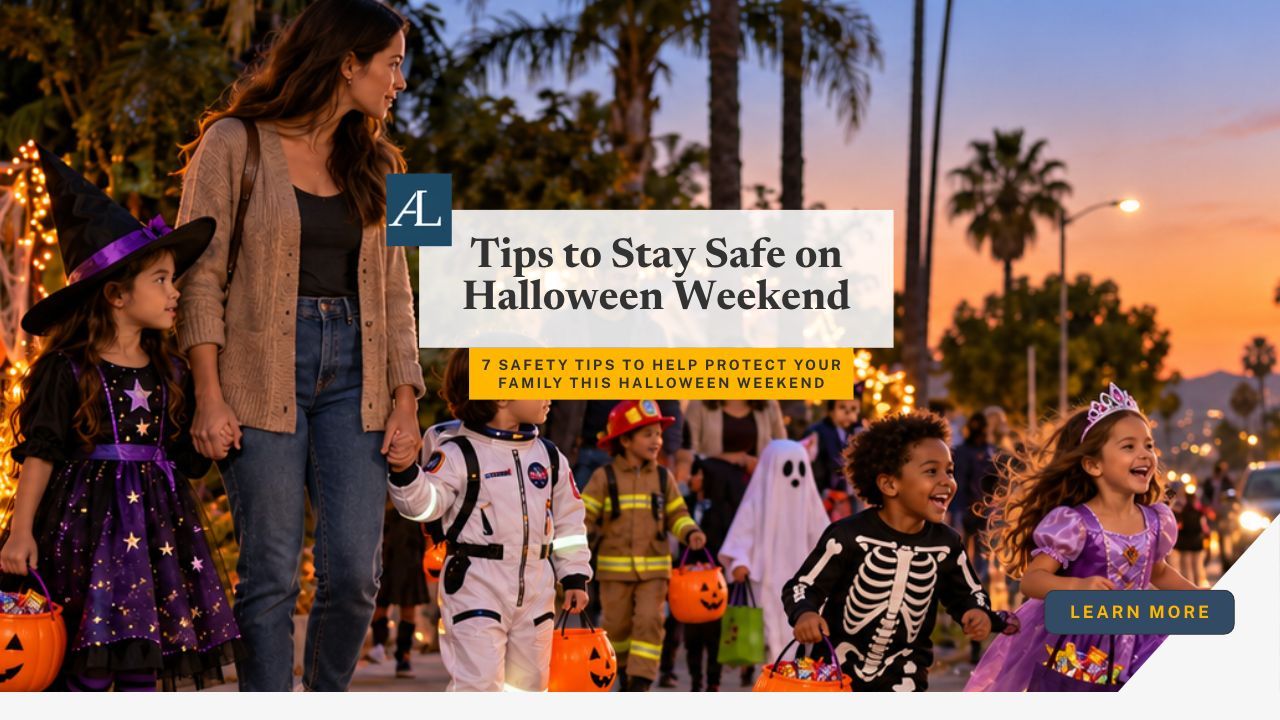
Halloween accident prevention deserves a place in your plans before the costumes, candy, and parties take over. Throughout Halloween celebrations, families walking through California neighborhoods share the streets with drivers heading to gatherings, picking up passengers, and returning home after dark. A turning vehicle or a driver looking at a phone can change a family’s weekend in seconds, leaving someone facing emergency treatment, missed work, and questions about who will pay for the harm.
The best time to plan for those risks is before the celebrations begin. Halloween accident prevention starts with decisions people can make before leaving home, including choosing a walking route and arranging a sober ride. If someone else’s negligence causes an injury, Avrek Law Firm’s California personal injury attorneys can explain the available options. Call 866-598-5548, start a chat, or request a free case review to discuss what happened.

Why Halloween accident prevention matters every year
Halloween weekend can include parties, school events, neighborhood gatherings, and visits to seasonal attractions before or after October 31. Even when Halloween falls on a weekday, celebrations may stretch across several evenings. Families and drivers should plan around the events actually happening in their area rather than assume that the traffic risks begin and end with one night of trick-or-treating.
A 42-year study published in JAMA Pediatrics found a 43% higher relative risk of pedestrian fatalities on Halloween evenings than during the same hours one week before and after. The researchers examined U.S. data from 1975 through 2016, covering 5 p.m. through 11:59 p.m. The finding describes a historical national pattern, not a prediction for an individual child or a particular Halloween.
Alcohol is another reason to take Halloween accident prevention seriously. NHTSA’s Halloween campaign encourages people to arrange a safe, sober ride before drinking. That planning should cover every gathering on the calendar, including an office celebration, a neighborhood party, or a later trip to meet friends. A change of venue should never become an excuse to abandon the transportation plan.
Plan for dusk before the candy route begins
Check the local sunset time for the date and California community where you will be celebrating. A route that starts in daylight may look very different on the way home. Families should include that darker return trip in their Halloween accident prevention plans, especially when celebrations take them beyond familiar neighborhood streets. Choose familiar streets with sidewalks and useful lighting, identify crossings before the walk, and keep younger children close enough for an adult to guide each crossing.
Practical Halloween accident prevention also means making children easier to see without relying on visibility gear to keep them safe. Carry flashlights, add reflective material where it will be visible, and check whether a mask blocks a child’s view. Stop at the curb together and look for turning vehicles, including drivers who may be watching other traffic instead of the crosswalk.
Plan the return route for Halloween accident prevention
Before heading out, take a few minutes to think through the entire route, including the walk back to the car. A street that seems manageable in daylight may have long gaps between lamps or vehicles blocking the view at a corner. Halloween accident prevention works best when the route limits unnecessary crossings and gives the group enough room to stay together. Choose a meeting point in case people become separated, and make sure another adult knows the plan.
Discuss the crossing routine with children before the excitement begins. They should wait for the supervising adult, look in every direction traffic could approach, and avoid following another group into the road without checking. A driver stopping in one lane does not establish that every lane is clear. When younger and older children walk together, let the adults manage the pace so the smaller children are not rushing to catch up between houses.
Include mobility needs in Halloween accident prevention. Someone using a stroller, wheelchair, or walking aid may need extra room at curb ramps and more time to cross. Avoid a route that repeatedly forces the group off the sidewalk to pass decorations. If a particular crossing feels unsafe, choose another location even if it means skipping a house. The candy route should fit the people walking it, rather than pressure everyone to keep moving at the same speed.
Make Halloween accident prevention part of every drive
Drivers should allow extra travel time and reduce speed where children are walking. Look carefully before turning, backing out of driveways, or passing parked vehicles that could hide a small child. Put the phone away before moving, and ask a passenger to handle directions or messages when possible. A posted speed limit does not eliminate the need to slow down for conditions.
California’s Basic Speed Law requires a speed that is safe for the circumstances. Weather, visibility, traffic, and the road itself matter. For Halloween accident prevention, that means adjusting to what is actually happening on the block, even when an otherwise familiar route seems quiet at first.
Halloween accident prevention at turns and driveways
Halloween accident prevention is especially important during ordinary movements that drivers make almost automatically. Before turning right, look for people approaching the crossing from either side, including children who are shorter than a vehicle’s hood. Before a left turn, check the crossing after selecting a gap in oncoming traffic. A driver can correctly judge the vehicle traffic and still overlook a pedestrian if the final scan is rushed.
When leaving a driveway or parking space, check the surrounding area and move only when the path is clear. A backup camera or warning system is an aid, not confirmation that no child is nearby. Stop if your view is blocked or someone enters the area. Do not wave a pedestrian across other traffic you cannot control; another driver may be approaching from a direction neither of you has checked.
Delivery stops and passenger pickups deserve the same attention. A person stepping around a stopped van may enter a driver’s view late, and a passenger opening a door can create another hazard. Halloween accident prevention means selecting a lawful stopping place with a clear approach, leaving crossings unobstructed, and allowing people to enter or exit safely. If the convenient spot creates a conflict with pedestrians, continue to a safer location instead of asking them to navigate around your vehicle.
Arrange a sober ride before the first drink
Transportation planning is an essential part of Halloween accident prevention and should cover the entire evening, including the ride home and any stop after a party. Choose a driver who will remain sober, arrange a rideshare or taxi, or make plans to stay where you are celebrating. Keep enough phone battery and money available to use the plan if the evening changes. A last-minute promise to drive carefully is not a substitute for a safe driver.
When using a rideshare, wait in a safe place away from moving traffic and confirm the vehicle and driver before entering. Ask for a lawful pickup location that does not require stepping between cars or crossing unexpectedly. Halloween accident prevention includes the walk to the vehicle as well as the ride itself.
Build a backup ride into Halloween accident prevention
A useful Halloween accident prevention plan accounts for a canceled ride, a dead phone, or a friend who decides to drink after initially offering to drive. Save an alternate transportation option before leaving home. If several people are attending a party together, agree that nobody is expected to ride with someone who seems unable to drive safely. A shared plan is easier to follow when the decision has already been made before the evening becomes busy.
Parents arranging transportation for teenagers should clarify who is driving, where pickup will happen, and whom to contact if plans change. Encourage a call for help without making the teenager solve the transportation problem first. The immediate goal is getting everyone out of an unsafe situation. Discussions about a missed curfew or an unexpected change can happen after the group has reached a safe place.
Hosts can support Halloween accident prevention by making sober transportation part of the invitation and keeping pickup areas visible. If a guest cannot safely drive, help arrange another option instead of treating a cup of coffee or a short rest as proof of readiness. Do not pressure a guest to leave simply because the gathering is ending. Where possible, resolve transportation before people are standing outside deciding what to do next.
Plan a safe return trip after dark
Halloween accident prevention should account for fatigue as well as alcohol. A parent may be driving after a full workday, while a teenager may be returning from a gathering after an early morning and hours of activities. Being the designated driver does not eliminate the need to be rested. NHTSA’s drowsy driving guidance emphasizes adequate sleep and planning ahead before a drive.
Set a realistic departure time before leaving home, and allow room for a change of plans. If the driver becomes too tired to continue safely, arrange another ride or stay somewhere safe until an appropriate alternative is available. Halloween accident prevention includes recognizing when the original plan no longer fits the driver’s condition. Finishing a planned route is less important than responding to the circumstances in front of you.
Confirm where everyone will meet for the ride home
A useful pickup plan identifies a specific place where the group can wait safely away from moving vehicles. A vague instruction to meet outside can leave children or guests searching across a crowded parking area. Confirm the location, who is collecting whom, and how to communicate if the event finishes early. Halloween accident prevention is easier when everyone understands the same plan before phones become difficult to hear or people separate.
Choose a pickup point that allows the vehicle to stop lawfully without blocking a crossing or requiring passengers to step between parked cars. Children should wait with the supervising adult instead of approaching every arriving vehicle. If the intended space becomes crowded or inaccessible, agree on a safer alternative and communicate it clearly. Do not expect a child to interpret a driver’s hand signal as permission to cross an active traffic lane.
For families with several events on the calendar, reassess transportation for each outing. The adult available for one gathering may not be the person collecting children from the next, and a daytime pickup location may be poorly lit after dark. Halloween accident prevention works best when the plan is specific to the actual trip. Keep emergency contact details accessible and make sure children know whom to contact if their expected ride does not arrive.
Adjust the plan if rain or poor visibility develops
Check local conditions before heading out and again before the trip home. If rain arrives, wet pavement, windshield glare, and reduced visibility can make it harder to see people crossing the street. Drivers should increase following distance and reduce speed; families can shorten walking routes or choose a different activity if conditions become unsafe.
Weather belongs in a Halloween accident prevention plan as a condition to monitor. There is no need to assume that Southern California will have a rainy Halloween. The useful question is whether the conditions at the time of the trip require a safer route, a different departure time, or a decision to stay put.
Watch visibility from inside the vehicle
Before leaving, clear the windshield and other windows and confirm that the lights and wipers work. Decorations inside a vehicle should not block the driver’s view. Halloween accident prevention requires seeing people near the edges of the road as well as the traffic directly ahead. If glare or fogged windows interfere with that view, address the problem in a safe place before continuing.
Families can prepare an indoor alternative without treating a weather change as a failed celebration. Keep the decision practical: whether the route remains visible, whether people can walk without entering traffic, and whether the ride home is safe. Halloween accident prevention does not require finishing an itinerary simply because everyone is already dressed. Make the same assessment again when leaving a party, since conditions may differ from those at the start of the evening.
Check walkways before welcoming visitors
Homeowners and event organizers can support Halloween accident prevention by walking their approach routes before guests arrive, looking for extension cords, loose decorations, spills, and steps that are difficult to see. Keep lighting adequate and avoid placing decorations where visitors have to step into the street to get around them. Recheck the area during the evening because a clear entrance can become crowded or obstructed.
Halloween accident prevention on private property matters alongside road safety. If someone falls, legal responsibility depends on the condition, who controlled the area, and what reasonable precautions were required. An injury alone does not establish that an owner or organizer was negligent.
Halloween accident prevention around decorations
Halloween accident prevention begins at the point where guests approach the property. Check whether an inflatable decoration, parked vehicle, or crowd at the entrance blocks the route people will naturally use. Give visitors a clear way to reach the door without stepping over cables or walking behind a reversing vehicle. If a decoration repeatedly falls into the path, move it rather than relying on guests to notice and avoid it each time.
At a larger gathering, identify who will check the entrance and other shared areas during the evening. A spill that occurs after the initial inspection still needs attention. If a problem cannot be corrected immediately, take appropriate steps to keep people away while it is addressed. Save emergency access space and avoid letting a line of arriving guests spill into a driveway or the street.
For businesses and organized events, Halloween accident prevention should account for arrival and departure as well as the attraction itself. Guests may be unfamiliar with the site, distracted by costumes, or carrying children when they leave. Clear directions and maintained walking areas can reduce confusion. If someone reports an injury, document the report and the condition honestly, preserve available footage, and obtain emergency assistance when necessary rather than arguing about fault at the scene.
Know what to do if someone is hurt
Call 911 for an injury emergency and follow the dispatcher’s instructions. Medical care comes first. When it is safe, obtain the driver’s information, take photographs of the scene, and collect witness contact details. For a fall, identify the exact location and the condition involved, then report the incident to the person responsible for the property.
Despite careful Halloween accident prevention, a negligent driver can still cause serious harm. Preserve original photographs, messages, and recordings, and keep treatment records together. A car accident lawyer or pedestrian accident lawyer can assess what evidence is needed and whether another party may be responsible.
Keep the account factual from the beginning
After an injury, separate what you saw from what you learned later. Write down the location, approximate time, and people who were present, then save any photographs or messages without editing the originals. Halloween accident prevention cannot eliminate every careless act, but families can prepare to respond calmly if an incident occurs. Accurate information helps medical providers and investigators understand the sequence without requiring someone to guess while still upset.
If you were driving, check whether a separate DMV report is required. The California DMV’s SR-1 guidance generally requires a report within 10 days when a collision causes injury or death, or property damage exceeding $1,000. That report is separate from notifying police or an insurer. Ask your insurance representative or attorney about the applicable reporting obligations instead of assuming that a police response completed every required step.
Financial concerns should not distract from necessary care. Keep bills, treatment instructions, and records of missed work together, and have an attorney review any proposed injury release. Halloween accident prevention is the focus before the weekend; after an injury, the focus shifts to treatment and protecting the information needed for a fair claim assessment. Avrek can explain how the driver’s conduct, available insurance, and documented losses may affect the available options.
When precautions do not prevent a serious injury
Taking reasonable precautions can reduce risk without controlling another person’s decisions. A family may choose a marked crossing, carry lights, and wait for a safe opportunity, yet still encounter a driver who fails to look before turning. Halloween accident prevention should never be used to assume that an injured person must have done something wrong. The legal evaluation should examine the actual conduct and circumstances rather than start with that conclusion.
Imagine a driver turning toward a neighborhood gathering while looking for a parking space. If the vehicle strikes someone crossing, the investigation may examine the driver’s attention, speed, view, and timing alongside the pedestrian’s movements. This hypothetical example shows why a statement such as “the street was busy” does not identify who was responsible. The details need to explain how the collision occurred and whether reasonable care could have avoided it.
For families practicing Halloween accident prevention, understanding that distinction can help after a crash. Preserve evidence of the route, crossing, clothing, and surrounding conditions, but do not feel required to argue the case at the roadside. Emergency responders need clear information and access to anyone who is hurt. Questions about fault can be addressed later through records, witness information, and legal analysis.
A consultation should also address the practical consequences of the injury. Medical treatment, time away from work, and support needed at home may all be relevant to assessing losses. Bring the information already available and ask what else would help. The attorney can explain the difference between investigating responsibility, identifying insurance, and determining what compensation the evidence may support.
Halloween accident prevention remains valuable even when the worst happens despite careful planning. It can help people recognize useful details and respond with a clear emergency plan. Avrek can review an injury caused by alleged negligence and explain whether legal representation may help with the investigation and claim. The initial conversation should give you understandable next steps rather than pressure to accept an immediate valuation.
Halloween accident prevention questions from California families
Does a dark costume mean the driver is not responsible?
No. Clothing is one detail in a larger investigation that may include lighting, speed, attention, and the driver’s opportunity to avoid the collision. A dark costume does not automatically decide fault. Preserve the clothing and scene photographs so those issues can be evaluated from evidence rather than assumptions.
Should I wait until after the holiday weekend to address an injury?
Do not delay necessary medical care because it is a holiday weekend. Once urgent needs are addressed, preserve what you can and get advice about insurance communications. A Halloween accident prevention plan should include emergency contacts so family members know whom to call if the evening goes wrong.
How should we choose when to start trick-or-treating?
Check local event hours and sunset times, then plan both the walk and the return trip. Starting in daylight may make the route easier to assess, but the group should still be prepared for darkness. Halloween accident prevention includes choosing a manageable outing, carrying lights, and allowing time to return without rushing across streets.
What should I check before an older child goes with friends?
Make sure the group has a clear route, a way to contact an adult, and a plan for getting home. Discuss crossings and pickups as part of Halloween accident prevention rather than assuming that being older removes the traffic risks. Confirm what the children should do if they become separated, feel unsafe, or need transportation earlier than expected.
What if a driver says the street was too dark to see anyone?
That statement does not settle responsibility. Investigators may examine the actual lighting, vehicle speed, headlights, sightlines, and opportunities to avoid the collision. Halloween accident prevention requires drivers to respond to reduced visibility. Preserve photographs and potential video sources so the conditions can be evaluated rather than accepted solely through one person’s description.
Serving Los Angeles and surrounding California communities
From neighborhood crossings in Los Angeles and Pasadena to residential streets in Long Beach and Orange County, Halloween accident prevention depends on attention to the conditions around each trip. Avrek’s Los Angeles personal injury lawyers can help injured people understand how local scene evidence, insurance coverage, and California law may affect a claim.
Hurt on Halloween? Talk to Avrek Law Firm
Halloween accident prevention is everyone’s responsibility, and people injured by negligence deserve answers about their rights. If a driver or unsafe property condition leaves you hurt, call 866-598-5548, start a chat, or request a free consultation with Avrek Law Firm. We can review the circumstances, explain the next steps, and discuss representation. There are no upfront attorney fees, and attorney fees are contingent on recovering compensation.
- 📩 Submit a request through our online form
- 📞 Call 866-598-5548 now to speak with our team
- 💬 Start a live chat for immediate assistance
There are no upfront fees, and you don’t pay unless we win.