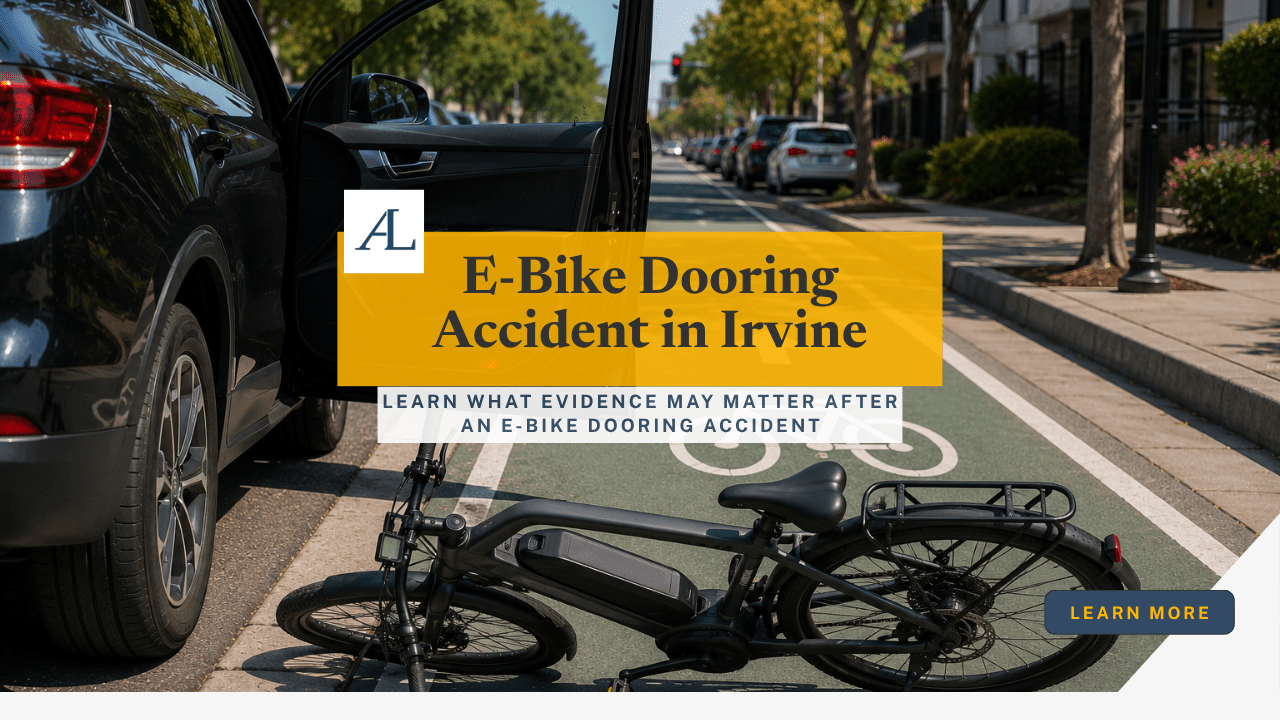
An e-bike dooring accident in Irvine can happen in seconds, but the evidence needed to explain what happened may disappear quickly. A parked vehicle door opens into the rider’s path. The rider has little time to react. The impact may send the rider into traffic, onto the pavement, or over the handlebars before anyone fully understands how the collision occurred.
These accidents are different from many other e-bike crashes because the hazard often appears suddenly from a parked or stopped vehicle. The person opening the door may say they looked first. The rider may say there was no time to avoid impact. Insurance companies may focus on the rider’s speed, lane position, or equipment before fully reviewing the vehicle door position, nearby cameras, roadway layout, or witness statements.
That is why evidence matters so much after an e-bike dooring accident in Irvine. The location of the vehicle, the position of the open door, the rider’s path of travel, and the available lane space may all affect how fault is evaluated. Medical records, damaged gear, bike repair estimates, and insurance communications may also become important when explaining the full impact of the crash.
At Avrek Law, we help injured riders understand what documentation may matter after an e-bike collision and how early evidence preservation can affect the claim. In a dooring case, small details can change the entire evaluation of what happened.
What Makes Dooring Accidents Different From Other E-Bike Crashes
Dooring accidents are unique because the hazard often comes from a parked or stopped vehicle rather than from moving traffic alone. In many cases, the rider is traveling lawfully in a bike lane, travel lane, or shoulder when the vehicle door suddenly opens into the riding path.
Parked vehicle doors and the rider’s path of travel
The central question in many dooring cases is whether the vehicle door opened into a space where the rider was already traveling or reasonably expected to travel. A driver or passenger may say the door was open only briefly, but even a brief opening can create an unavoidable hazard for an e-bike rider.
An e-bike dooring accident in Irvine may involve a rider traveling in a bike lane near parked cars, a delivery driver opening a door near the curb, or a rideshare passenger exiting into a traffic lane. The door itself can become the impact point, but the rider’s path before impact is just as important. Investigators may need to understand where the e-bike was positioned, how fast the rider was moving, how far the rider was from the parked vehicle, and whether there was any safe space to avoid the door.
California Vehicle Code § 22517 addresses opening vehicle doors on the side available to moving traffic and states that a door should not be opened unless it is reasonably safe and does not interfere with moving traffic.
Bike lane, travel lane, shoulder, or parking zone location
Lane location can strongly affect the analysis after an e-bike dooring accident in Irvine. A rider in a marked bike lane may have a clearer argument that the vehicle door entered the rider’s expected path. A rider in a travel lane, shoulder, or parking-adjacent area may still have a valid claim, but the investigation may involve more detailed questions about roadway layout and positioning.
Irvine includes residential streets, commercial centers, office parks, school zones, and multi-lane roads where e-bikes, parked vehicles, delivery vehicles, and passenger cars often share tight spaces. In these settings, the location of the bike lane, parking zone, curb, and travel lane can help explain whether the rider had room to react.
Insurance companies sometimes argue that the rider was too close to parked vehicles or should have anticipated a door opening. Those arguments should be tested against the actual roadway conditions. If the bike lane placed riders directly next to parked vehicles, or if the available riding space was narrow, the rider may have had very little ability to avoid the hazard safely.
Timing, reaction distance, and visibility questions
Timing is one of the most important issues in a dooring case. A door that opens several seconds before a rider approaches may create a different factual question than a door that opens directly into the rider’s path at the last moment.
An e-bike dooring accident in Irvine often turns on reaction distance. Even at moderate speed, an e-bike rider may have only a fraction of a second to respond when a door suddenly opens. The rider may not be able to brake, swerve, or avoid the collision without entering moving traffic.
Visibility also matters. Tinted windows, large vehicles, parked SUVs, glare, nighttime lighting, and traffic congestion may affect whether the rider could see someone inside the vehicle preparing to exit. The person opening the door may also have had limited visibility if mirrors were obstructed or if they failed to check before opening the door.
Scene Evidence That May Help Explain How the Door Opened
Scene evidence can disappear quickly after a dooring accident. The vehicle may move. The door closes. The e-bike is picked up. Debris is cleared. Witnesses leave. That is why early documentation often becomes critical.
Photos of the vehicle, open door, lane position, and e-bike damage
Photographs may be some of the most important evidence after an e-bike dooring accident in Irvine. Images showing the open door, the parked vehicle, the bike lane, the curb, the rider’s final position, and the damage to the e-bike can help explain how the impact occurred.
Close-up photos may show paint transfer, dents, scratches, broken mirrors, bent handlebars, damaged brake levers, or impact marks on the door edge. Wider photos may show whether the door opened into a bike lane, whether the rider had space to avoid it, and how surrounding traffic affected the situation.
The position of the door is especially important because once it closes, the most obvious evidence of the hazard may be gone. If safe to do so, photographing the door angle and surrounding lane layout before vehicles move can help preserve details that may become disputed later.
Measurements from the parked vehicle to the riding lane
Measurements can help explain how much space the rider actually had. A photo may show that a vehicle door extended into the lane, but measurements can provide more specific context.
After an e-bike dooring accident in Irvine, the distance from the parked vehicle to the bike lane, the width of the bike lane, the length of the door when opened, and the distance from the curb may all become relevant. These details may help show whether the rider’s path was obstructed or whether the available lane space was too narrow to avoid impact.
Measurements may also help evaluate insurer arguments about whether the rider should have been farther away from the parked vehicle. In some locations, the roadway design may leave riders with limited practical choices. If moving farther left would place the rider into traffic, the rider’s position may have been reasonable under the circumstances.
Witnesses, nearby cameras, and business surveillance footage
Witnesses may provide important information about how the door opened, whether the rider had time to react, and whether the person exiting the vehicle looked before opening the door. Nearby drivers, pedestrians, cyclists, business employees, rideshare passengers, or residents may have seen the collision or the seconds immediately before impact.
Video evidence can be even more powerful. Businesses, parking structures, homes, dashcams, delivery vehicles, and rideshare vehicles may capture part of the event. An e-bike dooring accident in Irvine near a shopping center, office complex, apartment building, or school may have more potential camera sources than riders initially realize.
The challenge is that many surveillance systems overwrite footage quickly. A camera that recorded the crash may delete that video within days. Early preservation requests can make a major difference when the parties disagree about whether the door opened suddenly or whether the rider had time to avoid it.
E-Bike Details Writers Should Research and Document
The e-bike itself can become important evidence. Insurance companies may examine the type of e-bike, the rider’s speed capability, equipment condition, and whether the bike was functioning properly before the crash.
E-bike class, speed capability, and equipment
California recognizes different classes of electric bicycles, and the class may affect how the bike is evaluated after a crash. The California DMV explains that electric bicycles have fully operable pedals, motors under 750 watts, and are categorized into three classes based on how motor assistance works and when assistance stops.
After an e-bike dooring accident in Irvine, insurers may ask about the bike’s class, speed capability, throttle or pedal-assist function, and whether the bike had any modifications. These questions do not automatically mean the rider did anything wrong. They are part of how insurers evaluate speed, reaction time, and whether the rider was operating the e-bike safely.
The e-bike’s display, app data, controller settings, purchase records, and manufacturer specifications may all help clarify what kind of e-bike was involved. If the insurer argues that the rider was going too fast, the available evidence should be reviewed carefully rather than assumed.
Lights, reflectors, brakes, tires, and maintenance condition
The condition of the e-bike may also matter. Brakes, tires, lights, reflectors, and general maintenance may be reviewed if the insurance company claims the rider could have stopped sooner or avoided the door.
An e-bike dooring accident in Irvine often happens too quickly for even a well-maintained bike to avoid impact. Still, documenting the e-bike’s condition can help address claims that equipment failure contributed to the collision. Photos of the brake system, tire condition, lights, reflectors, and damage pattern may help show whether the bike was functioning before the crash.
Repair shop evaluations can also become useful. A technician may identify whether damage occurred from the collision itself or whether there were pre-existing mechanical issues. This can help separate legitimate equipment questions from insurance speculation.
Helmet, phone mount, cargo, and other rider equipment
Rider equipment may become relevant after an e-bike crash, especially when injuries are serious. Helmets, phone mounts, bags, cargo racks, child seats, delivery containers, and other equipment may help explain the rider’s movement, visibility, and injuries.
After an e-bike dooring accident in Irvine, the condition of the helmet may be important if the rider hit their head or face. Cracks, scrapes, dents, or impact marks may support the injury timeline. Damaged clothing, gloves, shoes, phone mounts, lights, or cargo may also help show how the rider fell and what parts of the body absorbed the impact.
Insurance companies sometimes raise distraction arguments if a phone was mounted on the e-bike or found near the rider. The existence of a phone mount does not prove distraction. The actual evidence should be reviewed, including whether the rider was using navigation, whether the phone was active, and whether any witness or video evidence supports the claim.
Medical and Insurance Records After an E-Bike Dooring Crash
Medical and insurance records help connect the physical crash to the injuries, costs, and claim issues that follow. These records are especially important because dooring crashes can cause injuries that are more serious than the term “dooring” may suggest.
Emergency care, orthopedic treatment, and follow-up visits
An e-bike rider may suffer significant injuries when a vehicle door opens suddenly. The rider may strike the door, fall onto pavement, hit another vehicle, or be thrown into traffic. Emergency care records may document pain complaints, visible injuries, head impact concerns, fractures, road rash, or neurological symptoms shortly after the collision.
After an e-bike dooring accident in Irvine, follow-up care may involve orthopedic evaluations, physical therapy, imaging studies, wound care, concussion assessments, or specialist referrals. The medical timeline may help show how symptoms developed and what treatment became necessary.
Insurance companies often review whether the rider sought treatment promptly and whether follow-up recommendations were followed. Delays in care may create disputes, even when the delay had a reasonable explanation. Clear medical records can help reduce confusion about when injuries appeared and how they affected daily life.
Bike repair estimates, replacement costs, and damaged gear
E-bike repair costs can be substantial. Motors, batteries, frames, wheels, displays, brake systems, and electronic components may all be damaged in a dooring crash. Even if the bike looks repairable, internal electrical or frame damage may make the bike unsafe.
After an e-bike dooring accident in Irvine, repair estimates can help document the financial impact of the crash and the force of the collision. Replacement costs may also matter if the bike is totaled or if key components cannot be safely repaired.
Damaged gear should also be documented. Helmets, lights, locks, clothing, bags, delivery equipment, child seats, or accessories may all represent additional losses. Keeping receipts, photographs, and repair invoices can help support the property damage portion of the claim.
Communications with auto insurers, property insurers, or other parties
Dooring claims may involve more than one insurance company. The person who opened the door may be covered under an auto policy. If the vehicle was used for rideshare, delivery, work, or business purposes, additional coverage questions may arise. In some cases, property insurers or business-related policies may also become part of the discussion.
An e-bike dooring accident in Irvine may therefore involve communication with auto insurers, rideshare companies, employers, property owners, or other parties connected to the parked vehicle. Keeping copies of all letters, emails, claim numbers, adjuster names, and recorded communication requests can help organize the claim as it develops.
Insurance companies may ask for statements, photos, repair documentation, medical records, or authorizations. Before providing detailed information, injured riders often benefit from understanding how the claim is being evaluated and what coverage may apply.
Dooring Evidence Can Disappear Faster Than Riders Expect
An e-bike dooring accident in Irvine is often decided by details that are easy to lose. The door closes. The vehicle leaves. Camera footage is overwritten. Witnesses move on. The bike is repaired. Injuries evolve. By the time an insurance company begins disputing fault, some of the most important evidence may already be harder to find.
That is why early documentation matters. Vehicle position, door angle, bike lane layout, measurements, witness statements, surveillance footage, e-bike damage, rider equipment, medical records, and insurance communications may all help explain what happened. These details may become especially important when insurers argue that the rider was traveling too fast, riding too close to parked cars, or had enough time to avoid impact.
Speaking with an Irvine e-bike accident lawyer may help injured riders understand what evidence should be preserved after a dooring crash. In many cases, these claims also overlap with issues handled by an Irvine personal injury lawyer, especially when serious injuries, disputed liability, or multiple insurance policies are involved.
Avrek Law helps injured riders throughout Irvine and Southern California evaluate dooring evidence, insurance disputes, and injury documentation after serious e-bike crashes. If you were hurt after a vehicle door opened into your path, our team can review what happened and explain what options may exist moving forward.
- 📩 Submit a request through our online form
- 📞 Call 866-598-5548 now to speak with our team
- 💬 Start a live chat for immediate assistance
There are no upfront fees, and you don’t pay unless we win.