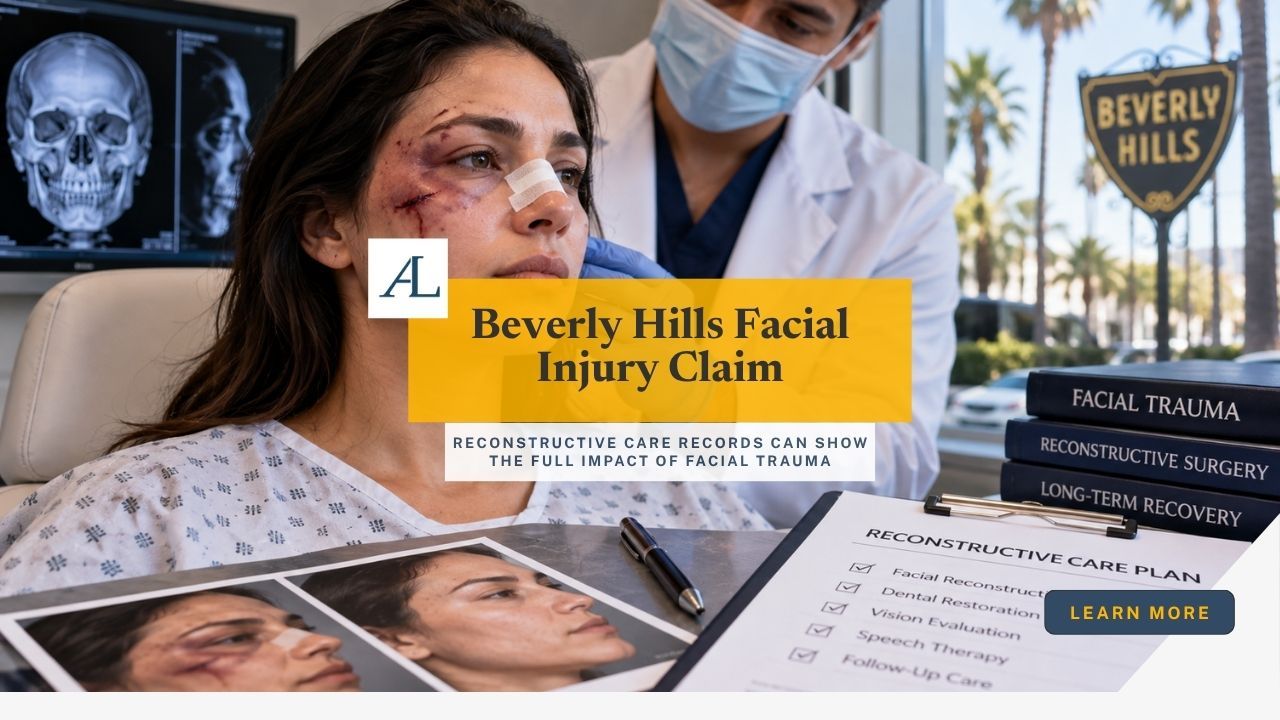
A Beverly Hills facial injury claim can become complicated quickly because severe facial trauma may require emergency treatment, surgery, dental care, vision or hearing evaluations, reconstructive procedures, rehabilitation, and continued medical monitoring. The first hospital visit may address immediate threats and stabilize fractures or wounds, but that initial care may represent only the beginning of a much longer recovery. As swelling changes and specialists conduct additional evaluations, the injured person may receive new diagnoses, revised treatment plans, or recommendations for staged procedures.
Facial injuries are not limited to changes in appearance. The official MedlinePlus Facial Injuries and Disorders resource explains that severe facial injuries can affect sight, speech, breathing, and swallowing, while fractures commonly involve areas such as the nose, cheekbone, and jaw. Those functional concerns are one reason a Beverly Hills facial injury claim should not be valued solely through photographs of visible cuts or bruising. The medical record must show how the trauma affected the person’s health, function, work, relationships, and daily independence.
A catastrophic facial injury can also involve several medical specialties. Emergency physicians may stabilize the patient, while oral and maxillofacial surgeons, plastic or reconstructive surgeons, dentists, ophthalmologists, ear-nose-and-throat specialists, neurologists, speech therapists, occupational therapists, and other providers address different parts of the recovery. Each office may create separate records, photographs, imaging, recommendations, and billing. A strong Beverly Hills facial injury claim should connect those records into one clear timeline rather than presenting them as unrelated appointments.
This article focuses specifically on facial trauma and reconstructive care. Avrek’s related article on how a personal injury lawyer can help with long-term medical care after a crash provides broader information about organizing treatment records, future medical needs, and insurance documentation when recovery extends beyond the emergency stage.
When a vehicle accident causes catastrophic facial trauma, choosing the right representation matters. An experienced Beverly Hills auto accident lawyer at Avrek Law Firm can preserve crash evidence, organize records from multiple specialists, document future care recommendations, and handle insurance communications while the injured person focuses on recovery. Avrek’s Beverly Hills practice also addresses serious motor vehicle injuries, rehabilitation, future medical costs, lost income, and other losses that may follow a catastrophic collision.
Call 866-598-5548, start a live chat, or request a free case review today. There are no upfront legal fees, and you do not pay unless we win.
Building the Medical Timeline in a Beverly Hills Facial Injury Claim
A Beverly Hills facial injury claim should be built around a complete medical timeline extending from the crash through emergency care, surgeries, specialist treatment, rehabilitation, and anticipated future procedures. Insurers may focus heavily on the first diagnosis or the first operation, but severe facial trauma can continue to develop medically as swelling decreases, healing progresses, and providers assess function over time.
The timeline should identify when each symptom or limitation appeared, which provider evaluated it, what testing was performed, and what treatment was recommended. It should also explain why care moved from one specialist to another. A referral to dental treatment, vision care, speech therapy, or reconstructive surgery is not a break in the injury story. It may be the next necessary stage of treating the same crash-related trauma.
Different providers may use different terminology. One record may describe a facial fracture, another may identify maxillofacial trauma, and another may focus on a specific jaw, orbital, nasal, dental, nerve, or soft-tissue condition. Those variations do not automatically create inconsistency. The complete record should show how the diagnoses relate to one another and how the treatment plan changed as providers gained more information.
Emergency Treatment, Imaging, Surgery, and Hospital Records
Emergency records often provide the first objective evidence in a Beverly Hills facial injury claim. Ambulance and emergency-department notes may document bleeding, swelling, pain, confusion, difficulty breathing, dental trauma, vision complaints, facial movement problems, or other concerns reported immediately after the collision. Photographs taken by first responders or hospital staff may also preserve the condition before swelling, wound care, or surgery changed the appearance.
Hospital imaging may include X-rays, CT scans, or other studies ordered by the treating providers. The claim should preserve the written reports as well as information about where the original images are stored. If specialists reviewed those studies or requested additional imaging, their interpretations should be included in the timeline rather than relying only on the emergency physician’s initial summary.
Operative records can be especially important. They may describe the injuries addressed, the procedures performed, hardware or materials used, complications encountered, and recommendations for follow-up care. An insurer reviewing only billing codes may miss details contained in the operative report, discharge summary, nursing notes, and specialist consultations.
The injured person may also have treatment for fractures elsewhere in the body, a traumatic brain injury, neck trauma, or other injuries from the same collision. Avrek’s article on what a broken bones attorney does after a serious car collision discusses why imaging, surgical notes, therapy records, and specialist documentation can become central in a serious fracture claim. Those same recordkeeping principles can support a Beverly Hills facial injury claim involving fractures of the face or jaw.
Dental, Vision, Hearing, and Specialist Evaluations
Facial trauma may affect different functions that are evaluated by separate providers. A dental or oral specialist may document broken or displaced teeth, changes in the bite, jaw pain, difficulty chewing, or the need for restorative treatment. An ophthalmologist or other vision provider may evaluate blurred or double vision, eye movement, visual fields, or trauma around the orbit. An ear-nose-and-throat specialist may evaluate hearing changes, nasal obstruction, breathing concerns, or injuries affecting nearby structures.
A Beverly Hills facial injury claim should preserve each specialist’s referral, intake history, examination findings, diagnostic testing, treatment recommendation, and follow-up plan. It should also identify whether one provider’s treatment must occur before another procedure can begin. Dental reconstruction, for example, may depend on bone healing or surgical planning. Vision or breathing concerns may require evaluation before a later reconstructive stage.
Functional symptoms should be documented in ordinary language as well as medical terminology. The injured person may have difficulty reading, eating, speaking clearly, sleeping, driving, using a phone, tolerating light or noise, or participating in conversations. These practical limitations help explain why an injury that appears localized to the face can affect nearly every part of daily life.
Insurance companies may try to separate dental, vision, hearing, or neurological treatment from the motor vehicle claim. A complete timeline can show when the symptoms began, who referred the patient, and how the providers connected the treatment to the collision. The goal is not to assume medical causation, but to preserve what qualified providers actually documented.
Changes in Diagnosis or Treatment Recommendations During Recovery
A diagnosis may change during recovery as specialists obtain new imaging, observe healing, or evaluate persistent symptoms. A provider may revise the surgical plan, recommend additional treatment, or determine that a procedure should be delayed until swelling decreases or another injury stabilizes. These changes are not necessarily contradictions. They may reflect the normal process of evaluating a complex injury over time.
A Beverly Hills facial injury claim should preserve earlier and later recommendations together. Removing an initial treatment plan from context can make it appear that a procedure was abandoned or unnecessary. The complete record may show that the plan was modified because the patient healed differently than expected, developed a complication, required another specialty’s input, or needed more time before the next stage.
Appointment notes, patient portal messages, referral letters, preauthorization requests, denied authorizations, and scheduling communications may help explain why treatment changed. If a procedure was postponed because of medical concerns, insurance delays, provider availability, or the need for additional testing, the reason should be documented rather than leaving an unexplained gap.
The claim should also distinguish between a tentative possibility and a formal medical recommendation. A provider may discuss several options before selecting one. Insurers may portray every discussed possibility as speculative, or alternatively portray an early option as the final plan. Careful organization shows what was considered, what was recommended, and what remained dependent on future evaluation.
Documenting Reconstructive Care in a Beverly Hills Facial Injury Claim
A Beverly Hills facial injury claim involving reconstructive care should show why each procedure is being considered and what function or condition it is intended to address. Insurers may focus on appearance and label later procedures cosmetic, even when the treating provider is addressing trauma-related structure, movement, breathing, eating, speech, vision, scarring, or other functional concerns.
The American Society of Plastic Surgeons Reconstructive Procedures resource explains that reconstructive surgery is performed to treat body parts affected aesthetically or functionally by trauma, congenital defects, or developmental abnormalities. That distinction is important because reconstruction after a catastrophic crash may address appearance and function together rather than fitting neatly into an insurer’s cosmetic-versus-medical label.
Documentation should come from the treating providers. A legal team can organize records and challenge unsupported insurance assumptions, but surgeons and other qualified clinicians determine what procedures are medically appropriate. The claim should preserve their examination findings, treatment goals, anticipated sequencing, risks, alternatives, and follow-up recommendations.
Reconstructive Surgery Consultations and Staged Procedure Plans
Severe facial trauma may require more than one procedure. An initial operation may stabilize fractures or repair urgent injuries, while later procedures address healing, scarring, bone alignment, dental function, facial movement, or other residual problems. A Beverly Hills facial injury claim should document each stage rather than allowing the insurer to treat the first surgery as the end of care.
Consultation records should identify the provider’s findings, proposed procedure, treatment goal, expected timing, and factors that may change the plan. If a surgeon recommends waiting until healing reaches a certain point, that recommendation should be preserved. A delay based on medical judgment does not mean the treatment is unnecessary.
Written treatment plans, procedure estimates, preoperative instructions, authorization requests, photographs, and follow-up notes can help establish the future-care picture. When several specialists are involved, the timeline should show how their recommendations interact. One procedure may need to precede dental work, vision treatment, scar care, or therapy.
Future care should not be reduced to one rough cost estimate. The claim may need to consider consultations, imaging, surgery, anesthesia, facility charges, follow-up appointments, prescriptions, therapy, medical devices, transportation, missed work, and possible revisions identified by providers. Avrek’s article on documenting future care needs after a catastrophic motor vehicle accident explains why projected surgeries, rehabilitation, assistive needs, and long-term medical monitoring should be supported by records before a serious claim is resolved.
Speech, Eating, Breathing, and Facial-Movement Therapy
A Beverly Hills facial injury claim may include rehabilitative care addressing speech, eating, swallowing, breathing, facial movement, or other functions affected by the trauma. MedlinePlus notes that severe facial injuries can affect sight, speech, breathing, and swallowing, which is why therapy and specialist documentation may remain important long after external wounds begin to heal.
Therapy notes can provide detailed evidence of function. They may record what the patient could do at the beginning of care, what exercises or strategies were recommended, how the person responded, and which activities remained difficult. Progress may occur gradually and may not be visible in a standard photograph.
Eating limitations can affect nutrition, social routines, work schedules, and family life. Speech limitations may interfere with phone calls, meetings, customer interactions, presentations, and ordinary conversations. Breathing or sleep-related concerns may affect stamina and concentration. Facial-movement limitations can affect expression, comfort, eye protection, or communication, depending on the injury and medical findings.
The claim should avoid treating therapy as optional simply because the patient has been discharged from surgery. Surgery and rehabilitation may address different parts of recovery. Provider notes can explain why continued therapy is recommended and what may happen if treatment is interrupted.
Medical Photographs and Provider Notes Showing Changes Over Time
Medical photographs can be valuable in a Beverly Hills facial injury claim because facial trauma changes over time. Swelling may increase or decrease, bruising may develop, surgical wounds may heal, scars may mature, and facial symmetry or movement may change. One photograph taken on the day of the crash cannot show the entire recovery.
Photographs should be handled respectfully and with attention to privacy. Provider-created clinical images may have consistent lighting, angles, and dates that make them more useful than casual photographs. The injured person may also maintain personal photographs showing changes between appointments, but those images should be stored securely and shared only as appropriate.
Provider notes should accompany photographs when possible. A picture may show a visible change without explaining what caused it, whether it affects function, or what treatment is recommended. The medical record can connect the visual evidence to examination findings and the care plan.
Before-and-after comparisons can also help establish the person’s pre-crash baseline. Recent family photographs, identification photographs, work headshots, or other ordinary images may show appearance before the collision. Those materials should be selected carefully and should not be treated as a substitute for medical evidence.
Showing the Daily Impact of a Beverly Hills Facial Injury Claim
A Beverly Hills facial injury claim should document how the trauma affects daily function, not only what appears in hospital and surgical records. Facial injuries can influence communication, eating, personal care, work, sleep, transportation, relationships, and participation in public or social settings. Some limitations may be obvious, while others are known only to the injured person and close family members.
Daily-impact evidence should be specific. A statement that life became harder is less useful than records showing missed meetings, reduced work hours, difficulty eating certain foods, assistance with wound care, canceled activities, transportation to specialists, or the need for more time to complete routine tasks.
The person’s experience may change throughout recovery. Early limitations may come from pain and swelling, while later concerns may involve movement, sensation, scars, dental function, or additional procedures. A complete claim should preserve those changes rather than presenting one snapshot.
Work, Communication, Personal Care, and Social Activity Limitations
Work records can show how a Beverly Hills facial injury claim affected employment. The injured person may miss work for surgery and appointments, reduce hours, use medical leave, avoid travel, or need modified duties. A job involving speaking, customer contact, camera appearances, food service, driving, physical activity, or public interaction may be affected differently from a job that can be performed remotely.
Employer communications, schedules, attendance records, pay statements, leave records, job descriptions, and written accommodations can document those changes. Self-employed people may need calendars, canceled appointments, contracts, invoices, client communications, or business records showing reduced activity.
Communication limitations may appear in voice messages, emails, meeting notes, or requests to change job responsibilities. The injured person may need extra time to speak, repeat information, or avoid long conversations because of discomfort. Those changes should be documented factually rather than exaggerated.
Personal care can also become more difficult. The person may need help with wound care, medication, oral hygiene, dressing, transportation, meal preparation, or appointment management. A short caregiving log can show what assistance was needed, who provided it, and how long the task took.
Social activity changes may be relevant when they reflect the injury’s real effect. The person may avoid meals with others because eating is difficult, decline events during recovery, or feel uncomfortable participating in photographs or public activities. These experiences should be described with care and without suggesting that appearance is the only harm.
Family Assistance, Transportation, and Appointment Schedules
Family members often take on substantial responsibilities after catastrophic facial trauma. They may attend consultations, take notes, arrange transportation, manage prescriptions, prepare appropriate meals, assist with personal care, communicate with insurers, or monitor recovery after procedures. A Beverly Hills facial injury claim should document that work rather than treating it as invisible.
Calendars can show the number and frequency of appointments across multiple specialties. Transportation records may include mileage, parking, rideshare costs, hotel stays, or time away from work. If the injured person travels to different hospitals, surgeons, therapists, dentists, or imaging centers, those practical costs can accumulate over months.
Caregiver records should identify the task and time required. A family member may reduce work hours, use leave, rearrange childcare, or pay someone else to handle household responsibilities. Those records help explain the broader effect of the injury on the household.
Communications with medical offices should also be preserved. Messages may show why an appointment was urgent, why treatment was rescheduled, or why the patient needed assistance understanding instructions. They can help explain apparent gaps or delays that an insurer might otherwise misinterpret.
Pain, Sensory Changes, and Recovery Milestones
Pain and sensory changes should be documented through medical records and accurate personal reporting. A person may report numbness, tingling, sensitivity, pressure, headaches, jaw discomfort, pain with chewing, or other symptoms depending on the injury. The claim should use the descriptions recorded by the patient and providers rather than making assumptions about diagnosis.
A Beverly Hills facial injury claim can include a brief symptom journal showing when pain increased, which activities triggered difficulty, how sleep was affected, and whether medication or therapy changed the symptoms. Short, contemporaneous entries are generally more useful than trying to recreate months of experience later.
Recovery milestones matter too. The first day the person can eat normally, return to work, drive, speak for an extended period, sleep comfortably, or participate in a family event can show progress while also revealing how long the limitation lasted. Improvement does not erase the earlier harm.
The claim should remain balanced. Records showing good days as well as difficult days are more credible than a description suggesting every symptom remained constant. The purpose is to show the actual recovery, including setbacks, improvements, and unresolved concerns.
Crash Evidence That Can Support a Beverly Hills Facial Injury Claim
Medical documentation explains the injury, but crash evidence helps explain how it happened. A Beverly Hills facial injury claim may involve contact with an airbag, steering wheel, dashboard, window, seat, headrest, interior trim, loose object, or shattered glass. The person may also suffer facial trauma after being thrown from a motorcycle or bicycle or struck as a pedestrian.
Photographs of the vehicle and scene should be preserved before repairs. Interior photographs may show deployed airbags, broken glass, blood or biological material, damaged trim, bent components, seat position, restraint condition, and contact marks. Exterior damage can help explain impact direction and vehicle movement.
The person’s clothing, glasses, phone, dental appliance, helmet, or other damaged personal property may also help establish the mechanism. Those items should not be discarded before they are photographed and evaluated for preservation.
Vehicle Interior, Airbags, Glass, and Contact Points
The interior condition can be particularly important in a Beverly Hills facial injury claim. A deployed airbag may show that a qualifying crash event occurred, but the deployment alone does not explain every injury. The position of the seat, steering wheel, dashboard, airbag, glass, and occupant should be considered together.
Close-up and wide photographs should be taken before the vehicle is cleaned or repaired. Images should include the windshield, side windows, mirrors, dashboard, steering wheel, airbags, seatbelts, seats, center console, doors, and any visible contact marks. If investigators or repair technicians remove components, records should identify what was removed and where it went.
Dashcam footage, onboard vehicle data, and surveillance may help establish the speed, direction, and number of impacts. A person may have suffered facial trauma during a first impact, then experienced additional movement during a second collision. The evidence should preserve the entire sequence.
Repair estimates and final invoices may identify parts connected to the impact, but they are not medical records. The Beverly Hills facial injury claim should use vehicle evidence to explain the physical event while relying on qualified providers to diagnose and treat the injury.
Witnesses, Cameras, and Emergency-Response Records
Witnesses may describe the occupant’s position, airbag deployment, broken glass, visible injuries, confusion, bleeding, or statements made immediately after the crash. Their accounts should be collected separately and compared with scene photographs and emergency records.
Beverly Hills hotels, restaurants, offices, garages, intersections, homes, and commercial properties may have surveillance footage. A camera may show the collision, vehicle movement, occupant exit, or emergency response. Even footage that does not clearly show the injury can help establish timing and impact sequence.
A Beverly Hills facial injury claim should identify cameras quickly because footage may be overwritten. Preservation requests should include the date, approximate time, location, vehicle descriptions, and direction of travel.
Police, fire, and ambulance records may document the scene before vehicles were moved and before hospital treatment changed the visible injuries. Report numbers, agency information, photographs, diagrams, body-camera information where available, and witness names should be preserved with the medical timeline.
Pre-Crash Baseline and Post-Crash Documentation
A pre-crash baseline can help show what changed. Recent dental records, vision prescriptions, hearing records, medical photographs, work records, and ordinary personal photographs may establish prior condition and function. The purpose is not to disclose unrelated private information, but to distinguish new trauma from earlier issues when relevant.
An insurer may search for any prior dental work, facial injury, scar, vision problem, hearing concern, or jaw complaint and argue that the collision caused nothing new. A Beverly Hills facial injury claim should address relevant prior history honestly while showing what was different after the crash.
Post-crash records should be organized chronologically. The claim may include emergency photographs, imaging, surgery, dental treatment, specialist findings, therapy, clinical photographs, work records, and family observations. When these materials tell a consistent story, the insurer has less room to isolate one record and ignore the overall progression.
Insurance Questions About Long-Term Treatment
A Beverly Hills facial injury claim may remain open for a substantial period because reconstructive and rehabilitative treatment can unfold in stages. Insurance companies may question whether later procedures remain connected to the crash, whether they are medically necessary, or whether the patient has already recovered enough for settlement.
These disputes should be addressed through provider documentation, not assumptions. The surgeon or specialist should explain the condition being treated, the purpose of the proposed procedure, the expected timing, and any factors that could change the plan. A legal team can then organize that information and respond to the insurer’s coverage or valuation arguments.
Disputes Over Future Procedures or Medical Necessity
An insurer may describe a proposed procedure as cosmetic because it affects appearance. That label may oversimplify the treatment. Reconstructive care after trauma can address aesthetic and functional effects together, and the American Society of Plastic Surgeons identifies trauma as one reason reconstructive procedures may be performed.
A Beverly Hills facial injury claim should preserve the provider’s explanation of medical purpose. A procedure may address breathing, vision, jaw alignment, eating, speech, facial movement, scar restriction, structural support, or another documented concern. The claim should avoid substituting legal language for the provider’s actual findings.
Insurers may also challenge costs, timing, or the likelihood that a procedure will occur. Written recommendations, scheduling plans, authorization requests, cost information, and follow-up notes can strengthen the future-care evidence. When treatment remains conditional, the condition should be explained rather than hidden.
The claim should distinguish between care already completed, care formally recommended, and treatment that remains a possible future option. That level of precision makes the demand more credible and reduces arguments that every projected cost is speculative.
Requests for Additional Records or Independent Medical Examinations
Insurance companies may request extensive records after a catastrophic facial injury. Some requests relate directly to the claim, while others may seek broad medical, dental, psychological, employment, or personal history. The injured person should understand what is being requested before signing an authorization.
A Beverly Hills facial injury claim may involve records from numerous providers, and indiscriminate production can create duplication or confusion. An attorney can organize responsive records, identify missing documents, and determine how applicable legal obligations affect the request.
An insurer may also request an independent medical examination during litigation or under other applicable procedures. The scope, timing, examiner, and records involved can matter. The injured person should not ignore a formal request, but should obtain legal guidance before assuming that every request must be accepted exactly as presented.
Consistency remains important. Symptoms described to the examiner should match the person’s genuine experience and treatment history. The person should not minimize serious limitations to appear cooperative or exaggerate concerns in an effort to strengthen the claim.
Settlement Timing Before Reconstructive Care Is Complete
Settlement timing is one of the most important issues in a Beverly Hills facial injury claim. An early offer may arrive after the emergency bills and first surgery are known but before dental restoration, scar treatment, rehabilitation, or later reconstructive procedures are complete. At that stage, the future costs and long-term functional outcome may still be uncertain.
A settlement release may affect the ability to seek additional compensation later. The exact terms should be reviewed carefully before signing. An injured person should understand whether the agreement closes claims for future procedures, lost income, complications, therapy, and other damages that have not yet been fully documented.
Financial pressure can make an early offer tempting. Medical bills, missed work, transportation, and household expenses may already be accumulating. Avrek’s article on how a personal injury lawyer can help with long-term medical care after a crash explains why treatment records, future needs, and the connection between the crash and ongoing care should be organized before the claim is resolved.
A careful settlement evaluation does not require waiting indefinitely. It requires enough medical information to understand the completed care, recommended future treatment, functional limitations, prognosis, insurance coverage, and effect on work and daily life.
Compensation and Records in a Beverly Hills Facial Injury Claim
The potential value of a Beverly Hills facial injury claim depends on the circumstances, evidence, liability, insurance coverage, medical findings, treatment, and long-term effect on the injured person. No specific outcome can be promised. A complete claim may include both economic losses supported by records and non-economic harm supported by medical and daily-life evidence.
Medical expenses may include emergency care, hospitalization, imaging, surgery, dental treatment, specialist evaluations, reconstructive procedures, therapy, prescriptions, medical devices, and reasonably supported future care. Bills alone are not enough; treatment records should explain why the services were provided and how they relate to the injury.
Income losses may include missed work, used leave, reduced hours, modified duties, lost commissions, business interruption, and diminished earning capacity when supported by the evidence. Employment records and medical restrictions should be organized together.
Property losses may include vehicle repairs, towing, storage, rental expenses, damaged glasses, dental appliances, phones, clothing, and other personal items. Those losses should remain organized separately from medical damages even though they arise from the same collision.
Non-economic damages may address pain, emotional distress, loss of enjoyment, functional limitations, disfigurement, and the broader effect on daily life. A Beverly Hills personal injury lawyer can help determine which evidence is needed to document these losses without reducing the person’s experience to one medical bill or one photograph.
Deadlines for a Beverly Hills Facial Injury Claim
A Beverly Hills facial injury claim should be investigated immediately even though California provides a filing period for many personal injury actions. The official California Code of Civil Procedure Section 335.1 provides a two-year period for an action involving injury to, or death of, an individual caused by another person’s wrongful act or neglect. Different procedures or shorter deadlines may apply depending on the defendants and facts.
The two-year period should not be treated as a reason to delay. Surveillance footage may disappear, vehicles may be repaired or sold, witnesses may become difficult to locate, and medical photographs may not capture the earliest condition unless someone acts promptly. Evidence preservation should begin long before a lawsuit deadline becomes immediate.
The treatment timeline may also extend close to or beyond a filing deadline when reconstructive care is staged. The injured person should not assume that waiting for every procedure to be completed automatically extends the legal deadline. An attorney can protect the filing timeline while the medical recovery continues.
Frequently Asked Questions About a Beverly Hills Facial Injury Claim
What Records Can Support a Beverly Hills Facial Injury Claim?
A Beverly Hills facial injury claim may be supported by ambulance records, emergency notes, imaging, operative reports, hospital records, dental files, vision and hearing evaluations, specialist consultations, therapy notes, medical photographs, treatment plans, work restrictions, bills, wage records, family-care logs, crash photographs, video, and vehicle evidence.
The records should be organized chronologically so the insurer can see how the injury, treatment, function, and future-care recommendations developed over time.
Can Facial Trauma Affect More Than Appearance?
Yes. MedlinePlus explains that severe facial injuries may affect sight, speech, breathing, and swallowing in addition to causing pain and changes in appearance. The exact effect depends on the injury and must be evaluated by qualified medical providers.
A Beverly Hills facial injury claim should document every provider-confirmed functional concern instead of focusing only on visible scarring or photographs.
Is Reconstructive Surgery the Same as Cosmetic Surgery?
Not necessarily. The American Society of Plastic Surgeons explains that reconstructive surgery treats body parts affected aesthetically or functionally by trauma and other conditions. A trauma-related procedure may address appearance, function, or both.
The treating provider should explain the purpose of each proposed procedure. The insurer should not be allowed to decide medical necessity solely by attaching a cosmetic label.
What if My Diagnosis or Surgical Plan Changes?
Treatment plans can change as healing progresses and specialists obtain more information. A change does not automatically mean the earlier recommendation was wrong or the later care is unrelated.
A Beverly Hills facial injury claim should preserve the full sequence of consultations and explain why the provider modified the plan. Referral records, imaging, appointment notes, and written recommendations can provide that context.
Should I Accept a Settlement Before Reconstructive Care Is Finished?
An early settlement should be reviewed carefully. The injured person may not yet know whether additional surgery, dental restoration, scar treatment, therapy, or other care will be needed. A signed release may affect the ability to seek additional compensation later, depending on its terms.
The medical plan, future costs, insurance coverage, and release language should be evaluated before a Beverly Hills facial injury claim is resolved.
Can Dental, Vision, or Hearing Treatment Be Included?
Those forms of treatment may be relevant when providers connect them to the collision and document the need for care. The claim should include specialist findings, testing, recommendations, bills, and follow-up records rather than assuming every issue will appear in the hospital chart.
Separate treatment offices may create separate files, so the records should be collected and connected through one medical timeline.
Should I Take Photographs of the Injury?
Photographs can help document changes over time, but they should be taken and stored respectfully. Clinical photographs created by providers may be particularly useful because they are associated with dated treatment records. Personal photographs may supplement that evidence when appropriate.
A Beverly Hills facial injury claim should not rely on photographs alone. Medical notes are needed to explain what the images show and how the injury affects health or function.
How Long Do I Have to File a Claim?
Many California injury actions are subject to the two-year period in California Code of Civil Procedure Section 335.1. Other rules can apply depending on who caused the crash and whether a public entity or another specially regulated party is involved.
Evidence should be preserved immediately even when the court filing deadline appears far away.
Do I Need a Lawyer for a Catastrophic Facial Injury Claim?
Legal representation is particularly important when the injury involves several specialists, staged reconstructive procedures, future treatment, disputes over medical necessity, lost income, or permanent functional and visible changes.
A Beverly Hills auto accident lawyer can investigate the collision and preserve vehicle evidence, while a Beverly Hills personal injury lawyer can organize the medical, employment, insurance, and daily-life documentation needed to present the complete claim.
Call or Contact Avrek Law Firm 24/7 for a Free Consultation and Pay Nothing Unless We Win
A Beverly Hills facial injury claim can become difficult when treatment involves multiple specialists, insurers characterize reconstructive care as cosmetic, or settlement discussions begin before the long-term medical plan is clear. These cases may depend on emergency records, imaging, operative notes, dental and vision evaluations, therapy records, medical photographs, future-care recommendations, crash evidence, work documentation, and a detailed recovery timeline.
Avrek Law Firm helps injured drivers, passengers, pedestrians, cyclists, and families investigate catastrophic motor vehicle injuries throughout Beverly Hills and the surrounding Los Angeles area. Our team can move quickly to preserve vehicle and camera evidence, obtain medical records, identify every potentially responsible party, manage insurance communications, and document both completed treatment and reasonably supported future care.
If you or someone you love suffered severe facial trauma in a Beverly Hills motor vehicle accident, Avrek Law Firm is ready to help.
Call 866-598-5548, start a live chat, or complete our online consultation form today for a free, no-obligation case review. There are no upfront legal fees, and you do not pay unless we win.
Serving the Beverly Hills Community
Avrek Law Firm represents people injured in catastrophic vehicle accidents throughout Beverly Hills and nearby communities. Local context matters in a Beverly Hills facial injury claim because the roadway, traffic volume, nearby properties, collision type, and available cameras may determine what evidence can be preserved.
A serious crash near Wilshire Boulevard, Santa Monica Boulevard, Sunset Boulevard, Beverly Drive, Canon Drive, Crescent Drive, Rodeo Drive, hotel entrances, restaurant corridors, retail properties, medical buildings, or parking structures may involve surveillance controlled by several businesses. The investigation should identify those camera sources before footage is overwritten.
A Beverly Hills auto accident lawyer can help reconstruct the collision, while a Beverly Hills personal injury lawyer can document how facial trauma affected medical care, work, communication, personal care, social activity, and long-term independence.
A Beverly Hills facial injury claim should be handled with urgency, privacy, and respect. The person should have space to recover while the legal team preserves evidence and builds a claim that reflects far more than the first hospital bill.
- 📩 Submit a request through our online form
- 📞 Call 866-598-5548 now to speak with our team
- 💬 Start a live chat for immediate assistance
There are no upfront fees, and you don’t pay unless we win.