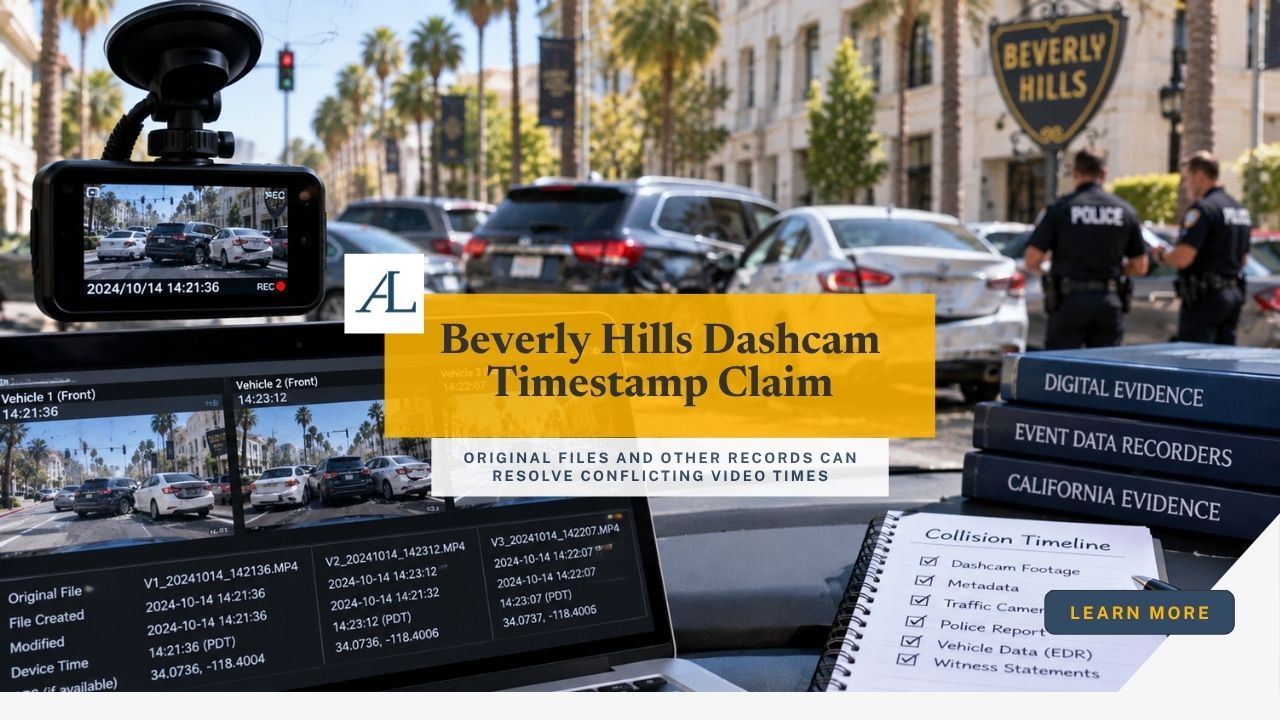
A Beverly Hills dashcam timestamp claim can become complicated quickly when two or more recordings appear to show different times for the same multi-vehicle collision. One driver’s dashcam may display 2:14 p.m., another may show 2:16 p.m., and a nearby business camera may appear to place the crash at a third time. An insurer may treat those differences as proof that one recording is inaccurate, incomplete, or unrelated to the collision. In reality, a displayed timestamp should be investigated before anyone assumes that the video itself is unreliable.
Dashcam clocks are not necessarily synchronized with one another. One device may have been set manually. Another may have corrected its clock through a connected phone or GPS service. A camera may still use a prior time zone, an outdated daylight-saving setting, or the factory default after losing power. The timestamp displayed on the video may also differ from the file-creation date shown on a computer, cloud account, messaging service, or exported copy.
NIST explains that digital-device clocks can drift and may be periodically corrected through outside time sources. That means two devices can record the same real-world event while displaying slightly different times, especially when one has not synchronized recently. The official NIST Keeping Us on Time resource provides useful background on device clocks, clock drift, and external time synchronization.
A Beverly Hills dashcam timestamp claim should therefore be built around a master timeline rather than whichever clock appears most precise. Visible traffic signals, brake lights, vehicle movements, emergency calls, police dispatch records, phone data, event data recorder information, surveillance footage, weather, and identifiable landmarks can help synchronize the recordings. The goal is to determine how each clip relates to the collision, not to force every device to display the same clock time.
This article focuses narrowly on disagreements between timestamps and the preservation of original digital files. Avrek’s related article on Anaheim traffic collision claims when dashcam and traffic camera video tell different stories focuses more broadly on conflicting camera angles and incomplete perspectives. The Beverly Hills article addresses a different problem: two videos may show the same sequence accurately while their clocks disagree.
When a multi-vehicle crash leaves you injured, choosing the right representation matters. An experienced Beverly Hills auto accident lawyer at Avrek Law Firm can help preserve dashcam files, identify additional recordings, compare video with vehicle and emergency-response records, and challenge an insurer’s attempt to rely on one timestamp without reviewing the complete evidence. Avrek’s Beverly Hills office handles accident claims involving disputed fault, complex evidence, medical losses, and multiple insurance companies.
Call 866-598-5548, start a live chat, or request a free case review today. There are no upfront legal fees, and you do not pay unless we win.
Why a Beverly Hills Dashcam Timestamp Claim Can Contain Different Times
A Beverly Hills dashcam timestamp claim may involve several recordings that are each useful even though their displayed times do not match. A timestamp is usually generated according to the settings and internal clock of the recording device. It is not automatically an independently verified statement of the exact local time. The recording itself may accurately show the vehicle movement, traffic signal, and collision sequence even when the displayed clock is several seconds, minutes, or an hour off.
The first step is to separate three concepts: the time printed over the video image, the metadata associated with the original file, and the real-world time established through outside records. Those times may match, but they do not always. An exported clip may receive a new file-creation date. A messaging service may display the time the clip was sent rather than recorded. A cloud platform may store information in Coordinated Universal Time before converting it to local time. Each source must be identified before the times are compared.
Incorrect Clock Settings, Time Zones, and Daylight-Saving Adjustments
A camera may have the wrong date or time simply because no one updated its settings. A driver may install the dashcam, enter the approximate time, and never check it again. A replacement battery, firmware update, long period without power, or disconnected vehicle battery may cause the device to return to an older date or a default setting. The recording can still show the collision even though the clock overlay is inaccurate.
Time-zone settings can produce predictable differences. One device may display Pacific Time while another stores or displays UTC. A connected app may convert the file to local time when it is viewed, while the dashcam itself continues using another setting. A one-hour difference may result from an incorrect daylight-saving setting rather than a missing hour in the collision timeline.
The official NIST Daylight Saving Time Rules page explains that time-zone and daylight-saving corrections are commonly applied by a device’s operating system and that an incorrect setting can make a clock display the wrong hour. That does not prove why a particular dashcam is wrong, but it demonstrates why clock configuration must be investigated before an insurer treats an hour-long difference as evidence that a recording came from another event.
A Beverly Hills dashcam timestamp claim should document the dashcam’s make, model, serial number, date and time settings, time zone, GPS or phone connection, daylight-saving setting, and whether the driver adjusted the clock after the crash. Photographs of the settings screen can help preserve that information. The owner’s manual or manufacturer support materials may also explain how the model assigns and displays time.
The investigation should not change the settings before documenting them. Correcting the clock immediately may make the display more convenient but erase evidence of the offset that existed when the collision occurred. If the camera showed a time seven minutes slow, that consistent seven-minute difference may become the key to synchronizing it with another recording.
Device Resets, Battery Loss, and Software or Firmware Issues
Dashcams may rely on the vehicle’s power, an internal battery, a capacitor, or a combination of power sources. If the device loses power, it may stop recording, close the current file, create a corrupted segment, or reset part of its clock. The effects vary by model and should be evaluated using the actual device rather than assumptions.
A collision itself may interrupt power. The impact may disconnect a cable, damage the vehicle battery, trigger an electrical shutdown, or cause the camera to restart. A file immediately before the crash may show one timestamp, while a later file created after restart may use a default date. That does not necessarily mean the files were manipulated.
Software and firmware can also affect how time is recorded or displayed. An app may update its interpretation of the camera’s clock. A firmware update may change time-zone handling. A mobile phone paired with the camera may synchronize the time only when the app is opened. These issues should be documented using the device history, app version, update records, manuals, and manufacturer information where available.
In a Beverly Hills dashcam timestamp claim, the full memory card may reveal whether the clock offset existed before the collision. Earlier files from the same drive may show a consistent difference. Video recorded on prior days may show whether the timestamp was routinely wrong. A sudden jump between two adjacent clips may suggest a reset or interruption rather than an inaccurate recording of vehicle movement.
The camera should be handled carefully. Repeatedly turning it on, driving with it, or reinserting the memory card can cause loop-recording systems to overwrite older footage. A qualified professional may need to create a protected copy before anyone tests the settings or attempts a repair.
Differences Between Original Files, Exports, and Shared Clips
An original dashcam file and a clip sent through text, email, social media, or a cloud-sharing platform are not always identical. The shared version may be shortened, compressed, converted to a different format, stripped of some metadata, or assigned a new file-creation date. The platform may also display when the video was uploaded or downloaded rather than when it was recorded.
A Beverly Hills dashcam timestamp claim should preserve the original recording before relying on a shared clip. The original file may contain the highest-quality video, audio, embedded time information, GPS data, device identifiers, or other metadata. It may also exist as one part of a series of consecutive files that show what happened before and after the selected clip.
Exports can create confusion when an insurer compares file dates. A driver may export the video two days after the collision, causing the computer to show an export date rather than the crash date. Someone may trim the clip for easier sharing without intending to alter its meaning. The shortened copy can still be useful, but it should not replace the original.
The original memory card, device, cloud account, app, and unedited files should be identified. If a driver has already shared a clip, each version should be labeled according to its source. The claim file might distinguish among “original dashcam file,” “app export,” “texted copy,” “insurer upload,” and “social-media copy.” That avoids treating all copies as though they carry the same technical information.
For broader background on the value and limits of dashcam recordings, Avrek’s article on the advantages of using dashcam footage in auto accident cases explains how video can help clarify fault when witness accounts conflict. The presence of useful video, however, does not remove the need to preserve its original form and understand its clock.
Comparing Other Evidence in a Beverly Hills Dashcam Timestamp Claim
A Beverly Hills dashcam timestamp claim should compare the recordings with events visible or documented outside the camera. The most useful synchronizing event is something that appears in more than one source. A traffic signal changing, a pedestrian entering the crosswalk, a vehicle’s brake lights turning on, an emergency vehicle arriving, or a distinctive car passing can provide a shared reference point.
The master timeline should distinguish between exact times and estimated times. A 911 system may record an exact call-received time. A witness may estimate that the crash happened “around 4:30.” A medical chart may show when the patient was registered rather than when the collision occurred. Each record remains useful when its meaning is understood.
Traffic Signals, Visible Landmarks, Weather, and Road Conditions
Traffic signals can help synchronize conflicting videos. One dashcam may show a green light changing to yellow as a vehicle enters the intersection. Another camera may show cross traffic beginning to move seconds later. A business recording may capture the same light reflected in a window. Matching those events can show that the videos depict the same collision even when their clocks differ.
Visible landmarks can also help. A bus, shuttle, delivery truck, pedestrian group, valet vehicle, distinctive advertisement, hotel entrance, or emergency vehicle may appear in several recordings. Shadows, headlights, storefront lighting, rain, wet pavement, and traffic congestion may provide additional context.
A Beverly Hills dashcam timestamp claim should avoid using general weather or daylight assumptions when the video contains more precise evidence. Saying that one clip “looks later” because the image is darker may be unreliable if the cameras have different exposure settings. It is better to identify specific shared events that can be aligned frame by frame.
Road conditions and traffic movement may help establish the larger sequence. If one camera shows vehicles stopping because of congestion and another shows the resulting collision from behind, the recordings may be synchronized through brake lights and vehicle order. The complete sequence may matter more than the timestamp printed in the corner.
The scene should also be photographed while the roadway layout remains available. Lane markings, signal positions, buildings, signs, trees, medians, driveways, and camera locations can help establish where each device was aimed. A map showing the cameras and their fields of view can explain why one recording captured an event earlier than another.
Phone Records, Emergency Calls, Vehicle Data, and Police Dispatch Times
Phone and emergency records may provide independently generated times. A passenger may call 911 immediately after impact. Another driver may photograph the scene. A witness may text someone that traffic is blocked. These records can help anchor the real-world time of the collision, but they should be interpreted carefully. A call placed at 3:18 does not prove the impact occurred at exactly 3:18; it establishes that the crash had happened by the time of the call.
Police and fire records may include the time a call was received, the time units were dispatched, the time responders arrived, and the time the scene was cleared. Those entries should not be blended into one “police time.” Each represents a different event in the response timeline.
Vehicle information may also help establish relative timing. Federal regulations in 49 CFR Part 563 Event Data Recorders address the collection, storage, and retrieval of crash-event data from vehicles equipped with EDRs. Depending on the vehicle and applicable recording conditions, data may include speed, brake status, changes in velocity, and information about multiple recorded events. The regulation also makes clear that EDR data are different from audio and video.
EDR information often uses time relative to the crash event rather than a dashcam-style wall clock. That means it may not directly say the collision occurred at 3:17:42 p.m., but it may show that braking began several seconds before impact or that two qualifying events occurred within a short interval. That relative sequence can be compared with visible braking and impacts in the videos.
Avrek’s related article on event data recorder evidence after a car accident explains how speed, braking, steering, and other vehicle information may provide objective context when driver accounts differ. In a timestamp dispute, the EDR does not replace the recordings; it can help test the sequence shown in them.
Witness Accounts and Business Surveillance From the Same Period
Witnesses may help identify the order of events even when they cannot provide an exact time. A person may remember seeing the first vehicle stop, hearing two separate impacts, and then seeing a driver exit while another camera was still recording. Those observations can help connect clips that otherwise appear separated by conflicting clocks.
A Beverly Hills dashcam timestamp claim should collect witness accounts before people repeatedly view shared footage. Watching a video can affect how someone later describes personal memory. The strongest statement distinguishes between what the witness personally observed and what the witness learned from recordings or other people afterward.
Business surveillance may provide another clock, but it should not automatically be treated as the correct one. A hotel, restaurant, parking structure, office building, retail property, medical facility, or residence may have cameras with their own settings. The recording may still provide a valuable independent angle and a sequence of events.
The original business footage should be requested rather than a phone recording of the monitor. The request should include a wider time period before and after the crash so investigators can identify shared traffic events. The property should also be asked whether the system clock was synchronized, whether the exported video preserves the original overlay, and whether anyone changed the settings after the collision.
Beverly Hills collisions may occur near Wilshire Boulevard, Santa Monica Boulevard, Sunset Boulevard, Beverly Drive, Canon Drive, Rodeo Drive, hotels, restaurants, medical buildings, retail properties, garages, and valet areas where several private cameras may exist. A Beverly Hills personal injury lawyer can help identify the businesses and properties that may hold recordings before routine retention systems overwrite them.
Preserving Original Files in a Beverly Hills Dashcam Timestamp Claim
A Beverly Hills dashcam timestamp claim can be weakened when only edited or exported clips remain. The best practice is to preserve the recording device, original memory card, complete files, app data, and available cloud backup before the camera continues normal loop recording.
NIST’s digital-evidence materials recognize that modern evidence may come from vehicles, cloud systems, phones, and other storage devices, and emphasize the importance of methods that capture information reliably without changing it. The official NIST Digital Evidence Resources page provides broader information about those preservation challenges.
Preservation does not mean that an injured person should attempt a technical forensic examination alone. It means avoiding unnecessary changes and identifying where the original data are located. A qualified specialist can determine whether a forensic copy, protected image of the memory card, file hash, metadata extraction, or manufacturer-specific process is appropriate.
Metadata, Memory Cards, Cloud Backups, and File-Creation Information
Metadata can include the file name, file type, creation or modification dates, duration, frame rate, device information, GPS coordinates, and other technical fields. Not every dashcam stores the same information, and not every date shown by a computer means the same thing. A file may be created on the memory card during recording, copied to a phone later, and exported to a computer later still.
A Beverly Hills dashcam timestamp claim should preserve those different layers rather than selecting whichever date supports one side. A technical review may distinguish the embedded overlay from the file-system date, app information, and cloud upload time. A conflict between those fields may be explainable once the movement of the file is documented.
The entire memory card may contain information not visible in the selected collision clip. Adjacent files can show continuity before and after impact. System folders may identify the device or recording mode. Locked or emergency-event folders may contain a duplicate file. The card should not be reformatted, repaired, or reused until preservation needs are considered.
Cloud backups may provide another original or near-original copy, but the account should be documented before settings are changed. The owner should preserve login information, subscription details, connected devices, upload history, and any app messages about synchronization or storage. Downloading the clip may create a new copy, so the downloaded version should be labeled rather than mistaken for the only original.
Photographs of the dashcam installation can also matter. They may show the camera’s location, angle, power connection, GPS attachment, date display, and relationship to the windshield. Removing and reinstalling the device without documenting its original position may make later interpretation more difficult.
Avoiding Edits, Re-Exports, or Overwriting of Original Footage
Trimming a video for easier sharing can remove important seconds before or after impact. Re-exporting may change the frame rate, resolution, audio, file structure, or metadata. Adding captions, changing playback speed, applying stabilization, or converting the format can create another version that should not replace the original.
An injured person does not need to hide the existence of an edited clip. The better approach is to preserve the original and label every later copy. The claim file can explain that a short version was created for email while the complete original remains available.
Loop recording creates a more urgent risk. Many dashcams reuse storage by overwriting the oldest unlocked files. Continuing to drive with the same memory card may erase the minutes before the crash, adjacent camera angles, or earlier files showing the clock offset. The device should be removed from normal use once it is safe and practical to preserve the relevant recording.
A Beverly Hills dashcam timestamp claim should also avoid public social-media posting before legal review. Public uploads may compress the video, invite inaccurate speculation, disclose private information, and create additional copies without preserving the best evidence. Sharing with police, an insurer, or legal counsel should occur through a process that keeps the original file intact.
If a clip has already been posted or sent, the original should still be preserved. The post, upload date, comments, and platform copy may become part of the evidence history, but they do not automatically replace the file stored on the device.
Documenting Who Collected, Copied, or Shared Each Recording
A simple handling log can prevent later confusion. It should identify who removed the memory card, who copied the files, which device was used, where the copies were stored, whether the original was returned, and who received each version.
A Beverly Hills dashcam timestamp claim may involve footage collected by a driver, passenger, witness, police officer, tow company, insurer, repair shop, or legal investigator. Each person may create a copy using a different method. Without documentation, the parties may later disagree about which file came directly from the camera.
If the matter proceeds to litigation, authentication may become important. California Evidence Code Section 1400 defines authentication of a writing as evidence sufficient to support a finding that the item is what the proponent claims it to be or proof through another legally permitted method. Preserving the original source, recording how the file was collected, and documenting later copies can help address that question.
The log does not need to be overly complicated. A dated note identifying the source and transfer may be more useful than relying on memory months later. File names should not be changed casually, and copies should be stored in a way that prevents accidental modification.
A qualified digital-evidence professional may calculate a cryptographic hash for the original file or forensic copy. The hash can help identify whether the preserved file remains unchanged after collection. That step may not be necessary in every insurance claim, but it can be valuable when an insurer alleges editing or when several copies circulate.
Insurance Disputes in a Beverly Hills Dashcam Timestamp Claim
A Beverly Hills dashcam timestamp claim may become a dispute before every recording is collected. One insurer may receive a clip from its insured and rely on that timestamp as the official sequence. Another carrier may have a different clip showing another time. Each adjuster may focus on the version that reduces their driver’s responsibility.
The claimant should not assume that insurers will voluntarily coordinate every recording. Each company has its own file, insured, coverage position, and financial interest. A complete claim should identify every camera, obtain the original files when possible, and build one synchronized timeline before final settlement discussions.
Adjusters Relying on One Clip Without the Full Collision Sequence
A selected clip may begin only seconds before impact. It may show one vehicle entering the frame but omit the earlier lane change, sudden stop, obstruction, or first collision that triggered the chain reaction. The timestamp may also make the clip appear to occur before or after another event when the device clock is simply offset.
A Beverly Hills dashcam timestamp claim should request the full recording segment and adjacent files. The seconds after impact may show additional collisions, vehicle movement, admissions, driver conduct, or another car leaving the scene. Audio may capture horns, braking, separate impact sounds, or statements made while the camera continues recording.
The insurer’s interpretation should be compared with the physical damage. If a vehicle has front and rear damage, one clip showing only the rear impact may not explain the full collision. Debris, paint transfer, tire marks, airbags, vehicle data, and final positions may reveal another contact outside the camera’s view.
Avrek’s Los Angeles multi-vehicle freeway accident claim article explains why the first impact is not always the only cause of injury and why several insurers may dispute the order of a chain-reaction crash. The timestamp issue adds another layer because the recordings may appear out of sequence until their clock offsets are identified.
An adjuster may also pause the video at a favorable frame or use slow motion without acknowledging the original frame rate. The claimant should preserve normal-speed playback and the complete file so the clip is not interpreted through one selected image alone.
Disagreements About Vehicle Order, Signal Timing, and Impact Sequence
Conflicting timestamps can affect the alleged order of vehicles. One insurer may claim its driver entered the intersection first because that camera shows an earlier time. Another may claim the traffic signal changed before the collision based on a business camera. Neither conclusion is reliable until the clocks and visible events are synchronized.
A Beverly Hills dashcam timestamp claim should align the sequence through shared visual markers. The same traffic signal, brake light, pedestrian, bus, emergency siren, vehicle turn, or impact may appear in multiple sources. Once those events are matched, the recordings can often be placed in order even if their displayed clocks remain different.
Signal timing should be handled carefully. A camera may not show the signal facing a particular driver. Reflections and distant lights can be misleading. The official signal sequence, video angles, witness accounts, and vehicle movement may all need comparison before deciding which driver had the right of way.
Multi-vehicle impacts can occur only fractions of a second apart. A witness may perceive them as one collision, while audio or vehicle data identifies separate contacts. The claim should not force every source into an artificially precise timeline if the evidence supports only an approximate sequence.
Medical records should describe what the injured person felt without requiring the patient to identify exact impact times. A person may report being hit from behind and then from the side, or hearing two impacts. That history can be compared with the vehicle and video evidence without treating the patient as an accident reconstruction specialist.
Settlement Offers Before All Recordings Are Compared
An insurer may offer a settlement based on the first clip it receives. The adjuster may state that the timestamp proves its driver entered first, reacted in time, or was not present during an earlier event. Accepting that conclusion before obtaining the other recordings can leave important evidence unreviewed.
A Beverly Hills dashcam timestamp claim should not be resolved until the available videos, original files, metadata, clock settings, vehicle data, police records, witness accounts, and medical documentation have been reviewed sufficiently to understand the claim. That does not mean every case requires a formal digital-forensics examination. It means the claimant should know whether the supposed timestamp conflict has a reasonable explanation.
Release language also matters. One insurer may offer payment for only one impact while requesting a broad release of every driver and claim. Another may resolve vehicle damage while the bodily injury investigation remains open. The injured person should understand which parties, policies, losses, and future claims the document would close.
Medical recovery may also be incomplete. Even perfectly synchronized video does not determine the full value of medical treatment, missed work, pain, future care, transportation, or daily limitations. The crash timeline and damages timeline should be developed together but not confused.
Medical and Financial Records Still Matter When Dashcam Times Conflict
A Beverly Hills dashcam timestamp claim is ultimately an injury claim, not only a technical debate about clocks. Video may help establish which vehicle moved first, but medical records must show what injuries followed. Wage, repair, transportation, and out-of-pocket records must show how the collision affected the injured person financially.
Emergency and follow-up records should describe the collision sequence as accurately as the patient remembers it. If the person felt several impacts, was turned in the seat, struck the interior, or became confused after the crash, those details may help providers understand the symptoms. The patient should not adopt a video-based account that conflicts with genuine memory simply because an insurer says the footage proves it.
Treatment may include emergency care, imaging, primary care, orthopedics, neurology, physical therapy, pain management, surgery, rehabilitation, or other provider-directed care. Medical records should remain organized by date so the injury timeline can be compared with the reconstructed accident timeline.
Financial records may include missed work, reduced hours, vehicle repairs, towing, storage, rental costs, rideshare expenses, medical travel, prescriptions, and damaged personal property. A low repair estimate or short video clip should not be treated as a medical diagnosis.
A Beverly Hills personal injury lawyer can help connect the technical collision evidence with medical, employment, and daily-life documentation without allowing the timestamp dispute to overshadow the person who was injured.
What to Do After Discovering Conflicting Dashcam Times
Do not change the dashcam clock or reformat the memory card before documenting the existing settings. Photograph the device, screen, mount, cables, time, date, time zone, GPS status, app connection, and any error messages. Remove the device or card from normal loop-recording use when it can be done safely.
Preserve the entire relevant recording period, not only the moment of impact. Save the files before and after the crash, the original memory card, app data, cloud backup, and any exported copies. Label each version clearly.
Collect the other timeline evidence. Save phone photographs, calls, texts, navigation information, emergency-response records, tow documents, repair records, police information, witness contacts, and vehicle data. Identify nearby businesses and vehicles that may have additional cameras.
Do not publicly accuse another person of altering footage merely because the clocks disagree. A Beverly Hills dashcam timestamp claim often involves an explainable offset, time-zone setting, reset, or export difference. The original evidence should be reviewed before conclusions are made.
Keep a communication log for every insurer. Record the company, adjuster, claim number, phone number, email, date, request, statement, and settlement offer. Note which video version each adjuster has reviewed and whether the complete original was provided.
Reporting and Deadlines for a Beverly Hills Dashcam Timestamp Claim
California DMV reporting requirements may apply regardless of whether the parties agree about the video timeline. The official California DMV SR-1 Accident Reporting page states that the report generally must be sent within 10 days when someone is injured or killed or property damage exceeds $1,000. DMV also explains that the SR-1 is required in addition to a report made to police, CHP, or an insurance company.
The SR-1 should use verified identifying and collision information. A disagreement over dashcam clocks should not become a reason to guess about facts that remain unknown. The driver, insurer, broker, or legal representative can determine how to complete the report accurately based on the available records.
For many California injury actions, California Code of Civil Procedure Section 335.1 provides a two-year limitations period for an action involving injury to, or death of, an individual caused by another person’s wrongful act or neglect. Different or shorter procedures can apply depending on the parties and facts.
That filing period should not encourage delay. Dashcam footage may be overwritten within days. Vehicles may be repaired or sold within weeks. Business surveillance may disappear under routine retention schedules. A Beverly Hills dashcam timestamp claim should be investigated while the original devices, files, witnesses, and roadway evidence remain available.
Frequently Asked Questions About a Beverly Hills Dashcam Timestamp Claim
What Should I Do When Dashcam Timestamps Conflict?
Preserve every original recording, memory card, device, cloud backup, and app record. Do not adjust the clocks before photographing the settings. Collect emergency-call times, police dispatch records, phone data, business surveillance, witness statements, and vehicle information that can help build a master timeline.
A Beverly Hills dashcam timestamp claim should be analyzed through events visible across the recordings, not only the numbers printed on the screen.
Does a Wrong Timestamp Make Dashcam Video Useless?
No. The video may still accurately show vehicle movement, lane position, signals, braking, impact, and the collision sequence. A wrong clock can sometimes be corrected through a consistent offset when compared with independently timed events.
The reason for the difference should be investigated before an insurer rejects the recording.
Can Two Accurate Videos Display Different Times?
Yes. Separate devices may use different settings, time zones, daylight-saving configurations, synchronization methods, or internal clocks. One device may also have reset after losing power.
The recordings may still depict the same event. Shared visual or audible markers can help synchronize them.
Why Is the Original File Better Than a Texted or Emailed Copy?
The original may preserve better video quality, audio, device information, metadata, GPS information, and adjacent footage. A shared copy may be compressed, shortened, converted, or assigned a new creation date.
The shared clip can still be useful, but it should not replace the original evidence.
Can Event Data Recorder Information Resolve the Timestamp Dispute?
EDR information may help establish relative crash timing, speed, braking, changes in velocity, or multiple qualifying events, depending on the vehicle and available data. It ordinarily does not function like a dashcam clock, and federal EDR regulations expressly distinguish crash-event data from audio and video.
The 49 CFR Part 563 Event Data Recorders rules provide more information about regulated EDR data and retrieval requirements.
What if the Insurer Has Only a Short Clip?
Ask that the complete original recording and adjacent files be preserved. A short clip may omit the event that caused the driver to brake, swerve, change lanes, or enter the intersection.
A Beverly Hills dashcam timestamp claim should examine the collision sequence before and after impact, especially when several vehicles were involved.
Should I Send the Insurer My Memory Card?
Do not surrender the only original without understanding how it will be handled. Preserve a protected copy and document any transfer. The appropriate process depends on the claim and whether a qualified examination is needed.
An attorney can help coordinate access without allowing the only original to be lost, reformatted, or altered.
What if Someone Already Trimmed or Exported the Video?
Preserve the trimmed copy, but locate the original device, memory card, app, or cloud account. Label the edited or exported version clearly and document who created it and why.
An edit made for easier sharing does not automatically mean the underlying video is false, but the original remains important.
Can a Business Surveillance Timestamp Also Be Wrong?
Yes. Business cameras have their own clocks, settings, software, and export systems. The footage can still be valuable, but its displayed time should be tested against shared events and independently timed records.
No camera should be declared the “correct clock” merely because it belongs to a business.
Do I Need a Lawyer When Several Insurers Use Different Video Timelines?
Legal help is especially important when several vehicles and insurance companies are involved, original footage is at risk of being overwritten, or adjusters are relying on different clips to assign fault.
A Beverly Hills auto accident lawyer can help preserve and synchronize the collision evidence, while a Beverly Hills personal injury lawyer can organize the medical, employment, property, and daily-life losses connected to the crash.
Call or Contact Avrek Law Firm 24/7 for a Free Consultation and Pay Nothing Unless We Win
A Beverly Hills dashcam timestamp claim can become difficult when drivers submit recordings with different clocks, insurers rely on selected clips, or original files are overwritten before the discrepancy is investigated. These cases may depend on dashcam settings, complete memory cards, metadata, cloud records, emergency calls, police dispatch times, event data, traffic signals, business surveillance, witness accounts, vehicle damage, and a carefully constructed master timeline.
Avrek Law Firm helps injured drivers and passengers investigate complex multi-vehicle collisions throughout Beverly Hills and the surrounding Los Angeles area. Our team can move quickly to identify the recording devices, preserve original footage, compare the videos with independent evidence, communicate with multiple insurers, and document the medical and financial effects of the crash.
If you or someone you love was injured in a Beverly Hills multi-vehicle collision and the available dashcam timestamps do not match, Avrek Law Firm is ready to help.
Call 866-598-5548, start a live chat, or complete our online consultation form today for a free, no-obligation case review. There are no upfront legal fees, and you do not pay unless we win.
Serving the Beverly Hills Community
Avrek Law Firm represents people injured in complex crashes throughout Beverly Hills and nearby communities. Local context matters in a Beverly Hills dashcam timestamp claim because hotels, restaurants, retail properties, parking structures, medical buildings, valet operations, residences, and commercial corridors may each hold separate recordings with different clocks.
A collision near Wilshire Boulevard, Santa Monica Boulevard, Sunset Boulevard, Beverly Drive, Canon Drive, Crescent Drive, Rodeo Drive, a hotel driveway, restaurant entrance, parking structure, or busy intersection may be recorded by several private vehicles and properties. Those recordings should be preserved before routine systems overwrite them.
A Beverly Hills auto accident lawyer can help reconstruct the vehicle sequence and digital timeline, while a Beverly Hills personal injury lawyer can document how the collision affected medical treatment, income, transportation, property, and daily life.
A Beverly Hills dashcam timestamp claim should be handled with urgency and technical care. Two clocks may disagree while both videos still contain essential evidence of what happened.
- 📩 Submit a request through our online form
- 📞 Call 866-598-5548 now to speak with our team
- 💬 Start a live chat for immediate assistance
There are no upfront fees, and you don’t pay unless we win.