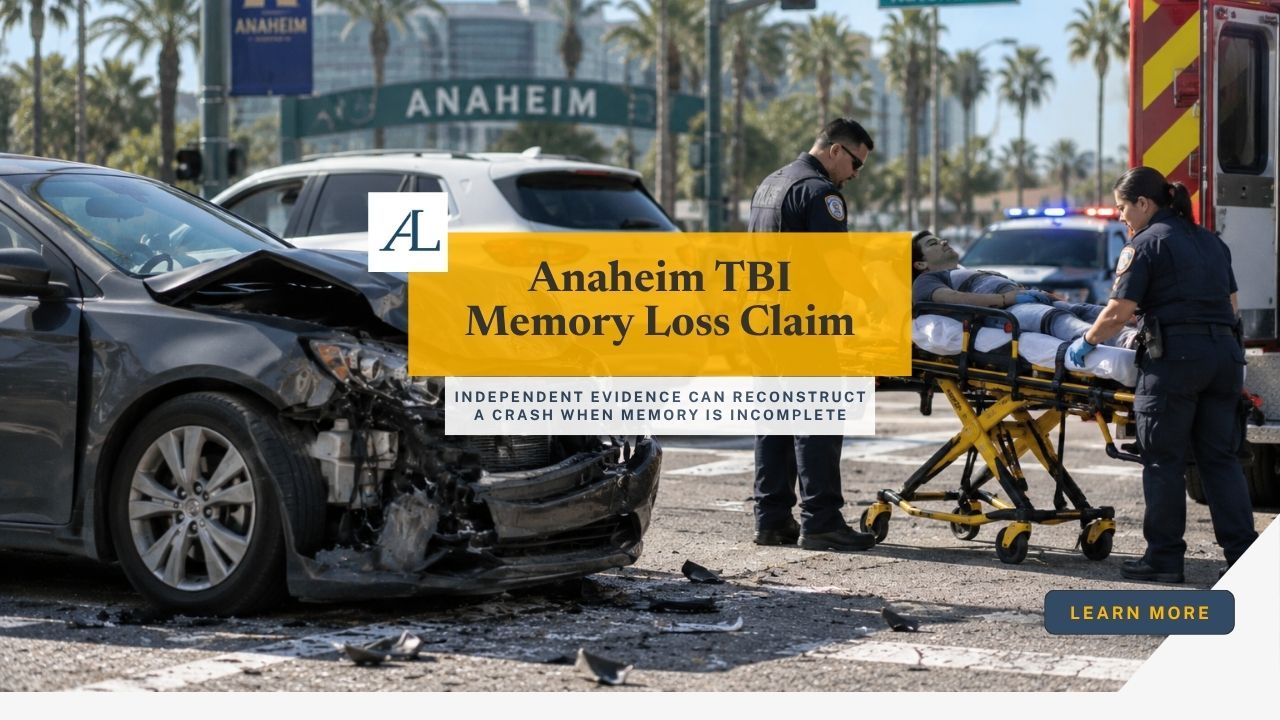
An Anaheim TBI memory loss claim can become complicated quickly because the injured person may not remember what happened immediately before, during, or after the collision. A driver or passenger may remember beginning the trip, approaching an intersection, or traveling on the freeway, then have no clear memory until emergency responders arrived or they woke up in the hospital. That gap does not automatically make the person’s claim unreliable. Memory loss may itself be one of the symptoms that requires medical evaluation and careful documentation.
Traumatic brain injury symptoms do not look the same for everyone. The official CDC Symptoms of Mild TBI and Concussion resource explains that symptoms can affect how a person feels, thinks, acts, or sleeps. The CDC includes short- or long-term memory problems, difficulty concentrating, feeling slowed down, confusion, headaches, dizziness, fatigue, irritability, and sleep changes among the possible symptoms, and it notes that some symptoms may not appear until hours or days after the injury.
An Anaheim TBI memory loss claim should therefore be built around more than the injured person’s ability to describe the crash. Emergency records, witness accounts, passenger statements, dashcam footage, business surveillance, vehicle damage, electronic vehicle records, navigation history, phone data, police diagrams, and final resting positions may all help reconstruct the collision. Medical records can then show whether memory problems, confusion, headaches, cognitive changes, or other neurological symptoms appeared after the event.
This article focuses specifically on claim reconstruction when memory is incomplete. For a broader explanation of the relationship between collisions and memory symptoms, see Avrek’s related article on how a car accident can cause memory loss.
When a crash leaves you or someone you love unable to remember what happened, choosing the right representation matters. An experienced Anaheim car accident lawyer and traumatic brain injury lawyer at Avrek Law Firm can help preserve independent evidence, organize the medical timeline, manage insurer communications, and pursue compensation for the full impact of the injury.
Why an Anaheim TBI Memory Loss Claim Requires Independent Evidence
An Anaheim TBI memory loss claim often requires a different investigative approach from a claim in which the driver remembers every part of the collision. The injured person may not be able to describe which light was green, whether traffic had stopped, which vehicle made contact first, or how the car moved after impact. Insurers may try to use that missing information as a reason to delay the claim or accept another driver’s version without sufficient review.
Independent evidence can fill those gaps. The goal is not to pressure the injured person to recover memories or make assumptions. It is to reconstruct the crash using objective sources and compare that reconstruction with the medical evidence. A person should be encouraged to describe only what they genuinely remember, including the point where memory becomes unclear.
Memory may also return in fragments. Someone may initially remember nothing about the impact but later recall a horn, brake lights, a sudden movement, or a conversation immediately before the collision. These fragments should be discussed with medical and legal professionals rather than treated as a complete account. A carefully documented claim distinguishes between confirmed memory, partial recollection, information learned from others, and conclusions drawn from independent evidence.
Difficulty Describing the Events Before or During the Collision
A driver or passenger with post-crash memory problems may remember the beginning of the trip but not the collision itself. They may know they were traveling toward work, a hotel, Disneyland Resort, the Anaheim Convention Center, Angel Stadium, the Honda Center, or another destination, yet be unable to recall the final minutes. They may remember being on I-5, SR-57, SR-91, Harbor Boulevard, Katella Avenue, Ball Road, or another Anaheim route without remembering the traffic movement that led to impact.
An Anaheim TBI memory loss claim should not force the injured person to answer questions beyond their actual recall. Statements such as “I do not remember,” “my last clear memory is approaching the intersection,” or “I learned that detail from the police report” can be more accurate than guessing. An uncertain estimate about speed, signal status, or vehicle movement may later be treated by an insurer as a firm statement, even though the person was trying only to be helpful.
The missing period may involve events before the collision, the impact itself, or the immediate aftermath. Some people remember seeing danger but not the collision. Others remember impact but cannot recall speaking with police or paramedics. Still others have difficulty organizing the event in chronological order. The medical record should identify these problems when they are reported so the claim does not depend on an artificially complete story.
The injured person’s inability to describe the crash may be frustrating, but it does not give another driver’s statement automatic priority. The other driver may also have had a limited view, experienced shock, or have a reason to minimize fault. All available accounts should be checked against the scene evidence.
Confusion Recorded by First Responders or Emergency Providers
First responders may document confusion before the injured person understands that memory has been affected. Paramedic and emergency records may describe whether the person knew their name, location, date, destination, or what had happened. Providers may note repeated questions, slowed responses, difficulty following instructions, altered awareness, or an inability to recall the collision.
These early records can be especially important in an Anaheim TBI memory loss claim because they may show that the problem was present before an insurance dispute developed. A person who repeatedly asked why they were in an ambulance or could not explain how the crash occurred may have been demonstrating a genuine neurological concern rather than avoiding questions.
Emergency records should be reviewed as a group. Ambulance notes, emergency-department records, imaging reports, nursing observations, physician evaluations, discharge instructions, and referral notes may each contain different information. One chart entry may say the person was alert, while another documents difficulty recalling the event. Those statements are not necessarily inconsistent. A person can be awake, able to speak, and still have significant memory problems.
The medical record may also describe loss of consciousness, although an Anaheim TBI memory loss claim does not require proof that the person was unconscious. Memory, concentration, balance, mood, sleep, and other cognitive symptoms may occur even when there was no confirmed loss of consciousness. The claim should follow the medical evidence rather than relying on assumptions about what a brain injury must look like.
Why Early Statements May Be Incomplete Rather Than Intentionally Inconsistent
Early statements are often given under difficult circumstances. The injured person may be in pain, frightened, fatigued, medicated, overwhelmed by emergency activity, or still trying to understand where they are. A short answer to a police officer or paramedic may not represent a complete account of the event.
In an Anaheim TBI memory loss claim, an insurer may compare a brief statement at the scene with a later statement and label any difference an inconsistency. That approach can be misleading. The first account may have omitted details because the person could not recall them, while a later account may incorporate information from video, witnesses, the police report, or returning memory. The source of each detail should be identified rather than blended together.
For example, the injured person may initially say they remember being rear-ended because that is the only impact they felt clearly. Video may later show that the vehicle was first sideswiped and then struck from behind. A later description of two impacts does not necessarily mean the person changed the story dishonestly. It may mean independent evidence clarified a sequence the injured person could not remember.
A legal team can create a statement timeline that identifies what was said, when it was said, the person’s medical condition at that time, and what evidence later became available. That context can prevent insurers from using a medically plausible memory gap as a credibility attack.
Independent Evidence That Can Reconstruct the Crash
Independent evidence is often the foundation of an Anaheim TBI memory loss claim. Because the injured person may not be able to supply a complete narrative, the investigation should begin with evidence that existed independently of memory: vehicle positions, damage patterns, debris, photographs, surveillance footage, electronic data, navigation history, witness accounts, and official records.
The evidence should be preserved quickly. Vehicles can be repaired or sold. Business cameras may overwrite footage. Dashcams can record over older files. Witnesses may forget details or become difficult to locate. Phones may be replaced, cloud accounts closed, and navigation histories deleted. Early preservation creates a more reliable record and reduces the insurer’s ability to rely only on its insured’s version.
A strong reconstruction does not assume that one type of evidence will answer every question. Vehicle damage may show the impact angle but not the signal status. Video may show the vehicle movement but not the occupants’ injuries. Medical records may show confusion but not which driver caused the collision. The complete claim combines these sources.
Witnesses, Passengers, and Statements From Other Drivers
Passengers may be among the most important witnesses in an Anaheim TBI memory loss claim because they may have seen the traffic conditions, heard the injured driver react, or observed what happened immediately afterward. A passenger may remember another vehicle entering the lane, a driver running a light, traffic stopping suddenly, or the injured person appearing confused after impact.
Independent witnesses can provide an outside view. Another motorist, pedestrian, bicyclist, rideshare driver, hotel employee, security guard, business worker, or nearby resident may have seen only part of the crash, but that partial view can still be valuable. One witness may have seen the signal. Another may have seen the vehicle positions. A third may have heard more than one impact.
Witness accounts should be collected promptly and separately. People should not be encouraged to agree on one version or discuss details until their memories match. Independent recollections are more useful when each person describes what they personally saw and heard.
Statements from the other drivers matter too, but they should be tested against objective evidence. A driver may say the injured person changed lanes suddenly, while damage and video suggest the other vehicle crossed the lane line. A driver may claim the injured person failed to brake, while vehicle data or skid evidence indicates braking occurred. No single statement should control the claim without comparison to the remaining evidence.
Dashcams, Traffic Cameras, Business Video, and Phone Recordings
Video can provide the most direct reconstruction when memory is incomplete. Dashcams may show traffic speed, lane position, signals, brake lights, turns, merging vehicles, and the seconds before impact. A rear-facing camera may capture a following vehicle. A rideshare or delivery vehicle may have additional camera systems.
Anaheim’s resort, entertainment, hotel, retail, and commercial areas may contain numerous private cameras. Hotels, restaurants, shopping centers, parking structures, gas stations, apartment buildings, businesses, and event venues may have exterior surveillance facing a roadway or driveway. Cameras near Harbor Boulevard, Katella Avenue, Ball Road, Anaheim Boulevard, Disney-area hotels, the Convention Center, Angel Stadium, and the Honda Center may be controlled by different entities, each with its own retention schedule.
An Anaheim TBI memory loss claim should identify potential cameras immediately. A preservation request may need to describe the date, approximate time, location, vehicles, and direction of travel. Even footage that does not show the impact may capture a vehicle approaching, leaving the scene, changing lanes, or stopping afterward.
Phone recordings may include photographs, videos, voice memos, emergency calls, or messages sent by witnesses and passengers. These records should be preserved in their original form when possible so the date and time remain available. A screenshot can be useful, but the original file may contain additional information.
Vehicle Data, Navigation History, and Final Vehicle Positions
Modern vehicles may contain information that helps establish speed, braking, steering, restraint use, impact timing, or changes in vehicle movement. The available data vary by vehicle and collision, so the legal team should identify the year, make, model, VIN, installed systems, and tow location before assuming what can be recovered.
Avrek’s related article on event data recorder evidence after a car accident explains how electronic vehicle information may help evaluate speed, braking, steering, and other objective factors. In an Anaheim TBI memory loss claim, that information can be particularly useful when the injured person cannot describe the final seconds before impact.
Navigation and phone-location histories may also help establish the route, destination, and timing. These records can show whether the person was traveling normally along a planned route, stopped at a location, or deviated because of traffic. They should be collected carefully and only to the extent relevant to the crash, because personal devices contain extensive private information.
Final vehicle positions, damage locations, debris, tire marks, broken glass, fluid trails, traffic signals, lane markings, curbs, medians, and barriers can help reconstruct the vehicle movement after impact. A car found in a different lane may have been pushed, spun, or redirected. Damage on several sides may indicate multiple impacts. Wide scene photographs and close-up damage photographs should be preserved together.
Medical Records That Support an Anaheim TBI Memory Loss Claim
Medical documentation must do more than show that the injured person visited a hospital. It should create a timeline connecting the collision to memory problems, confusion, headaches, dizziness, sleep disruption, mood changes, concentration difficulties, or other symptoms. An Anaheim TBI memory loss claim becomes easier to explain when emergency records, follow-up evaluations, specialist notes, and family observations consistently describe how the person’s functioning changed.
The CDC notes that mild TBI and concussion symptoms differ between individuals and may change throughout recovery. Some symptoms may appear immediately, while others may not be noticed until hours or days later. Problems with memory, attention, clear thinking, dizziness, fatigue, mood, and sleep are among the symptoms identified by the agency.
Medical care should be guided by health needs, not by the insurance claim. A lawyer cannot diagnose a traumatic brain injury, and a normal conversation or outward appearance does not resolve the medical question. Licensed providers must evaluate the symptoms and determine what testing, treatment, restrictions, or referrals are appropriate.
Emergency Notes Describing Orientation and Recall
Emergency records may document whether the patient was oriented to person, place, time, and event. A person may know their name and location but be unable to remember the collision. They may answer routine questions correctly while repeating the same questions about what happened. These details can be more informative than a single statement that the person was “alert.”
An Anaheim TBI memory loss claim should preserve the complete emergency record, including ambulance notes, triage materials, nursing observations, physician evaluations, imaging, medication records, discharge instructions, and referral recommendations. Different members of the medical team may have observed different symptoms.
The timing of statements matters. If a police officer interviewed the person before treatment, the record may show that the person was confused or unable to provide a complete account. If the person gave an insurer a statement soon after discharge, medication, fatigue, pain, or cognitive symptoms may have affected the conversation.
Family members should write down what they observed without attempting to provide a diagnosis. They may note that the person repeated questions, did not recognize the location, forgot that the crash happened, or could not recall why they were in the hospital. These observations can later be shared with medical providers.
Follow-Up Evaluations for Cognitive or Neurological Symptoms
Memory problems may continue after the emergency visit or become more noticeable when the person tries to resume normal activities. Someone may forget conversations, appointments, passwords, routes, tasks, or instructions. They may lose track of time, struggle to organize information, or need reminders for responsibilities they previously managed independently.
An Anaheim TBI memory loss claim should include follow-up records from primary care, neurology, rehabilitation, therapy, neuropsychology, or other providers involved in the recovery. The appropriate providers and testing depend on the patient’s symptoms and medical recommendations.
Related symptoms may include headaches, dizziness, nausea, light or sound sensitivity, vision changes, fatigue, sleep problems, mood changes, slowed thinking, and concentration difficulty. The medical record should distinguish between symptoms the person experiences, findings observed by providers, and diagnoses made after evaluation.
Avrek’s article on Los Angeles car accident TBI neuropsychological testing explains how structured testing may help evaluate memory, attention, processing speed, executive function, and other cognitive concerns when providers determine such testing is appropriate. Although that article focuses on Los Angeles, the documentation principles may also help explain why an Anaheim patient’s functioning needs more detailed evaluation.
Treatment gaps should be explained honestly. Transportation problems, appointment availability, insurance authorization, work demands, childcare, or confusion may interfere with follow-up care. A gap does not necessarily mean the symptoms disappeared, but the reason should be documented whenever possible.
Family Observations About Memory Changes After the Accident
Family members may notice changes that do not appear during a short medical appointment. A person may present well for fifteen minutes, then forget the conversation after returning home. They may repeat questions, miss medication, lose track of bills, become confused while driving, or need help managing appointments.
These observations can support an Anaheim TBI memory loss claim when they are specific, dated, and consistent. A useful note might explain that the person asked the same question four times during dinner, forgot an appointment despite several reminders, became lost on a familiar route, or could no longer complete a routine work task without assistance.
Family observations should remain separate from medical conclusions. Relatives can describe what changed and what help they provided, while medical professionals determine whether those changes are related to a traumatic brain injury or another condition. This separation makes the evidence clearer and more credible.
Pre-crash records can establish a baseline. Work emails, calendars, school records, household schedules, messages, and testimony from people who knew the injured person may show how independently they functioned before the collision. The claim can then compare that baseline with documented changes afterward.
A daily symptom journal may also help, but it should be accurate rather than exaggerated. Short entries about memory problems, headaches, sleep, fatigue, appointments, and activity tolerance can be more useful than long statements written months later from memory.
How Memory Problems Can Affect Work, School, and Daily Independence
An Anaheim TBI memory loss claim may involve much more than the inability to recall the collision. Memory and concentration problems can interfere with employment, school, household responsibilities, finances, driving, communication, and relationships. These effects should be documented through records created in everyday life.
At work, the injured person may forget instructions, repeat assignments, miss deadlines, make unusual mistakes, or need written reminders. A supervisor may reduce the person’s duties, shorten shifts, or require additional oversight. Pay records, attendance logs, accommodation requests, performance reviews, and supervisor communications may help show how functioning changed after the crash.
At school, a student may miss assignments, struggle to retain reading, forget exam material, need additional time, or experience headaches and fatigue during class. Attendance records, instructor emails, accommodation documents, grade changes, and tutoring records may support the timeline.
Daily independence may also change. A person may need help with transportation, medications, childcare, meal preparation, appointments, banking, or household tasks. Caregiver calendars, receipts, messages, and family schedules can show how much assistance became necessary.
These records do not replace medical evidence. They demonstrate how documented symptoms affected real activities outside the clinic. When insurers argue that the injured person appears physically recovered, daily-function evidence can show why the claim remains significant.
Insurance Disputes in an Anaheim TBI Memory Loss Claim
Insurance companies may challenge an Anaheim TBI memory loss claim from several directions. They may argue that the claimant cannot prove how the crash happened, that statements are inconsistent, that memory complaints are subjective, that the collision was not severe enough, or that another medical condition caused the symptoms.
These arguments should be answered with organized evidence rather than speculation. The collision reconstruction and medical timeline should be developed together. Independent evidence can establish what happened, while medical records and daily-function documentation show what changed afterward.
The injured person should be cautious about giving detailed recorded statements before the evidence and medical issues are understood. A person with memory problems may try to fill silence, estimate details, or agree with an adjuster’s wording. Those responses can later be presented as firm admissions.
Recorded Statement Requests Before Memory Symptoms Are Evaluated
An adjuster may call shortly after the crash and ask the injured person to describe the collision from beginning to end. In an Anaheim TBI memory loss claim, that request can create obvious problems. The person may not yet realize the extent of the memory gap, may be taking medication, or may not have reviewed any independent evidence.
The safest approach is accuracy. The person should not guess about speed, signal status, impact sequence, or another driver’s conduct. They should not adopt information learned from someone else as if it were a personal memory. Speaking with an attorney before a detailed recorded interview can help ensure that the person’s limitations are explained properly.
An insurer may also contact a spouse, parent, or passenger and ask that person to explain what the injured claimant remembers. Secondhand summaries can introduce errors. Whenever possible, the original witness should describe their own observations, and medical records should document the claimant’s cognitive symptoms.
If a statement has already been given, it should be preserved and reviewed in context. The date, time, claimant’s condition, available evidence, and wording of the adjuster’s questions may all matter.
Challenges Based on Gaps or Differences in the Claimant’s Story
Insurance companies may place several statements side by side and highlight every difference. One report may say the person does not remember impact. A later medical record may mention a brief image of headlights. A family member may say the person described hearing a horn. Those details should be separated and explained rather than treated as one inconsistent narrative.
An Anaheim TBI memory loss claim should identify the source of each fact. Was it personally remembered? Reported by a passenger? Shown on video? Taken from the police report? Learned after reviewing vehicle data? Clear source labeling reduces confusion and prevents an insurer from claiming that evidence-based reconstruction is a changing story.
The same principle applies to impact sequence. A person may initially believe there was one collision but later learn that the vehicle was struck twice. Medical records describing one jolt do not necessarily disprove two impacts, especially if they were close together. Physical damage and video may provide the more reliable answer.
Credibility should be evaluated fairly. Admitting uncertainty is not the same as dishonesty. In many cases, the willingness to say “I do not remember” makes the remaining account more reliable.
Disputes Over Whether the Crash Caused the Cognitive Symptoms
Causation disputes are common when symptoms are not visible. The insurer may point to prior headaches, stress, sleep problems, medication, anxiety, depression, or another condition and argue that the crash did not cause the memory complaints. A careful claim does not hide prior history. It distinguishes the person’s pre-crash baseline from the new or worsened symptoms after the collision.
An Anaheim TBI memory loss claim may be supported by evidence showing that the person functioned normally before the crash, demonstrated confusion immediately afterward, reported memory symptoms during treatment, and continued to struggle in documented daily activities. The closer and more consistent the timeline, the harder it becomes to dismiss the symptoms as unrelated.
Vehicle damage is relevant, but it should not be treated as a medical diagnosis. A car may have limited exterior damage while an occupant experiences significant movement. Conversely, severe damage alone does not prove a particular medical condition. Providers evaluate the patient, while accident evidence explains the physical event.
The claim should not be settled before the cognitive recovery picture is understood. Memory symptoms may improve, remain stable, or require additional evaluation and support. An early offer based only on emergency bills may fail to account for continued treatment, reduced income, assistance needs, and the broader effect on the injured person’s life.
What to Do When You Cannot Remember an Anaheim Car Accident
Medical care should come first when someone experiences confusion, memory loss, loss of consciousness, worsening headache, repeated vomiting, unusual behavior, severe drowsiness, weakness, numbness, seizure activity, slurred speech, or difficulty recognizing people or places after a crash. The CDC identifies several of these as danger signs requiring immediate emergency attention.
The injured person should tell providers plainly that they cannot remember the collision or a period surrounding it. That complaint should not be minimized as ordinary stress without evaluation. Family members can help by telling medical staff what they observed, including repeated questions, confusion, unusual behavior, or changes from the person’s normal functioning.
Someone should also preserve the practical evidence. Photograph the vehicles, interior, airbags, seatbelts, dashboard warnings, damage, roadway, lane markings, debris, final positions, signals, and visible injuries when it is safe. Collect witness names and identify nearby cameras. Save police information, towing records, insurance letters, medical paperwork, phone data, and navigation history.
The vehicle should not be repaired, released, or destroyed before the need for inspection or data preservation is considered. The injured person may not remember what happened, but the vehicle may contain evidence that helps answer the missing questions.
A family member can maintain one communication log containing each adjuster’s name, company, claim number, request, and deadline. This is particularly useful when the injured person is having difficulty remembering calls, documents, or instructions.
Reporting the Collision and Preserving Official Records
California requires an SR-1 report in many injury collisions. The official California DMV SR-1 Accident Reporting page states that the driver, insurance agent, broker, or legal representative must send the report within 10 days when someone is injured, even if the injury is minor, when someone is killed, or when property damage exceeds $1,000. The DMV also states that this requirement is separate from reports made to police, CHP, or an insurer.
An Anaheim TBI memory loss claim may require help completing the reporting process because the injured person cannot recall every detail. The report should use known facts and available documents rather than guesses. A representative or attorney can help determine how to handle missing information while preserving accuracy.
The police or CHP report may also become important. It can identify drivers, registered owners, insurers, witnesses, statements, citations, roadway conditions, and an initial collision diagram. However, it should not be treated as the only evidence, especially when the injured person could not give a full statement at the scene.
Official records should be preserved with the rest of the claim file. That includes report numbers, agency contacts, ambulance records, tow-yard information, photographs, body-camera request information where applicable, and correspondence concerning amendments or supplemental evidence.
Compensation That May Be Considered in an Anaheim TBI Memory Loss Claim
The value of an Anaheim TBI memory loss claim depends on the evidence, diagnosis, treatment, liability, insurance coverage, and effect on the injured person’s life. No two claims are identical, and no particular result can be promised. A complete evaluation may consider both current losses and reasonably supported future consequences.
Medical damages may include ambulance care, emergency treatment, imaging, physician visits, neurology, therapy, rehabilitation, medications, diagnostic testing, and future care recommended by qualified providers. Transportation and caregiver expenses may also matter when cognitive symptoms limit independence.
Income losses may include missed work, reduced hours, used leave, lost opportunities, diminished earning capacity, or the need to change duties. These losses should be supported with employer records, pay statements, tax documents, work restrictions, and vocational evidence when appropriate.
Non-economic damages may address pain, headaches, anxiety, emotional distress, loss of enjoyment, cognitive frustration, sleep disruption, and reduced independence. The fact that memory loss is invisible does not mean its impact is minor.
Property losses remain separate but related. Vehicle repairs, total-loss value, towing, storage, rental costs, damaged personal items, and replacement transportation should be documented without allowing the property claim to close the injury claim accidentally.
An Anaheim personal injury lawyer can help organize these categories and determine which records are needed before the claim is presented for settlement.
Deadlines for an Anaheim TBI Memory Loss Claim
An Anaheim TBI memory loss claim should be investigated immediately even though California provides a filing period for many injury cases. The official California Code of Civil Procedure Section 335.1 provides a two-year period for an action involving injury to, or death of, an individual caused by another person’s wrongful act or neglect. Different procedures or shorter deadlines may apply in particular cases, including certain claims involving public entities.
The two-year period should not be treated as a reason to wait. Business video may disappear within days. Vehicles may be repaired or auctioned within weeks. Electronic data may be overwritten. Witnesses may become harder to find. Medical records created during the earliest stage of confusion can also become more difficult to collect from several providers later.
Memory symptoms may themselves make delay more likely. The injured person may forget deadlines, lose documents, miss calls, or believe someone else completed a necessary step. Assigning a family member or legal team to maintain the timeline can help protect the claim.
Frequently Asked Questions About an Anaheim TBI Memory Loss Claim
What evidence can support a claim when the injured person cannot remember the crash?
An Anaheim TBI memory loss claim may be supported by police records, ambulance notes, emergency-room records, witness statements, passenger accounts, dashcam footage, business surveillance, traffic cameras, vehicle damage, electronic vehicle data, navigation history, phone records, debris locations, and final vehicle positions.
The goal is to reconstruct the collision through sources that do not depend entirely on the injured person’s memory. Medical records can then document whether confusion or memory problems appeared after the crash.
Does not remembering the collision automatically mean I have a TBI?
No. Memory loss can have different causes, and only a qualified medical professional can diagnose a traumatic brain injury or determine what additional evaluation is needed. However, memory problems, confusion, difficulty concentrating, and feeling mentally slowed are among the symptoms the CDC associates with mild TBI and concussion.
Anyone experiencing memory loss or confusion after a crash should tell a medical provider promptly and seek emergency help when danger signs are present.
Can I have a TBI even if I never hit my head?
A direct blow to the head is not the only event that may lead a medical provider to evaluate someone for brain injury. A collision can involve rapid acceleration, deceleration, rotation, or other body movement. The medical question must be evaluated by qualified providers based on the symptoms and circumstances.
Avrek’s related article on brain injuries without a direct head impact provides additional discussion of why crash-related brain injury concerns should not be dismissed solely because no one remembers the head striking an object.
What should I say when an adjuster asks how the crash happened?
Say only what you genuinely remember. Do not guess about speed, signal status, lane position, impact order, or what another driver did. Distinguish your own memory from information you learned later through witnesses, video, or the police report.
In an Anaheim TBI memory loss claim, a careful and honest explanation of the memory gap is better than an artificial narrative created to answer every question. Legal guidance before a detailed recorded statement can help protect the accuracy of the claim.
Can family observations help document memory problems?
Yes. Family members may notice repeated questions, forgotten appointments, confusion, personality changes, medication mistakes, difficulty driving, or problems managing routine tasks. Specific, dated observations can help show how functioning changed after the crash.
Those observations should remain separate from medical conclusions. Family members describe what they witnessed, while qualified providers determine diagnosis and treatment.
What if the police report relies heavily on the other driver’s version?
A police report is important, but it is not the only evidence. An injured person who was confused or could not remember the crash may have provided little information at the scene. Video, witnesses, damage, vehicle data, and other records may clarify or challenge the initial account.
An Anaheim car accident lawyer can review the complete evidence rather than allowing one driver’s statement to control the claim.
Should the vehicle be repaired immediately?
Necessary transportation and storage issues should be handled promptly, but potentially important evidence should be documented before repairs, disposal, or a total-loss transfer. Photographs, inspections, diagnostic scans, and electronic data may need to be considered depending on the collision.
An Anaheim TBI memory loss claim can become harder to reconstruct after the vehicle has been dismantled, repaired, or sold.
How long do I have to file an Anaheim car accident injury claim?
Many California injury actions are subject to the two-year period in California Code of Civil Procedure Section 335.1. Different or shorter procedures may apply depending on the parties and facts.
Evidence preservation should begin immediately, regardless of the filing period.
Does the crash need to be reported to DMV?
California DMV states that an SR-1 generally must be submitted within 10 days when someone is injured or killed or when property damage is over $1,000. The SR-1 is required in addition to reports made to police, CHP, or an insurance company.
Do I need a lawyer for a TBI memory-loss claim?
Legal help is particularly important when the injured person cannot describe the collision, an insurer is pressing for a recorded statement, video must be preserved, or vehicles contain potentially useful evidence.
A traumatic brain injury lawyer can coordinate the medical and accident evidence, while an Anaheim car accident lawyer can investigate fault, insurance coverage, and the collision sequence.
Call or Contact Avrek Law Firm 24/7 for a Free Consultation and Pay Nothing Unless We Win
An Anaheim TBI memory loss claim can become difficult when the injured person cannot remember the collision, the other driver’s version dominates the initial report, or an insurer treats an incomplete statement as proof that the claim is unreliable. These cases often depend on emergency medical records, witness accounts, camera footage, vehicle inspections, event data, navigation history, family observations, and fast preservation before evidence disappears.
Avrek Law Firm helps drivers, passengers, and families after serious motor vehicle accidents throughout Anaheim and Orange County. Our team can move quickly to identify missing evidence, preserve vehicles and digital records, organize the medical timeline, handle insurance communications, and pursue compensation for medical expenses, lost income, future care, pain and suffering, and the broader effect of cognitive symptoms.
If you or someone you love cannot remember an Anaheim motor vehicle accident and is experiencing possible TBI symptoms, Avrek Law Firm is ready to help.
Call 866-598-5548, start a live chat, or complete our online consultation form today for a free, no-obligation case review. There are no upfront fees, and you do not pay unless we win.
Serving the Anaheim Community
Avrek Law Firm represents injured people throughout Anaheim and neighboring Orange County communities. Local context matters in an Anaheim TBI memory loss claim because the roadway, traffic volume, visitor activity, nearby businesses, and crash location can determine what evidence is available.
A collision on I-5, SR-57, SR-91, Harbor Boulevard, Katella Avenue, Ball Road, Anaheim Boulevard, Euclid Street, or roads near Disneyland Resort, the Anaheim Convention Center, Angel Stadium, and the Honda Center may involve different responding agencies, surveillance sources, witnesses, traffic patterns, and vehicle movements. Avrek’s Anaheim car-accident page identifies the I-5, SR-57, SR-91, Harbor Boulevard, and resort-area corridors as important local traffic environments.
An Anaheim car accident lawyer can help reconstruct the crash when memory is incomplete, while an Anaheim personal injury lawyer can help organize the medical, insurance, employment, and daily-life evidence needed to show the full impact of the injury.
An Anaheim TBI memory loss claim should be handled with urgency, accuracy, and respect for the injured person’s limitations. The person should not be pressured to remember what the available evidence can establish independently.
- 📩 Submit a request through our online form
- 📞 Call 866-598-5548 now to speak with our team
- 💬 Start a live chat for immediate assistance
There are no upfront fees, and you don’t pay unless we win.