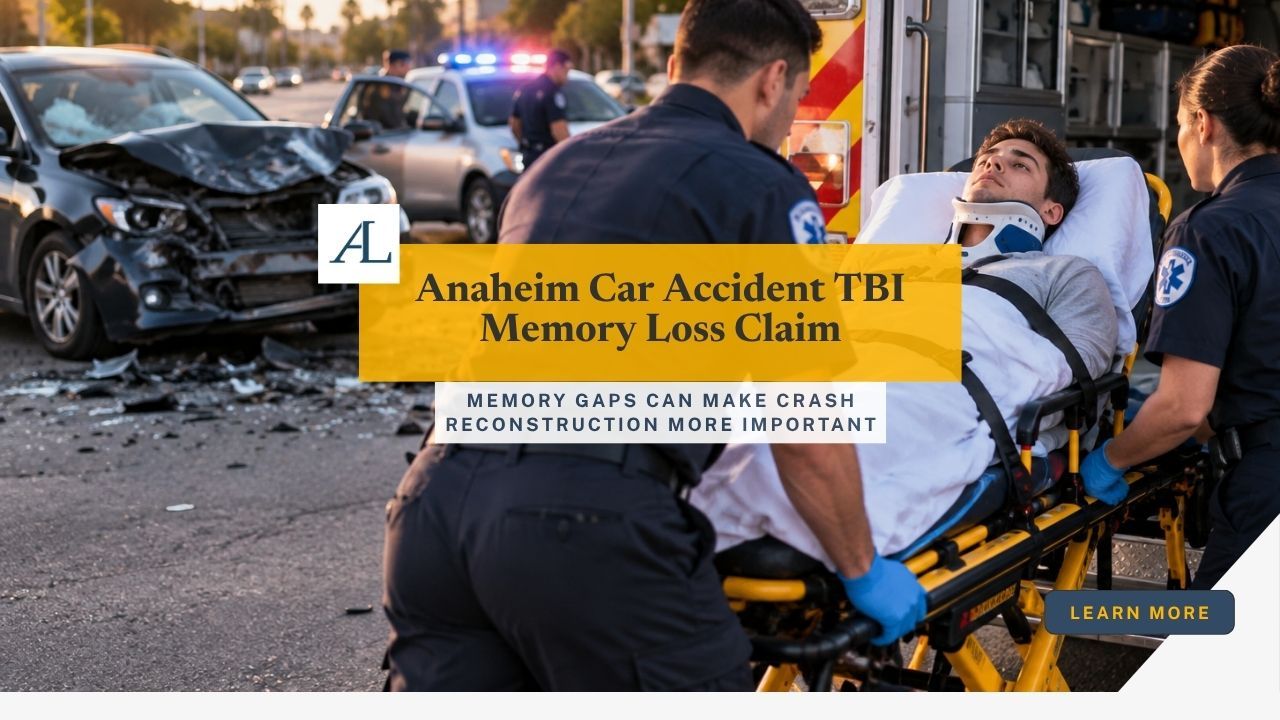
An Anaheim car accident TBI memory loss claim can become complicated quickly because the injured person may not remember the moments before, during, or after the collision. A crash can create a concussion, brain injury, or other cognitive symptoms that make it hard to explain what happened, who hit whom first, or how the vehicles ended up where they did. That memory gap does not mean the person is being inconsistent on purpose. It may mean the injury itself affected recall. MedlinePlus explains that traumatic brain injury can cause problems with thinking, memory, and daily function, which is why the claim should be built around objective evidence as well as the injured person’s symptoms. You can review that resource here: MedlinePlus traumatic brain injury.
When a crash leaves you or someone you love injured, choosing the right legal representation matters. An experienced Anaheim car accident lawyer at Avrek Law Firm can help preserve evidence, reconstruct the crash, and pursue the compensation you deserve.
Call 866-598-5548, start a live chat, or request a free case review today. There are no upfront fees, and you do not pay unless we win.
Why a Memory Gap Changes the Accident Investigation
An Anaheim car accident TBI memory loss claim often requires a different kind of investigation because the injured person may not be able to tell the whole story from memory alone. That means the claim has to rely more heavily on other sources of proof, including witness accounts, vehicle data, scene photos, and medical notes. The goal is to rebuild the sequence of events without forcing the injured person to guess about details they cannot remember.
This is especially important because insurers may try to treat a memory gap as if it were a contradiction. A person may say they remember driving to Anaheim, but not the moment of impact, and that can be completely consistent with a head injury. The issue is not whether the injured person can recite every detail. The issue is whether the crash caused the memory loss and whether the rest of the evidence supports the claim.
Difficulty Describing the Events Before or During the Collision
One of the first challenges in an Anaheim car accident TBI memory loss claim is that the injured person may not be able to describe what happened right before the collision. They may remember traffic, a light, a turn, or a sound, but then the memory stops. That missing section of the timeline can be one of the strongest signs that a head injury occurred.
A person may also have trouble identifying whether they were slowing, stopping, changing lanes, or bracing for impact. They may only know they were hurt and confused afterward. That is why early interviews should focus on what the person actually remembers, not on what an insurer hopes they will fill in later.
Confusion Recorded by First Responders or Emergency Providers
First responders and emergency providers may note confusion, disorientation, or memory trouble in the early records of an Anaheim car accident TBI memory loss claim. Those notes can become very important because they show the memory problem was noticed right after the crash, not invented later.
Emergency records may describe whether the person knew their name, the date, the location, or what had happened. If the record shows slowed responses, confusion, or trouble recalling details, that can help support the link between the crash and the cognitive symptoms.
Why Early Statements May Be Incomplete Rather Than Intentionally Inconsistent
Insurance companies sometimes point to early statements and say the injured person changed their story. In an Anaheim car accident TBI memory loss claim, that is often the wrong interpretation. An early statement may be incomplete simply because the person had not yet regained full memory or was still dealing with shock, pain, or medication effects.
That is why the timing of the statement matters. A short early account can be accurate even if it is not complete. The claim should not be judged by whether the person could provide perfect detail immediately after the collision.
Independent Evidence That Can Reconstruct the Crash
Because memory may be limited, an Anaheim car accident TBI memory loss claim should focus heavily on independent evidence. The crash scene, the vehicles, the people who saw it, and the data left behind can all help explain what happened. The more objective evidence that is preserved, the stronger the claim may become.
The point is not to replace the injured person’s account. It is to build a full picture around it.
Witnesses, Passengers, and Statements From Other Drivers
Witness statements can be crucial in an Anaheim car accident TBI memory loss claim because they may fill in the missing pieces of the event. A witness may have seen a vehicle run a light, drift across lanes, brake suddenly, or strike the injured person’s car from behind. A passenger may remember the sound, the motion, or the sequence before the crash. Another driver may have seen the final moments from a different angle.
These statements should be collected quickly because memory fades fast. Even if a witness only saw part of the collision, that can still help reconstruct the timeline.
Dashcams, Traffic Cameras, Business Video, and Phone Recordings
Video can be one of the strongest forms of evidence in an Anaheim car accident TBI memory loss claim. Dashcams may capture the vehicles before impact. Traffic cameras may show the flow of traffic. Business surveillance may show the crash scene or the moments before it. Phone recordings can sometimes capture what happened immediately afterward.
A short clip can resolve disputes about timing, lane position, and who had the right of way. That is why nearby video sources should be identified right away before the footage is deleted or overwritten.
Vehicle Data, Navigation History, and Final Vehicle Positions
Vehicle data can also help reconstruct an Anaheim car accident TBI memory loss claim. In some vehicles, event data may show speed, braking, or the sequence of impact. Navigation history may help establish where the injured person was headed and when the trip started. Final vehicle positions and damage locations can help explain how the collision unfolded.
If the vehicle was pushed into another lane, struck from behind, or spun across the roadway, those details may help match the physical evidence to the injury symptoms. The claim should gather all of that before repairs begin.
Medical Documentation of Post-Crash Memory Problems
Medical documentation is one of the most important parts of an Anaheim car accident TBI memory loss claim because the memory issue itself is part of the injury. The claim should show not only that the person was in a crash, but also that the crash caused symptoms that affected orientation, recall, and daily thinking.
Those records may come from the emergency room, follow-up appointments, neurology visits, therapy, or even family observations that were later reported to a provider.
Emergency Notes Describing Orientation and Recall
Emergency notes can be especially useful in an Anaheim car accident TBI memory loss claim because they may show the injured person had trouble with orientation right away. The record may mention whether the person knew where they were, what day it was, or what had happened. It may also note confusion, slowed speech, or trouble answering questions.
These details help establish that the memory gap was present immediately after the crash. That can make it much harder for an insurer to claim the memory loss was unrelated.
Follow-Up Evaluations for Cognitive or Neurological Symptoms
Follow-up evaluations can show whether the memory problems continued after the first visit. In an Anaheim car accident TBI memory loss claim, a provider may document headaches, dizziness, trouble concentrating, slower processing, sleep disruption, or memory issues that persisted after the crash.
Those records matter because cognitive symptoms may continue even after the person leaves the hospital. A doctor, neurologist, or therapist may notice the injury affects more than recall. It may also affect focus, mood, or the ability to complete ordinary tasks.
Family Observations About Memory Changes After the Accident
Family members often notice memory changes before anyone else. In an Anaheim car accident TBI memory loss claim, a spouse, parent, sibling, or caregiver may observe that the injured person repeats questions, forgets appointments, loses track of conversations, or seems more confused than before the crash.
Those observations can be important when they are shared with a medical provider or documented in a statement. Family observations do not replace medical evidence, but they can help show the memory change was real and noticeable.
Insurance Issues When the Injured Person Cannot Give a Complete Account
Insurance companies often become skeptical when the injured person cannot remember the crash. In an Anaheim car accident TBI memory loss claim, they may ask for a recorded statement too soon, point to gaps in the story, or argue that the crash did not cause the cognitive symptoms. Those disputes can be unfair if the memory issue is part of the injury itself.
The claim should be handled carefully so the injured person is not pressured into guessing.
Recorded Statement Requests Before Memory Symptoms Are Evaluated
Recorded statement requests can be risky in an Anaheim car accident TBI memory loss claim because the injured person may not yet understand the full extent of the memory problem. An adjuster may ask what happened right before the crash, how fast traffic was moving, or which vehicle hit first. If the person cannot remember those details, the insurer may later treat that as a weakness.
It is better to wait until the medical picture is clearer and the available evidence has been reviewed.
Challenges Based on Gaps or Differences in the Claimant’s Story
Insurers may also challenge an Anaheim car accident TBI memory loss claim by pointing to gaps or differences in the claimant’s story. But a gap in memory is not the same thing as a false statement. The injured person may simply not have full recall because of the injury.
The stronger response is to support the claim with emergency notes, witness statements, video, and vehicle data so the case does not depend entirely on memory.
Disputes Over Whether the Crash Caused the Cognitive Symptoms
The insurer may argue the memory problems came from stress, medication, dehydration, or a prior condition. In an Anaheim car accident TBI memory loss claim, that argument should be tested against the medical record, the timing of the symptoms, and the crash mechanics.
If the memory problems began immediately after the collision and were recorded by medical providers, that evidence can help prove causation.
What the Injured Person Should Save Right Away
An Anaheim car accident TBI memory loss claim should be backed by as much immediate evidence as possible. The injured person or a family member should try to save crash photos, witness names, medical paperwork, insurance letters, appointment notes, and any communication about the scene or the trip. If there is video, it should be preserved quickly.
California DMV says the SR-1 report generally must be filed within 10 days if someone is injured or killed, or if property damage is over $1,000. You can review that requirement here: California DMV SR-1 Accident Reporting.
That reporting step should happen even if the injured person cannot remember the crash clearly. The paperwork can help establish the timeline and keep the claim moving.
Frequently Asked Questions About an Anaheim Car Accident TBI Memory Loss Claim
What should I do if I cannot remember the crash?
If you cannot remember the crash, tell your doctor right away and make sure the memory loss is documented. In an Anaheim car accident TBI memory loss claim, the medical record and independent evidence are often more important than memory alone.
Does memory loss mean I have a brain injury?
Not always, but it can be a sign of one. A concussion or traumatic brain injury can affect recall, focus, and orientation. Medical evaluation is the best way to determine what happened.
What evidence helps most if I cannot describe the collision?
Witness statements, dashcam footage, traffic cameras, business video, vehicle data, and final vehicle positions can all help reconstruct the crash. Those sources can be especially important in an Anaheim car accident TBI memory loss claim.
Why do insurers question these claims so much?
Because memory gaps make it harder to reconstruct the crash. Insurers may try to use that uncertainty to their advantage, which is why the claim should be supported with objective evidence and medical documentation.
How long do I have to file a claim in California?
Many California injury claims are subject to a two-year deadline under California Code of Civil Procedure Section 335.1.
Do I need a lawyer for a TBI memory-loss claim?
Yes, especially if your memory is incomplete, the insurer is asking for a recorded statement, or video evidence needs to be preserved. An Anaheim car accident lawyer can help organize the evidence and protect the claim.
Call or Contact Avrek Law Firm 24/7 for a Free Consultation and Pay Nothing Unless We Win
An Anaheim car accident TBI memory loss claim can become difficult when the injured person cannot remember the crash, the insurer questions the story, or critical evidence is at risk of disappearing. These cases often depend on emergency records, witness accounts, camera footage, vehicle data, family observations, and fast action before the evidence is lost.
Avrek Law Firm helps injured drivers and families after serious motor vehicle crashes throughout Anaheim and Orange County. Our team can move quickly to preserve evidence, document the cognitive symptoms, track insurance communications, and pursue compensation for medical bills, lost income, pain and suffering, future care, and long-term recovery needs.
If you or someone you love was injured in an Anaheim crash and cannot remember what happened, Avrek Law Firm is ready to help.
Call 866-598-5548, start a chat, or complete our online form today for a free, no-obligation consultation. There are no upfront fees, and you do not pay unless we win.
Serving the Anaheim Community
Avrek Law Firm represents injured people throughout Anaheim and surrounding Orange County communities. Local context matters in an Anaheim car accident TBI memory loss claim because the roadway, traffic pattern, and crash location can shape the evidence.
A crash near the 5, 57, or 91 corridors, near Disneyland-area traffic, hotel zones, commercial driveways, or busy surface streets may involve lane changes, sudden stops, or driver mistakes that should be documented quickly. If the crash happened near a business entrance, rideshare pickup zone, or a crowded intersection, camera footage and witness accounts may be especially important.
An Anaheim car accident lawyer can help make sure the evidence is preserved before it is lost, and a Anaheim personal injury lawyer can help document the full impact of the injuries on work, mobility, and daily life.
- 📩 Submit a request through our online form
- 📞 Call 866-598-5548 now to speak with our team
- 💬 Start a live chat for immediate assistance
There are no upfront fees, and you don’t pay unless we win.