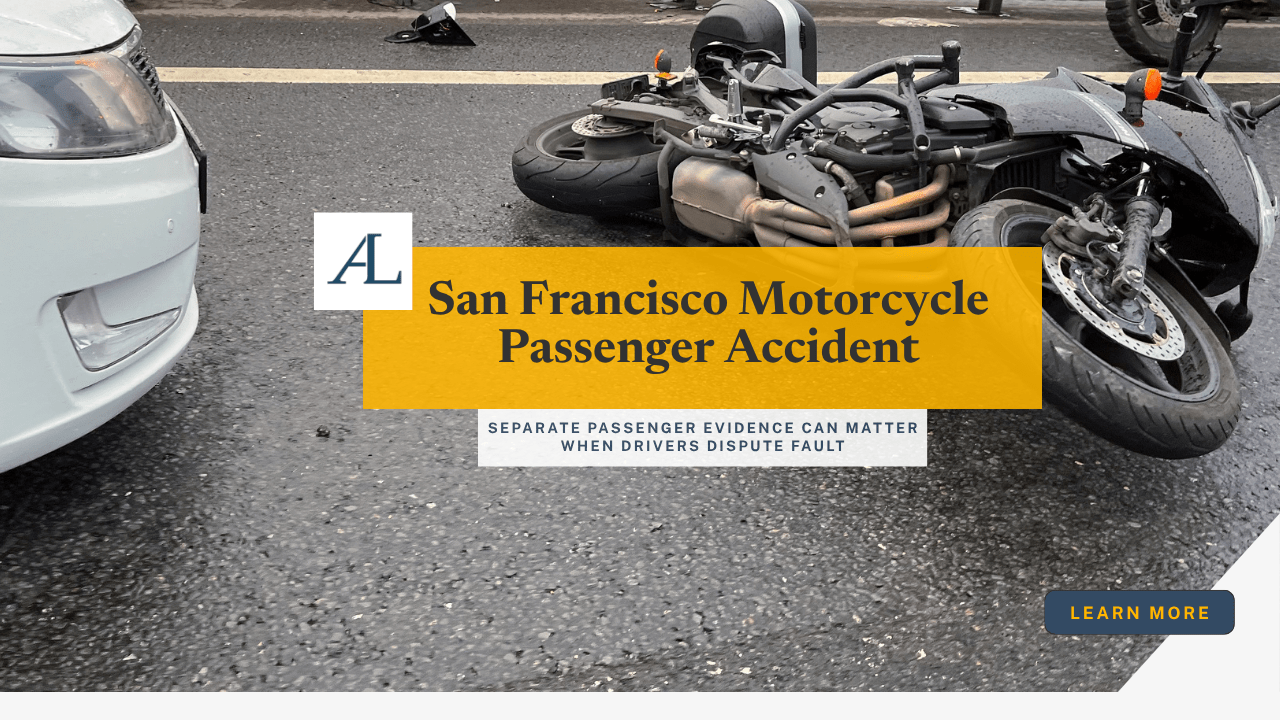
A San Francisco motorcycle passenger accident can become legally complicated when the motorcycle operator and the other driver each insist that the other caused the collision. The injured passenger may have had no control over either vehicle, yet may be pulled into competing insurance narratives about speed, lane position, signaling, braking, right-of-way, or which driver made the first unsafe move. That makes it especially important to separate the passenger’s own evidence and injuries from the claims made by the two drivers.
A motorcycle passenger often occupies a very different position from either operator. The passenger may have seen the roadway differently, may have noticed a vehicle approaching from the side, or may remember only part of the sequence because the passenger was seated behind the motorcycle operator. A San Francisco motorcycle passenger accident should therefore preserve the passenger’s independent account without forcing it to align with either driver’s version.
California DMV’s Motorcycle Handbook emphasizes that motorcycles are smaller and less visible than passenger vehicles and that riders face different risks in traffic. California DMV guidance for motorists also reminds drivers to look carefully for motorcycles because their size can make speed and distance harder to judge. Those visibility issues can become central when the drivers dispute who entered whose path.
A San Francisco motorcycle passenger accident may involve several potential insurance sources. The motorcycle operator may have liability coverage, the other driver may have liability coverage, and the passenger may also have access to other applicable coverage depending on the facts and policies involved. The California Department of Insurance Auto Insurance Guide provides general information about California auto insurance, but the actual coverage available in a specific motorcycle passenger case depends on the policy language and circumstances.
The passenger’s legal position should not be reduced to choosing which driver to believe. A San Francisco motorcycle passenger accident should be reconstructed from physical evidence, video, vehicle damage, witness statements, police records, roadway conditions, and the passenger’s own account. The two drivers may disagree sharply while objective evidence points toward one driver, both drivers, or another contributing factor.
When an injured motorcycle passenger is caught between competing fault allegations, an experienced San Francisco personal injury lawyer, motorcycle accident lawyer, and car accident lawyer at Avrek Law Firm can help preserve evidence, separate the passenger’s claim from the drivers’ disputes, and document the medical and financial losses caused by the crash.
Call 866-598-5548, start a live chat, or request a free case review today. There are no upfront legal fees, and you do not pay unless we win.
Keeping the Passenger’s Account Separate From the Drivers’ Accounts
A San Francisco motorcycle passenger accident should begin by preserving the passenger’s version of events before repeated insurance interviews, conversations with the drivers, or later discussions change the way the sequence is remembered. The passenger may not have a complete view of the road, but the observations that were actually made can still be important.
The goal is not to force the passenger into a reconstruction role. The passenger should describe what was seen, heard, felt, or remembered without guessing about exact speed, distances, or legal fault. A statement such as “I saw the car move toward us before impact” is more useful than an unsupported estimate about miles per hour or who legally had the right-of-way.
Passenger Seat Position and View of the Collision
The passenger’s seat position affects what could be observed. A San Francisco motorcycle passenger accident may involve a passenger seated directly behind the operator, where the driver’s body, helmet, or motorcycle equipment blocks part of the forward view. The passenger may have had a better view to one side than the other or may have noticed another vehicle only when it entered peripheral vision.
The motorcycle itself should be documented to show the passenger configuration. Seat height, passenger pegs, backrest, top case, luggage, and the operator’s seating position may all affect visibility. Photographs can help explain why the passenger could or could not see a particular part of the collision.
The passenger should also describe whether the motorcycle was traveling straight, turning, changing lanes, slowing, accelerating, or stopped before impact. A San Francisco motorcycle passenger accident may involve a passenger who remembers a sudden lean, braking maneuver, horn, or vehicle movement even if the passenger never clearly saw the other driver.
These observations should be preserved independently from the operator’s account. The passenger does not need to adopt the motorcycle driver’s version merely because they were traveling together.
What the Passenger Observed Before and During Impact
A San Francisco motorcycle passenger accident may involve important sensory details. The passenger may have seen the other vehicle’s turn signal, brake lights, lane position, or movement into the motorcycle’s path. The passenger may have heard the operator brake, shout, or sound the horn. The passenger may also remember whether the motorcycle changed direction immediately before contact.
The timing of those observations should be documented as accurately as possible. “I saw the car as it started turning” is different from “I saw the car several seconds earlier.” Small timing differences can matter when reconstructing the collision.
The passenger may also remember multiple impacts. A motorcycle can strike a vehicle and then fall, slide, or collide with another object. The passenger may hit the motorcycle, another vehicle, the roadway, a curb, a parked car, or roadside infrastructure. A San Francisco motorcycle passenger accident should document the complete impact sequence because different injuries may result from different parts of the crash.
Memory gaps should also be acknowledged. A passenger with a head injury may remember only part of the event. It is better to document that limitation than to fill the missing time with assumptions.
Why the Passenger Had No Control Over Either Vehicle
One of the most important distinctions in a San Francisco motorcycle passenger accident is that the passenger did not steer, brake, accelerate, or control the other vehicle. The passenger may have chosen to ride on the motorcycle, but that does not mean the passenger controlled how the operator responded to traffic.
Insurance companies may attempt to involve the passenger in fault discussions because the passenger knew the motorcycle driver, was riding socially, or was traveling with the operator. Those relationships should be separated from the actual collision conduct.
The passenger’s conduct can still matter in limited circumstances, but the central liability questions usually concern how the motorcycle operator and the other driver operated their vehicles. A San Francisco motorcycle passenger accident should therefore focus on the actions of the people who controlled the vehicles while preserving the passenger’s own observations and injuries separately.
Evidence That Can Help Resolve the Drivers’ Dispute
A San Francisco motorcycle passenger accident involving competing driver accounts should be reconstructed with objective evidence whenever possible. The more strongly the two drivers disagree, the more important physical and digital records become.
The investigation may include motorcycle damage, vehicle contact points, dashcams, helmet cameras, traffic cameras, business surveillance, witnesses, police diagrams, debris, roadway marks, and final resting positions. No single piece of evidence automatically determines fault, but several independent sources can establish a consistent sequence.
Motorcycle and Vehicle Contact Points
Damage patterns can help identify how the motorcycle and vehicle came together. A San Francisco motorcycle passenger accident may involve front-wheel or fork damage, side damage to the motorcycle, crushed passenger pegs, fairing damage, exhaust damage, or contact marks near the passenger seating area.
The other vehicle should also be photographed comprehensively. Damage to the front bumper may suggest a different collision sequence from damage concentrated along a side door or rear quarter panel. Paint transfer, scrapes, dents, broken lights, wheel marks, and mirror damage can all help locate the first contact.
The motorcycle should be preserved before repair or disposal when the impact sequence is seriously disputed. Repair shops may remove bent parts, replace forks, discard fairings, or straighten components that contain useful evidence.
A San Francisco motorcycle passenger accident should also document damage to the passenger area. Passenger pegs, grab handles, seat components, luggage, or other parts may show how the passenger moved during impact.
Helmet Cameras, Dashcams, Traffic Cameras, and Witnesses
Video can become some of the strongest evidence when both drivers dispute fault. A motorcycle helmet camera may show the other vehicle entering the lane, while a car dashcam may capture the motorcycle’s approach from another perspective.
The complete original recording should be preserved rather than only the impact clip. Earlier footage may show lane position, traffic lights, turn signals, speed changes, or interactions between the vehicles before the collision.
San Francisco’s dense urban environment may also provide business or building surveillance. A San Francisco motorcycle passenger accident at an intersection may be visible from multiple cameras even if no single camera captures the entire sequence.
Witness accounts should be collected independently. Another motorist, cyclist, pedestrian, transit rider, business employee, or resident may have seen the crash. The witness should describe what was actually observed rather than being told that one driver was at fault before giving the statement.
Police Diagrams, Debris, and Final Resting Positions
Police reports can provide diagrams, witness names, driver statements, citations, vehicle positions, and other early information. A San Francisco motorcycle passenger accident should preserve the report and any supplemental records that may become available.
The diagram should be compared with photographs and other evidence because diagrams are often simplified representations rather than full reconstructions.
Debris can help identify the impact location. Broken motorcycle components, glass, vehicle trim, fluid, or personal property may mark where contact occurred. Roadway gouges and scrape marks can also help show where the motorcycle fell or slid.
Final resting positions are useful but should be interpreted cautiously. The motorcycle may slide a substantial distance after impact, while the passenger may separate from the motorcycle. Vehicles can also be moved before police photographs are taken.
Insurance Policies That May Contact the Passenger
A San Francisco motorcycle passenger accident can generate contact from several insurance carriers. The motorcycle operator’s insurer may open one claim, the other driver’s insurer may open another, and the passenger may receive inquiries from each company asking for statements, medical records, or settlement discussions.
The passenger should keep each claim separate and maintain a record of the insurer, adjuster, claim number, and communications. The passenger should not assume that an insurer contacting them is acting solely in the passenger’s interest.
Motorcycle Operator Coverage and Other Driver Coverage
The motorcycle operator may carry liability coverage that becomes relevant if the operator contributed to the collision. The other driver’s liability insurance may also apply if that driver caused or contributed to the crash.
A San Francisco motorcycle passenger accident can therefore involve claims against one or both drivers depending on the evidence. The passenger does not need to decide immediately which driver caused the crash before the evidence is fully investigated.
The actual policy language and limits should be identified. The California Department of Insurance Auto Insurance Guide provides general information about liability and other vehicle insurance coverage in California, but individual policies must be reviewed separately.
Additional coverage may exist when a vehicle was owned by another person, used for work, rented, leased, or covered under another applicable policy. Those possibilities should be investigated before settlement.
Vehicle Ownership and Household Policy Questions
The motorcycle may be owned by the operator, another family member, a business, or another person. The other vehicle may likewise have an owner who was not driving at the time of the collision.
A San Francisco motorcycle passenger accident should identify both the driver and owner of each vehicle because ownership can affect insurance and other legal questions.
Household policies may also require review. The passenger may have auto insurance through another household vehicle, and the relevance of that coverage depends on the specific policy and facts.
The passenger should preserve insurance cards, declarations pages when available, claim letters, and any coverage-denial or reservation-of-rights communications.
Separate Statements, Claim Numbers, and Settlement Offers
Multiple insurers may ask the passenger for recorded statements. A San Francisco motorcycle passenger accident should maintain a separate communication log for each company so that the passenger knows who asked which questions and what information was provided.
The passenger should answer factual questions honestly but avoid guessing about speed, distance, right-of-way, or things that could not actually be seen from the passenger seat.
Separate settlement offers may also arrive. One insurer may offer payment while denying its driver caused the entire collision. Another may argue that the motorcycle operator was primarily responsible.
The release language should be reviewed carefully. A settlement with one party can sometimes contain broad language affecting claims against others, depending on the document. The passenger should understand exactly what is being released before signing.
Documenting the Passenger’s Individual Injuries
A San Francisco motorcycle passenger accident should document the passenger’s injuries independently from the motorcycle operator’s injuries. The passenger may experience a different impact, land in a different location, or suffer very different medical consequences.
The fact that the passenger and operator were on the same motorcycle does not mean their damages should be evaluated together.
Emergency Care, Surgery, Therapy, and Follow-Up Treatment
Motorcycle passengers can suffer fractures, head injuries, spinal injuries, shoulder injuries, knee trauma, soft-tissue injuries, nerve damage, road rash, internal injuries, or other conditions depending on the collision.
Emergency records should accurately describe the passenger’s role in the crash. A San Francisco motorcycle passenger accident should identify whether the passenger was thrown from the motorcycle, pinned, struck by another vehicle, or injured during the slide.
Preserve ambulance records, emergency-room notes, imaging, surgery records, specialist treatment, physical therapy, occupational therapy, prescriptions, and follow-up recommendations.
Symptoms that appear after the initial emergency visit should be reported to medical providers. The passenger should not assume that later pain, dizziness, numbness, or other symptoms are unimportant merely because they were not immediately documented.
Helmet, Clothing, Gear, and Personal Property Damage
The passenger’s helmet should be photographed and preserved when possible. Scrapes, cracks, impact marks, or damage to the face shield can help document the passenger’s contact with the roadway or another object.
A San Francisco motorcycle passenger accident may also damage jackets, gloves, boots, pants, phones, watches, bags, glasses, and other property. Protective motorcycle gear can be expensive, and replacement costs should be documented.
The passenger should avoid discarding damaged gear before photographs and insurance documentation are complete.
Personal-property damage can also support the collision reconstruction. Marks on one side of a helmet or jacket may correspond with the passenger’s impact direction, although qualified professionals should interpret the evidence when necessary.
Missed Work, Transportation Loss, and Daily Limitations
The passenger may miss work because of hospitalization, appointments, surgery, pain, medication effects, or physical restrictions. A San Francisco motorcycle passenger accident should preserve pay statements, work schedules, employer communications, disability notes, and records of reduced hours or modified duty.
Transportation can become another problem. The injured passenger may be unable to drive or use public transportation normally during recovery. Rideshare, taxi, rental, transit, or family transportation expenses should be documented.
Daily activities may also change. The passenger may need help bathing, dressing, preparing meals, caring for children, shopping, cleaning, or climbing stairs.
Specific examples make the claim clearer. Rather than simply saying life became harder, the San Francisco motorcycle passenger accident claim should show what tasks changed and for how long.
When Both Drivers Blame Each Other
A San Francisco motorcycle passenger accident can become particularly frustrating when each driver’s insurer insists that the other driver caused the crash. The passenger may receive letters or calls describing completely different versions of the same event.
The passenger should not feel compelled to resolve that dispute personally. Liability can be investigated through objective evidence, and more than one driver may potentially share responsibility depending on the circumstances.
One insurer may claim the motorcycle was speeding, lane splitting unsafely, or changing lanes. Another may claim the car turned, merged, or entered the motorcycle’s path. These allegations should be compared with video, vehicle damage, witnesses, traffic controls, and physical evidence.
The passenger’s lack of control over the vehicles remains an important distinction. A San Francisco motorcycle passenger accident should protect the passenger’s separate interests rather than allowing the claim to become merely a dispute between the motorcycle operator and the other driver.
What to Do After a Motorcycle Passenger Accident in San Francisco
Seek medical attention first. Motorcycle crashes can cause significant injuries even when the passenger initially feels able to stand or speak.
When safe, photograph the motorcycle, other vehicle, license plates, roadway, traffic signals, lane markings, damage, debris, skid or scrape marks, and surrounding cameras.
A San Francisco motorcycle passenger accident should also preserve the passenger’s helmet and gear, obtain witness contact information, and save any phone photographs or video from the scene.
The passenger should request the police report information and maintain separate records for each insurance claim.
Avoid extensive speculation in recorded statements. Describe only what you actually remember from the passenger seat.
Do not sign a release before understanding which drivers, vehicle owners, insurers, or other parties may be involved and what injuries or future treatment remain unresolved.
California Deadlines for a San Francisco Motorcycle Passenger Accident
California Code of Civil Procedure section 335.1 generally provides a two-year limitations period for many actions involving injury caused by another person’s wrongful act or neglect. The current California statutes are available through the California Code of Civil Procedure.
Different deadlines can apply depending on the defendants and circumstances, particularly when a public entity or government vehicle is involved.
A San Francisco motorcycle passenger accident should be investigated long before any filing deadline. Video can disappear, witnesses can become harder to find, motorcycles and vehicles can be repaired or destroyed, and damaged gear can be discarded.
The practical evidence-preservation deadline may therefore be measured in days or weeks rather than years.
Frequently Asked Questions About a San Francisco Motorcycle Passenger Accident
Can a motorcycle passenger bring a claim if both drivers blame each other?
Potentially, yes. A San Francisco motorcycle passenger accident may involve claims against one or both drivers depending on the evidence.
The passenger’s claim should be evaluated separately from the drivers’ competing accounts.
Does the passenger have to decide which driver was at fault?
No. The collision can be investigated using video, witnesses, police records, vehicle damage, roadway evidence, and other information.
The passenger should provide an accurate account without guessing about legal fault.
Can the motorcycle operator’s insurance cover the passenger?
Potentially, depending on the facts and policy. If the motorcycle operator contributed to the crash, applicable liability coverage may become relevant.
The actual insurance policy must be reviewed.
Can the other driver’s insurance also apply?
Yes, if the other driver caused or contributed to the collision. A San Francisco motorcycle passenger accident can involve more than one insurance claim.
What if the passenger could not see the road clearly?
That is common because the operator may block part of the passenger’s forward view. The passenger should explain exactly what could and could not be seen.
Limited visibility does not make the passenger’s observations useless.
What evidence is most helpful when the drivers disagree?
Helmet cameras, dashcams, traffic cameras, business surveillance, witness statements, vehicle and motorcycle damage, police diagrams, debris, and final positions can all help.
A San Francisco motorcycle passenger accident should preserve this evidence quickly.
Should the passenger give both insurers a recorded statement?
Use caution. Multiple insurers may ask similar questions while representing different interests.
The passenger should know who is requesting the statement and avoid guessing about details that were not actually observed.
Can the passenger have a separate lawyer from the motorcycle operator?
Potentially, and separate representation may be particularly important when the operator may share responsibility for the crash.
The passenger’s legal interests should be evaluated independently.
What if the motorcycle operator is my spouse, relative, or friend?
The personal relationship does not determine legal responsibility or insurance coverage.
A San Francisco motorcycle passenger accident should be investigated based on the evidence and policies involved.
Should damaged motorcycle gear be kept?
Yes, when possible. Preserve the helmet, jacket, gloves, boots, clothing, electronics, and other damaged property until documentation is complete.
Can a passenger recover lost wages?
Potentially, when the crash causes documented time away from work or reduced earnings.
Keep medical restrictions, employer records, schedules, and wage documentation.
What if both insurers deny responsibility?
A denial does not necessarily end the claim. The physical and digital evidence may support liability even when both carriers initially reject responsibility.
A San Francisco motorcycle passenger accident involving competing denials may require a more detailed investigation.
How long do I have to file a California motorcycle injury claim?
California Code of Civil Procedure section 335.1 generally provides two years for many personal injury actions, though different deadlines can apply.
Claims involving public entities can carry significantly shorter requirements.
Do I need a motorcycle accident lawyer?
Legal assistance can be particularly useful when both drivers dispute fault, several insurers are involved, or the motorcycle operator may share responsibility.
A San Francisco personal injury lawyer and motorcycle accident lawyer can help protect the passenger’s separate claim.
Call or Contact Avrek Law Firm 24/7 for a Free Consultation and Pay Nothing Unless We Win
A San Francisco motorcycle passenger accident can become complicated when the motorcycle operator and another driver each accuse the other of causing the crash. The injured passenger may have no control over that dispute, yet the outcome can affect which insurance policies respond and how quickly the claim moves forward.
The strongest approach is to preserve the passenger’s own evidence. The seat position, observations, helmet and gear, medical records, work losses, transportation changes, and daily limitations should be documented separately while the collision itself is reconstructed through video, witnesses, motorcycle and vehicle damage, police records, debris, and roadway evidence.
Avrek Law Firm can help investigate a San Francisco motorcycle passenger accident without treating the passenger as merely an extension of the motorcycle operator’s claim. Our team can communicate with the insurers, preserve evidence, identify potentially applicable policies, and document the passenger’s individual losses.
If you or someone you love was injured while riding as a motorcycle passenger in San Francisco and the drivers are disputing responsibility, call 866-598-5548, start a live chat, or complete our online consultation form today. Your consultation is free, and you do not pay unless we win.
Serving Injured Motorcycle Passengers Throughout San Francisco
A San Francisco motorcycle passenger accident may happen at an intersection, on a freeway approach, along a busy commercial corridor, or on a neighborhood street. The local setting can affect what evidence exists, including nearby cameras, witnesses, traffic controls, roadway markings, and police records.
San Francisco’s dense traffic environment can also create complicated collision sequences involving lane changes, turns, rideshare vehicles, delivery vehicles, buses, cyclists, and pedestrians. The passenger’s legal claim should focus on the specific evidence rather than assumptions about motorcyclists or drivers generally.
A San Francisco personal injury lawyer can help preserve local evidence while Avrek’s motorcycle accident lawyers address the driver dispute, insurance claims, medical documentation, and financial losses.
A San Francisco motorcycle passenger accident should ultimately be evaluated from the passenger’s independent perspective: what the passenger could see, what the evidence shows, which drivers or entities may be responsible, and how the crash affected the passenger’s health, employment, transportation, and daily life.
- 📩 Submit a request through our online form
- 📞 Call 866-598-5548 now to speak with our team
- 💬 Start a live chat for immediate assistance
There are no upfront fees, and you don’t pay unless we win.