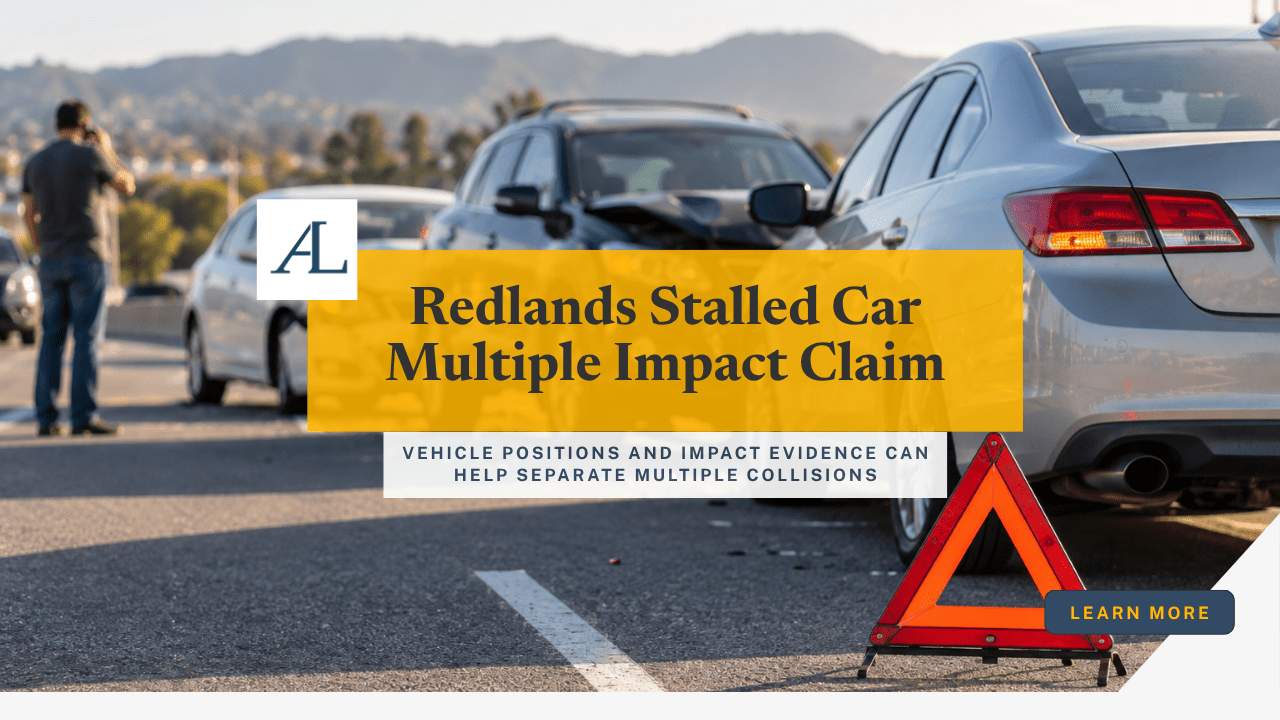
A Redlands stalled car multiple impact claim can become complicated almost immediately because the disabled vehicle may be struck once, moved into a new position, and then struck again by a different driver. The first impact may happen while the car is stopped in a traffic lane, on a shoulder, near an intersection, or beside the roadway. That collision may rotate the vehicle, push it into another lane, disable its lights, injure the occupants, or leave it exposed to a second impact before anyone can get to safety.
The insurance questions can become just as complicated as the crash sequence. One carrier may argue that the stalled driver created the danger by remaining in the roadway. Another may accept responsibility for the first impact but deny that it caused the most serious injuries. A later driver may claim the vehicle was impossible to see after the first collision changed its position or disabled its warning lights. A Redlands stalled car multiple impact claim should therefore be built around a precise timeline rather than a simplified statement that several cars were involved.
California’s official driving guidance tells motorists who must stop because of vehicle trouble to activate emergency flashers, pull off the road and away from traffic when possible, stop where the vehicle can be seen from behind if it cannot be moved completely off the roadway, and call for roadside help. The same guidance warns drivers not to stop just over a hill or around a curve where approaching traffic may have too little time to react. California DMV Emergency Flasher and Disabled Vehicle Guidance explains those recommendations.
Those precautions matter, but they do not automatically decide fault. A vehicle can stall without warning because of a mechanical failure, collision damage, overheating, electrical trouble, a tire problem, or another emergency. Even when the disabled driver could have taken an additional precaution, approaching motorists still have separate duties to use reasonable speed, maintain a prudent following distance, watch for hazards, and react to the roadway ahead. A Redlands stalled car multiple impact claim should examine every driver’s conduct independently.
This article focuses specifically on a stalled or disabled vehicle that is hit more than once. Avrek’s related article on Los Angeles multi-vehicle freeway accident claims explains broader chain-reaction disputes, while chain-reaction crashes and multi-car pileups addresses general fault allocation in multi-car collisions. The Redlands stalled car multiple impact claim adds the separate questions of why the first vehicle stopped, what warnings were available, and how the first collision changed the danger before the later impact.
When a disabled vehicle is struck repeatedly and someone is injured, choosing the right representation matters. A Redlands personal injury lawyer and car accident lawyer at Avrek Law Firm can help preserve the vehicles, electronic data, tow records, video, witness statements, medical documentation, and insurance communications before the sequence becomes harder to reconstruct. Avrek’s Redlands page lists auto-accident representation among the personal injury services offered in the area.
Call 866-598-5548, start a live chat, or request a free case review today. There are no upfront legal fees, and you do not pay unless we win.
Establishing Why and Where the Vehicle Stalled
A Redlands stalled car multiple impact claim should begin before the first collision. Investigators need to understand why the vehicle stopped, where it came to rest, whether the driver had any realistic opportunity to move farther from traffic, and what happened during the seconds or minutes before another vehicle arrived.
The reason for the stall can affect both liability and evidence. In a Redlands stalled car multiple impact claim, that background can explain whether the driver had any realistic opportunity to reach a safer position before traffic arrived. A sudden engine shutdown may leave the driver with little steering or acceleration. A prior collision may disable the car in the middle of an intersection. Heavy traffic may prevent the driver from reaching the shoulder. A mechanical defect may create a separate claim against a repair shop, manufacturer, owner, rental company, or maintenance provider. Those possibilities should be evaluated through records and physical evidence rather than assumptions.
Mechanical Problems, Traffic Conditions, or Prior Collision Damage
Mechanical problems can include engine failure, overheating, a dead battery, electrical loss, transmission trouble, tire failure, fuel problems, or a warning system that causes the vehicle to lose power. A Redlands stalled car multiple impact claim should preserve dashboard photographs, warning messages, diagnostic codes, maintenance records, tow-yard observations, and repair-shop findings before the vehicle is repaired or dismantled.
The driver should describe what happened in ordinary terms. They may have felt the engine lose power, seen warning lights, heard a noise, experienced steering difficulty, or noticed the vehicle would no longer accelerate. The driver should not guess at the technical cause. A qualified technician or engineer may need to evaluate the vehicle and records.
Traffic conditions can also explain why the driver could not move to a safer position. Stop-and-go congestion may surround the vehicle when it fails. A driver may attempt to coast toward the shoulder but become trapped by traffic. A vehicle may stall while waiting at a red light and remain exposed when the signal changes. These details matter because an insurer may later argue that the driver simply chose to stop in an unsafe place.
Prior collision damage creates another possible sequence. A small first incident may break a wheel, disable the engine, deploy airbags, or leave the vehicle immobile. A later driver may then strike the disabled car. In that situation, the Redlands stalled car multiple impact claim may involve a prior negligent driver, one or more later drivers, and different insurers disputing which impact produced which damage or injury.
Maintenance and repair history should be preserved even when the driver believes another motorist clearly caused the crash. An insurer may raise the stall itself as a fault issue. Complete records can show whether the vehicle had been serviced, whether a known defect existed, and whether the failure occurred without warning.
Travel Lane, Shoulder, Intersection, or Roadside Position
The exact resting position is critical in a Redlands stalled car multiple impact claim. A Redlands stalled car multiple impact claim should preserve both the original stall location and every later position created by impact. A vehicle stopped fully within a travel lane creates one type of hazard. A car partially on the shoulder and partially in traffic creates another. A vehicle disabled in an intersection, near a freeway ramp, around a curve, or at the crest of a hill may present different visibility and reaction-time questions.
Scene photographs should show the roadway from the perspective of each approaching driver. Wide images can preserve lane markings, curves, grades, traffic signals, streetlights, shoulders, medians, construction, parked vehicles, and surrounding businesses. Close photographs can document tire marks, fluid, debris, broken lighting, and the point where the disabled vehicle originally rested.
The location after the first impact may not match the location before it. A Redlands stalled car multiple impact claim should distinguish the pre-impact position from the final resting position. The first collision may push the stalled car several feet, rotate it across lanes, knock it off the shoulder, or move it into the path of another driver. A police diagram showing only the final scene may not capture that change.
Phone photographs, dashcams, traffic cameras, nearby surveillance, emergency calls, witness statements, and vehicle data can help establish the earlier position. Even a photograph taken by the stalled driver while waiting for help may become important because it shows the car before anyone struck it.
Roadway jurisdiction may matter too. A crash on I-10 or SR-210 may involve the California Highway Patrol, while a city-street crash may involve local law enforcement. The investigating agency, dispatch records, and tow response can help establish when the vehicle was reported and how long it remained exposed.
Hazard Lights, Signals, and Efforts to Warn Other Drivers
Warning efforts are frequently disputed in a Redlands stalled car multiple impact claim. A Redlands stalled car multiple impact claim should document which warnings existed before the first hit and which remained available afterward. The driver may say the hazard lights were on, while another motorist says no lights were visible. The first impact may damage the battery, lamps, wiring, or body panels and make the warning system stop working before the second impact.
The vehicle should be inspected before repair when lighting becomes important. Photographs may show illuminated flashers, broken lamps, disconnected wiring, or impact damage near the electrical system. Dashcam footage can show whether the lights flashed before the first impact and whether they remained visible afterward.
Other warning efforts may include tapping the brake pedal, using turn signals, calling 911, contacting roadside assistance, placing a warning triangle when safe, waving from a protected location, or asking another driver to help. The California Highway Patrol states that 911 may be used to report a stalled vehicle or debris blocking the roadway. CHP 911 Guidance can help explain why the timing and content of an emergency call may become relevant evidence.
A driver should not be blamed for refusing to stand in active traffic to place a warning device. Safety decisions must be evaluated in context. The person may have been injured, surrounded by fast-moving vehicles, unable to open a door safely, or advised by dispatch to remain inside. A Redlands stalled car multiple impact claim should examine what was reasonably possible, not what someone might imagine from a safe distance after the event.
Call logs, roadside-assistance records, text messages, photographs, and witness accounts can document these efforts. They can also show that the driver was actively trying to obtain help before the first or second collision occurred.
Reconstructing the Sequence in a Redlands Stalled Car Multiple Impact Claim
A Redlands stalled car multiple impact claim depends on separating the first collision from every later collision. The Redlands stalled car multiple impact claim should identify the time, direction, and physical result of each distinct contact. Occupants may feel several jolts within seconds and have difficulty identifying which vehicle struck when. A person may remember one loud impact but not realize another vehicle hit the opposite side. Airbags, confusion, pain, and moving traffic can make the sequence difficult to perceive.
Investigators should create a timeline using physical damage, video, audio, electronic data, witness accounts, police records, tow documents, and medical descriptions. The goal is not merely to identify the first driver. It is to determine how each impact changed the vehicle, occupants, and available reaction time for the next driver.
Which Vehicle Made the First Contact
The first contact often controls the rest of the sequence. A Redlands stalled car multiple impact claim should identify which vehicle approached first, its lane, speed, braking, and point of contact. The first driver may strike the rear of the stalled vehicle, clip a side, hit another car while swerving, or push the stalled car into a different lane.
Damage patterns can help. Rear crush on the stalled car may correspond with front damage on the first striking vehicle. Paint transfer, lamp fragments, bumper height, wheel damage, and scrape direction can link vehicles. When several vehicles have similar colors or overlapping damage, a qualified reconstruction professional may be needed.
Audio can also separate impacts. Dashcam footage may contain distinct collision sounds even when the camera does not show every vehicle. A witness may hear two or three impacts and remember the interval between them. Emergency calls may capture later impacts while the caller remains on the line.
The first driver may claim the disabled car appeared suddenly. That statement should be compared with sight distance, roadway lighting, traffic speed, hazard lights, and following distance. California Vehicle Code Section 22350 prohibits driving faster than is reasonable or prudent given traffic, visibility, weather, and road conditions, even when the driver is below the posted limit. California Vehicle Code Section 22350 provides the current statutory language.
How the First Impact Changed the Stalled Vehicle’s Position
The first collision may turn an already dangerous situation into a new hazard. A vehicle that was partly on the shoulder may be pushed fully into a lane. A car facing forward may rotate sideways. Hazard lights may fail. Debris may spread into adjacent lanes. Occupants may become trapped or disoriented.
A Redlands stalled car multiple impact claim should document the movement between impacts. That movement can determine whether the second driver had enough time and distance to react and whether the second impact was foreseeable or avoidable.
Video is often the strongest evidence, but physical clues can also help. Tire marks, gouges, fluid trails, debris patterns, wheel orientation, damaged guardrails, and final resting positions may show how the car traveled after the first contact. Police photographs taken before all vehicles were removed can preserve these details.
The first striking vehicle may also block visibility. A later driver might see only the first vehicle or a cloud of debris before reaching the stalled car. That does not automatically excuse the later driver. The later driver’s speed, following distance, lane choice, attention, and braking still require investigation.
California Vehicle Code Section 21703 requires drivers not to follow more closely than is reasonable and prudent given speed, traffic, and roadway conditions. California Vehicle Code Section 21703 may become relevant when a later driver was traveling too closely to stop after the first impact.
Damage Zones, Debris, and Final Resting Positions
Each impact can create a separate damage zone. A Redlands stalled car multiple impact claim may involve rear damage from the first vehicle, side damage from a later vehicle, and front damage when the stalled car is pushed into another object. Repair estimates and photographs should identify each area rather than treating the vehicle as one undifferentiated total loss.
Debris may also be traceable to particular impacts. Broken lights, bumper pieces, glass, wheel parts, and paint fragments can identify where contact occurred. Road crews often clear debris quickly, so scene photographs and police records become especially important.
Final resting positions show where the vehicles ended, not necessarily where the impacts began. Investigators should avoid assuming that a vehicle was struck exactly where it was photographed after the crash. The stalled car may have traveled through several positions.
Tow-yard intake photographs can preserve damage after the roadway is cleared. The tow company may also record where each vehicle was collected, whether wheels were locked, whether the engine would run, and whether the vehicle could be moved under its own power. Those details can help distinguish mechanical failure from crash damage.
A Redlands stalled car multiple impact claim should preserve every vehicle when the impact order is disputed. If one insurer repairs or destroys a vehicle before other parties can inspect it, valuable evidence may be lost.
Evidence That Can Separate the Collisions
A Redlands stalled car multiple impact claim should gather evidence from every available source because no single record may show the full sequence. In a Redlands stalled car multiple impact claim, several partial records may become persuasive when they are synchronized into one timeline. One dashcam may capture the first impact. A business camera may show the second. A witness may see the vehicle rotate. A police diagram may show final positions. Vehicle data may record more than one event.
The strongest claim combines these sources and clearly identifies what each one proves, what it does not prove, and where uncertainty remains.
Dashcams, Traffic Cameras, Witnesses, and Police Diagrams
Dashcams can show when the stalled vehicle became visible, whether hazard lights were operating, how traffic reacted, and which vehicle made first contact. Forward-facing and rear-facing cameras may capture different parts of the sequence. The complete original file should be preserved, including footage before and after the impact.
Traffic cameras and business surveillance may show the roadway from a wider perspective. A camera near a gas station, warehouse, restaurant, apartment building, intersection, or freeway ramp may capture the car stalling, the first collision, or the later impact. Requests should be sent quickly because many systems overwrite automatically.
Witnesses should be interviewed separately. A driver approaching from behind may see the hazard lights. A person in a nearby business may see the vehicle stop. A passenger may feel the first and second impacts differently. A tow operator may observe mechanical-failure evidence after the crash.
Police diagrams are helpful but may contain only final positions and brief statements. A Redlands stalled car multiple impact claim should compare the diagram with photographs, video, vehicle damage, and witness viewpoints. If the report lists the impact order incorrectly or omits a vehicle, supplemental evidence may be needed.
Avrek’s article on Los Angeles multi-vehicle freeway accident claims explains why chain-reaction cases require review of the full sequence rather than assuming the last driver caused everything. That same principle applies when a stalled car is struck, moved, and struck again.
Tow Records, Repair Records, and Vehicle Data
Tow records can establish when each vehicle left the scene, where it was stored, and who controlled it afterward. A Redlands stalled car multiple impact claim should preserve tow invoices, dispatch records, intake photographs, storage notices, release forms, and communications about salvage or repair.
Repair records can help separate damage zones. Initial estimates, supplements, teardown photographs, frame measurements, diagnostic scans, parts lists, technician notes, and final invoices may reveal damage that was not visible at the roadside. If the vehicle is declared a total loss, the insurer’s valuation file and salvage photographs should be retained.
Vehicle data may provide speed, brake status, accelerator input, changes in velocity, restraint information, or evidence of more than one recorded event depending on the vehicle and system. Not every vehicle stores the same information, and a standard repair scan is not the same as a forensic event-data retrieval.
Avrek’s related article on event data recorder evidence after a car accident explains how speed, braking, steering, and other vehicle information may help test competing accounts. A Redlands stalled car multiple impact claim may require data from the stalled vehicle and more than one striking vehicle.
Data preservation should occur before repairs, module replacement, battery disconnection, software updates, or disposal. A qualified professional may need to determine which systems should be downloaded and how to document the process.
Statements From Drivers and Passengers in Each Vehicle
Every driver may have a different view of the crash. The stalled driver may know why the vehicle stopped but not see the first vehicle approach. The first striking driver may see the stalled car but not know what happens after impact. A later driver may see only debris or a vehicle crossing lanes.
A Redlands stalled car multiple impact claim should keep those accounts separate. Each person should describe what they personally observed, heard, or felt. They should distinguish memory from information learned later through reports, video, or conversations.
Passengers can provide important detail. A passenger may remember hazard lights, an emergency call, the sound of a first impact, a pause, and then a second impact. Another may see a specific vehicle leave the scene. A passenger in the later vehicle may notice that the driver was following too closely or looking away.
Statements given at the scene, during medical treatment, and in recorded insurance calls should be compared carefully. Small differences may reflect shock, injury, or limited viewing angles rather than dishonesty. An insurer should not use one uncertain early statement to override objective evidence.
The driver of the stalled vehicle should avoid speculating about mechanical cause, exact speed, or impact force. Accuracy is more important than completeness. A Redlands stalled car multiple impact claim is stronger when the claimant acknowledges what they do not know and relies on evidence for the rest.
Insurance and Injury Questions After Multiple Impacts
A Redlands stalled car multiple impact claim may involve several insurers taking inconsistent positions. The Redlands stalled car multiple impact claim should therefore keep each carrier’s statements, evidence, and settlement position in a separate but coordinated file. The first driver’s insurer may accept liability for property damage but deny causing the most serious injury. The second driver’s insurer may argue that the first collision caused everything. The stalled vehicle’s insurer may investigate mechanical failure, collision coverage, towing, rental, and uninsured or underinsured motorist coverage.
The injured person may receive several recorded-statement requests and separate settlement offers. Each claim file should be tracked independently. Claim numbers, adjusters, policy limits, letters, emails, authorizations, and offers should be organized before any release is signed.
Competing Fault Positions From Several Insurers
Insurers often divide the crash in a way that protects their own policyholder. A Redlands stalled car multiple impact claim may prompt one carrier to blame the stalled driver for creating the hazard, another to blame the first striking driver for moving the car, and a third to argue that the later collision was unavoidable.
California’s comparative-fault system can allow responsibility to be allocated among multiple parties, but the allocation must be supported by evidence. The disabled driver’s conduct should not be treated as the only issue. Each approaching driver’s speed, attention, following distance, braking, lane position, and opportunity to avoid the hazard require separate analysis.
Mechanical failure may introduce additional parties. A repair shop, rental company, owner, employer, manufacturer, maintenance provider, or seller may need investigation if a defect or neglected repair caused the stall. That possibility does not relieve negligent approaching drivers of responsibility for later impacts.
A Redlands stalled car multiple impact claim should identify every available policy before settlement. Personal auto coverage, commercial coverage, vehicle-owner coverage, employer policies, umbrella policies, and uninsured or underinsured motorist coverage may all require review depending on the facts.
The claimant should not assume the first insurer to offer payment is the only responsible carrier. Accepting one settlement may affect claims against other parties if the release is broad.
Medical Records Describing the Collision Sequence
Medical records should describe the full impact history as accurately as possible. A person may be struck from behind, pushed sideways, and hit again from another direction. Different forces may contribute to neck, back, head, shoulder, chest, knee, hip, or other injuries.
A Redlands stalled car multiple impact claim can become harder when the emergency record mentions only “rear-ended” even though a later side impact also occurred. The patient should tell providers about every remembered impact, body movement, airbag deployment, interior contact, and loss of consciousness or confusion.
Symptoms may change after several impacts. The person may feel immediate pain after the first collision and worsening pain after the second. Others may not distinguish the impacts because they happen too quickly. Medical providers should document the patient’s genuine account without forcing false precision.
Insurers may ask which impact caused each injury. That question may require medical and reconstruction analysis. The injured person should not guess. The medical record can establish symptoms and findings, while qualified experts may evaluate causation when necessary.
Treatment records, imaging, therapy notes, work restrictions, medication history, and daily-function documentation can show how the injury developed. A Redlands stalled car multiple impact claim should connect these records with the crash timeline rather than allow insurers to isolate one impact and dismiss the rest.
Separate Settlement Offers and Release Language
Multiple insurers may make separate offers. One may offer to pay for rear damage. Another may offer a bodily-injury settlement for the later collision. A third may resolve towing or rental costs. The documents should be reviewed for language releasing all drivers, all insurers, or all claims arising from the event.
A Redlands stalled car multiple impact claim should not be settled before the claimant understands whether an offer addresses one impact or the entire sequence. A broad release signed in exchange for a modest payment from one carrier may jeopardize the ability to pursue another responsible party.
Settlement timing also matters medically. An early offer may arrive before specialists evaluate the injuries, before the vehicle data is preserved, or before the impact sequence is established. Once a claim is released, later-discovered treatment needs may not be recoverable.
The injured person should preserve the original offer, cover letter, release, check, email, and recorded communications. If the insurer describes the payment as applying only to property damage, the written language should match that representation.
A Redlands personal injury lawyer can help coordinate competing claims and determine whether settlement documents protect or surrender rights across the different impacts.
What to Do After a Stalled Car Is Hit More Than Once
Medical and roadway safety come first. A Redlands stalled car multiple impact claim is important, but no photograph or piece of debris is worth entering active traffic or ignoring emergency instructions. Call 911 when the vehicle blocks traffic, someone is injured, or another collision remains likely. CHP states that stalled vehicles blocking the roadway can be reported through 911, and callers should be ready to provide the freeway or street, direction, nearest ramp or cross street, and a description of the emergency.
If the vehicle can be moved safely before any collision, follow official guidance by using emergency flashers and pulling away from traffic when possible. After an impact, do not attempt to move through active lanes or stand beside the vehicle merely to collect evidence. Follow law-enforcement and emergency instructions.
When safe, photograph every vehicle, license plate, damage area, final position, lane, shoulder, hazard light, debris field, tire mark, road condition, sign, curve, hill, intersection, and visible injury. Record which photographs were taken before and after vehicles were moved.
A Redlands stalled car multiple impact claim should preserve the driver’s phone call to roadside assistance, 911 call, diagnostic warning, dashcam, messages, maintenance records, and towing information. Ask witnesses whether they saw the car stall, the first impact, or the later impact.
Seek medical evaluation and explain the multiple-impact sequence. Save discharge papers, imaging, referrals, bills, work restrictions, and follow-up records. Keep a separate log for each insurer and do not sign releases before the complete sequence and recovery picture are understood.
Reporting and Deadlines for a Redlands Stalled Car Multiple Impact Claim
California DMV requires an SR-1 within 10 days when someone is injured or killed or when property damage exceeds $1,000. The SR-1 is required in addition to any police, CHP, or insurance report. California DMV SR-1 Accident Reporting provides the current filing information.
A multi-impact crash may involve several vehicles, and the report should identify the known drivers, vehicles, insurers, date, location, and injuries accurately. The claimant should avoid guessing about the impact sequence when the investigation remains ongoing.
For many California personal injury actions, California Code of Civil Procedure Section 335.1 provides a two-year limitations period for injury caused by another person’s wrongful act or neglect. Different or shorter procedures may apply depending on the parties, including claims involving public entities.
A Redlands stalled car multiple impact claim should not wait for the filing deadline. Dashcam footage may be overwritten, vehicles may be repaired or salvaged, witnesses may become difficult to locate, and electronic data may be lost within days or weeks.
requently Asked Questions About a Redlands Stalled Car Multiple Impact Claim
What evidence is most important when a stalled car is hit more than once?
Important evidence may include photographs showing the vehicle before and after each impact, hazard-light evidence, 911 and roadside-assistance records, dashcams, traffic cameras, witness statements, police diagrams, tow records, repair records, event data, debris, final positions, and medical documentation.
A Redlands stalled car multiple impact claim should preserve evidence that separates the first collision from later collisions.
Is the stalled driver automatically at fault for being stopped in the roadway?
No. The reason the vehicle stopped, whether it could be moved, the roadway position, warnings, traffic conditions, and approaching drivers’ conduct all matter.
A sudden mechanical failure or prior collision may leave the driver with no safe alternative. Approaching drivers still must use reasonable speed, attention, and following distance.
What if the hazard lights stopped working after the first impact?
That fact should be documented through photographs, video, vehicle inspection, wiring damage, battery condition, and witness accounts.
A Redlands stalled car multiple impact claim may distinguish the warning available before the first impact from the warning available to a later driver after the vehicle was damaged.
Can more than one driver be responsible?
Yes. One driver may cause the first impact, while another driver may negligently cause a later impact that worsens the injuries or damage. Fault may also involve a vehicle owner, employer, commercial carrier, maintenance provider, or another party.
The evidence must show what each person did and how each collision contributed.
What if the first impact pushed my car into another lane?
The movement caused by the first impact is a central part of the claim. Video, damage, tire marks, debris, final positions, and witness accounts may help show that the car did not start in the location where the later driver struck it.
A Redlands stalled car multiple impact claim should not treat the final resting position as the original stall location.
How can medical records separate injuries from different impacts?
The patient should describe every remembered impact, movement, and symptom timeline accurately. Medical providers can document the history and findings, while qualified experts may evaluate which impacts caused or worsened particular injuries when that issue is disputed.
The claimant should not guess which collision caused each condition.
Can event data record more than one collision?
Some vehicles may preserve information associated with more than one qualifying event, but availability varies by vehicle, module, crash severity, and recording conditions.
A qualified retrieval and interpretation may help a Redlands stalled car multiple impact claim when impact order, braking, or vehicle movement is disputed.
Should I accept separate offers from different insurers?
Not before reviewing the release language and understanding which parties and claims each payment covers. One insurer may describe an offer as limited while the written release is much broader.
The full insurance picture, medical recovery, and impact sequence should be evaluated before settlement.
What if one of the later drivers leaves the scene?
Report the hit-and-run promptly and preserve every description, plate detail, dashcam clip, witness statement, traffic-camera source, and piece of vehicle debris.
Uninsured-motorist coverage may require review depending on the facts and policy terms.
How long do I have to file a California claim?
California Code of Civil Procedure Section 335.1 provides a two-year period for many personal injury actions. Other deadlines may apply depending on the parties and circumstances.
Evidence preservation should begin immediately even when the court deadline appears distant.
Do I need a lawyer for a stalled-car multiple-impact crash?
Legal help can be especially important when several insurers dispute the collision order, the first impact changed the vehicle’s position, mechanical failure is being blamed, or separate settlements are offered.
A car accident lawyer can help preserve the vehicles and digital evidence, identify coverage, and connect the collision sequence with the medical and financial losses.
Call or Contact Avrek Law Firm 24/7 for a Free Consultation and Pay Nothing Unless We Win
A Redlands stalled car multiple impact claim can become difficult when insurers disagree about why the vehicle stopped, which driver struck first, whether hazard lights were operating, and which impact caused the most serious injuries. These cases may depend on mechanical records, scene photographs, emergency calls, dashcams, traffic cameras, event data, damage zones, tow records, witness statements, medical documentation, and careful review of separate insurance policies.
Avrek Law Firm helps injured drivers and passengers investigate multi-vehicle collisions throughout Redlands and the surrounding Inland Empire. Our team can move quickly to preserve the disabled vehicle, identify every striking driver, obtain available footage and records, handle competing adjusters, and document the medical and financial impact of each collision.
An experienced legal team can evaluate a Redlands stalled car multiple impact claim before vehicles are repaired, data is overwritten, or an insurer pressures the injured person to sign a broad release. Prompt action can preserve the difference between the original stall position, the first impact, and the later collision.
If you or someone you love was injured after a stalled vehicle was struck more than once in Redlands, Avrek Law Firm is ready to help.
Call 866-598-5548, start a live chat, or complete our online consultation form today for a free, no-obligation case review. There are no upfront legal fees, and you do not pay unless we win.
Serving the Redlands Community
Avrek Law Firm represents drivers and passengers injured throughout Redlands and nearby San Bernardino County communities. A Redlands stalled car multiple impact claim may arise on I-10, SR-210, Redlands Boulevard, Lugonia Avenue, Alabama Street, Orange Street, University Street, or another roadway where a disabled vehicle remains exposed to traffic.
Local context can affect which agency responded, whether CHP or city police created the report, where the vehicles were towed, which businesses retained video, and whether Freeway Service Patrol or another roadside provider documented the stall.
A Redlands personal injury lawyer can help preserve local evidence and coordinate the collision investigation, while Avrek’s car accident lawyers can address the broader liability, medical, property, and insurance disputes.
A Redlands stalled car multiple impact claim should be investigated promptly. The disabled vehicle may be removed within minutes and repaired within days, but early evidence can show why it stopped, where it originally rested, and how each impact changed the scene.
- 📩 Submit a request through our online form
- 📞 Call 866-598-5548 now to speak with our team
- 💬 Start a live chat for immediate assistance
There are no upfront fees, and you don’t pay unless we win.