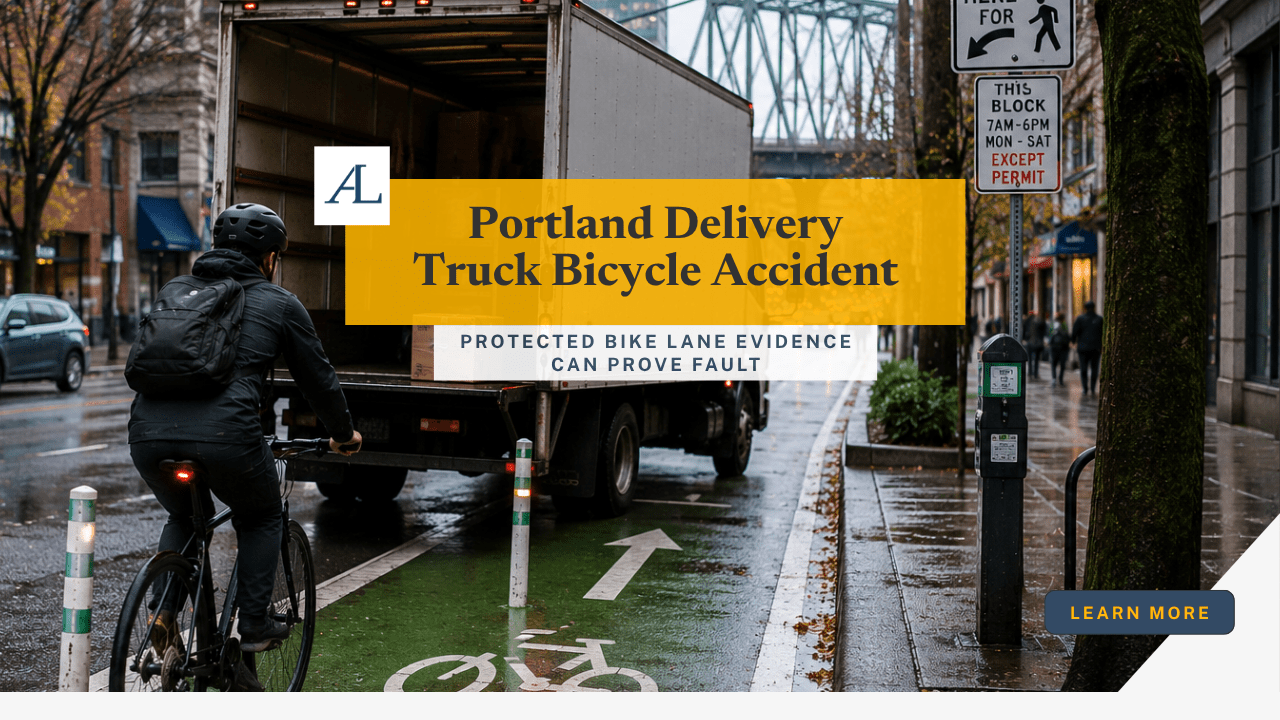
A Portland delivery truck bicycle accident claim can become complicated because protected bike lanes are supposed to separate cyclists from traffic, but delivery trucks can still create serious hazards when they block, cross, unload in, or turn across those lanes. Portland has built a strong bicycle network, including protected bike lanes, bike boxes, neighborhood greenways, and separated facilities designed to give riders safer routes through dense urban areas. Yet in busy delivery corridors, a single commercial truck stopped in the wrong place can force a cyclist out of a protected space and into moving traffic.
These crashes may happen in Downtown Portland, the Pearl District, Central Eastside, Lloyd District, South Waterfront, Northwest Portland, inner Southeast, near Naito Parkway, around bridge approaches, along commercial streets, or near restaurants, hotels, apartment buildings, offices, retail centers, and loading zones. A delivery truck may stop across a protected bike lane while unloading packages. A box truck may turn across a bike lane while entering a driveway. A freight driver may block the bike lane because the curbside loading space is occupied. A driver may open a cargo door, roll a hand truck into the bike lane, or pull away from the curb without checking for a rider.
A Portland delivery truck bicycle accident claim should never be treated as a simple bicycle accident. These cases may involve a commercial driver, a delivery company, a logistics contractor, a property owner, a business receiving deliveries, vehicle cameras, GPS records, delivery timestamps, insurance disputes, and Oregon bicycle laws. The crash may also involve public infrastructure, such as concrete separators, parking-protected bike lanes, curb extensions, signs, and lane markings. The strongest claim is built by documenting the full street environment before the delivery truck leaves and the bike lane returns to normal.
When a protected bike lane crash leaves you injured, choosing the right legal representation matters. An experienced Portland bicycle accident lawyer at Avrek Law Firm can investigate the delivery truck driver, preserve business and vehicle footage, identify commercial insurance coverage, review the protected bike lane layout, and pursue compensation for your injuries.
Call 866-598-5548, start a live chat, or request a free case review today. There are no upfront fees, and you do not pay unless we win.
Why a Portland Delivery Truck Bicycle Accident Claim Is Often More Complex Than a Regular Bike Crash
A Portland delivery truck bicycle accident claim is often more complex than a regular bike crash because protected bike lanes create a clear expectation that cyclists will have a separated or designated space to ride. When a delivery truck blocks that space, the rider may be forced into a sudden decision. They may brake hard, leave the lane, merge into traffic, ride around cargo, or squeeze between a truck and parked vehicles. If a crash follows, insurers may try to blame the cyclist without examining why the rider had to leave the protected lane in the first place.
Portland has made protected bike lanes a major part of its cycling infrastructure. PBOT explains that Portland had more than 50 miles of protected bike lanes as of 2024, and the bureau has been replacing plastic delineator posts with more permanent materials such as concrete traffic separators and concrete islands for parking-protected bicycle lanes. That local context matters because a Portland delivery truck bicycle accident claim may involve not only ordinary traffic rules, but also the way protected bike lanes are designed, maintained, and interrupted at driveways or loading zones.
A protected bike lane does not remove all danger. Delivery trucks still enter and cross bike lanes at driveways, alleys, curb cuts, intersections, and commercial loading areas. Some drivers may treat the bike lane as a temporary parking space, especially during rush deliveries or when curb access is limited. A Portland delivery truck bicycle accident claim should ask whether the driver had a lawful reason to enter the bike lane, whether the truck yielded to cyclists, whether the truck was stopped where parking was prohibited, and whether company pressure contributed to unsafe delivery behavior.
Delivery Trucks Can Block the Only Safe Path for Cyclists
A Portland delivery truck bicycle accident claim may begin with a delivery truck that did not hit the cyclist directly. The truck may have been stopped in a protected bike lane, parked across a buffer zone, or unloading across the rider’s path. The cyclist may then swerve into traffic, hit a separator, strike an open cargo door, collide with a pedestrian, or be struck by another vehicle while avoiding the obstruction. In these situations, the delivery truck’s role should still be investigated even if another vehicle made the final impact.
Commercial drivers often claim that the stop was brief, the hazard lights were on, or there was nowhere else to unload. Those explanations may not excuse the danger. Protected bike lanes exist because cyclists are vulnerable around larger vehicles, and a delivery truck can occupy a rider’s entire path. If the driver chose convenience over safety, a Portland delivery truck bicycle accident claim may involve negligence by the driver and possibly the delivery company.
The investigation should focus on the rider’s available choices. Was there enough room to pass safely? Was the traffic lane moving? Did the protected lane have concrete separators that made escape difficult? Did the truck block the lane near a driveway, bridge approach, or intersection? These details can show why the crash was not the rider’s fault.
Protected Bike Lanes Still Have Conflict Points
A Portland delivery truck bicycle accident claim often happens at conflict points where delivery trucks cross or enter the bike lane. These include driveways, alleys, loading docks, parking garage exits, hotel entrances, apartment service areas, restaurant delivery zones, and intersections. A protected lane may be physically separated for most of the block, but the protection may stop where vehicles must turn or cross.
This matters because a delivery truck driver may be allowed to cross a bike lane for certain movements, but that does not mean the driver can ignore cyclists already in the lane. Oregon law specifically addresses when motor vehicles may operate on a bicycle lane. ORS 811.440 allows a motor vehicle to operate upon a bicycle lane when making a turn, entering or leaving an alley, private road, or driveway, or when required in the course of official duty.
That rule can matter in a Portland delivery truck bicycle accident claim because it narrows the circumstances where a delivery truck may enter a bike lane. Even when a truck is entering a driveway or making a turn, the driver still has to perform that movement safely and watch for cyclists.
Insurers May Try to Blame the Cyclist for Leaving the Bike Lane
Insurers often argue that a cyclist caused their own crash by leaving the bike lane. In a Portland delivery truck bicycle accident claim, that argument may ignore Oregon law and the real-world danger created by the delivery truck. Oregon law does require cyclists to use a bicycle lane or path in certain situations, but it also recognizes exceptions when a rider is safely moving out of the lane to pass another bicycle, vehicle, or pedestrian, avoid debris or other hazardous conditions, prepare for turns, or continue straight where the lane is to the right of a mandatory right-turn lane.
This law is important because a delivery truck blocking a protected lane may be a hazardous condition. A cyclist forced out of the lane to avoid a truck, cargo door, pallet jack, debris, or parked delivery vehicle may have had a lawful and reasonable reason to move. A Portland delivery truck bicycle accident claim should document why the cyclist left the lane before an insurer can frame that movement as reckless.
Oregon Bicycle Lane Laws That May Affect a Portland Delivery Truck Bicycle Accident Claim
A Portland delivery truck bicycle accident claim may involve multiple Oregon traffic laws, including rules about yielding to riders in bicycle lanes, stopping or parking in bicycle lanes, unsafe passing, and comparative fault. These laws help frame the driver’s duties, but the facts still matter. A delivery truck driver may violate the law by blocking a bike lane, failing to yield while crossing the lane, or passing too closely after a cyclist is forced out of a protected lane.
ORS 811.050 states that a motor vehicle operator commits the offense of failure to yield to a rider on a bicycle lane if the driver does not yield the right of way to a person operating a bicycle, electric assisted bicycle, electric personal assistive mobility device, moped, motor assisted scooter, or motorized wheelchair upon a bicycle lane.
This rule can be central in a Portland delivery truck bicycle accident claim. A delivery driver crossing a bike lane to enter a driveway, alley, loading area, or parking lot may have to yield to a cyclist who is already approaching in that lane. If the driver misjudges the rider’s speed, fails to check the mirror, or turns across the bike lane, the driver’s failure to yield may become key evidence of fault.
Oregon Law Restricts Stopping and Parking in Bicycle Lanes
A Portland delivery truck bicycle accident claim may involve a truck that was stopped rather than moving. That distinction does not automatically protect the driver or company. ORS 811.550 lists places where stopping, standing, and parking are prohibited, and it specifically includes stopping, standing, or parking on a bicycle lane and on a bicycle path, subject to statutory exemptions.
This law can be especially important when a delivery truck parks in a protected bike lane while unloading. The driver may claim the delivery took only a few minutes or that the business had no loading dock. But if the truck was stopped in a place where stopping or parking is prohibited, that fact may support a Portland delivery truck bicycle accident claim. It may also show that the driver created a foreseeable hazard for cyclists who had to leave the lane or brake suddenly.
The evidence should show the exact location of the truck, the bike lane markings, signs, curb use, and any nearby loading zones. A photograph of the truck sitting inside the bike lane may be one of the strongest pieces of evidence in the case.
Motor Vehicles Are Not Free to Use Bicycle Lanes as Delivery Space
A Portland delivery truck bicycle accident claim may also involve the question of whether a truck was allowed in the bicycle lane at all. ORS 811.435 generally addresses operation of a motor vehicle on a bicycle lane or bicycle path, with exemptions provided under ORS 811.440. ORS 811.440 permits motor vehicle use of a bicycle lane for limited circumstances such as making a turn, entering or leaving an alley, private road, or driveway, or when required in official duty.
That framework matters because delivery work is not the same thing as a general right to occupy the bike lane. A driver may cross the lane to reach a loading dock or driveway, but parking in the bike lane, unloading across it, or using it as a staging area can create a different legal issue. A Portland delivery truck bicycle accident claim should examine whether the truck was briefly crossing the lane for a lawful movement or using the lane as part of its delivery operation.
Safe Passing Rules May Apply When Cyclists Are Forced Into Traffic
A Portland delivery truck bicycle accident claim may involve a rider who was forced out of a protected lane and then struck or sideswiped by a passing vehicle. ORS 811.065 states that a driver commits unsafe passing of a person operating a bicycle if the driver violates safe passing requirements. The statute defines safe distance, in relevant circumstances, as enough distance to prevent contact with the bicyclist if the bicyclist were to fall into the driver’s lane.
This rule may matter when a cyclist leaves a protected lane because a delivery truck blocked it and a driver in the adjacent lane passes too closely. A Portland delivery truck bicycle accident claim may therefore involve both the delivery truck that created the obstruction and the passing driver who failed to give enough room. The delivery truck may have started the hazard, while the passing vehicle may have worsened or completed the crash sequence.
Who May Be Liable in a Portland Delivery Truck Bicycle Accident Claim?
A Portland delivery truck bicycle accident claim may involve several responsible parties. The delivery truck driver may be liable for blocking the lane, crossing the lane without yielding, making an unsafe turn, or unloading in a way that obstructed the rider’s path. The delivery company may be liable if the driver was working, if route pressure encouraged unsafe stops, or if training did not address protected bike lane safety. A logistics contractor, retailer, restaurant, property owner, maintenance company, or public entity may also need review.
The key is control. Who controlled the truck? Who controlled the delivery schedule? Who controlled the loading zone? Who controlled the property entrance? Who controlled the bike lane design? Who had notice that delivery trucks repeatedly blocked the same protected lane? A Portland delivery truck bicycle accident claim should answer these questions before accepting an insurer’s narrow version of fault.
The Delivery Truck Driver
The driver is often the first party investigated in a Portland delivery truck bicycle accident claim. A driver may be responsible if they stopped in a bike lane, failed to yield while crossing the lane, opened a cargo door into the rider’s path, pulled away without checking mirrors, backed across a bike lane, or turned right across a cyclist. Delivery truck drivers operate larger vehicles with significant blind spots, and they must use extra care around cyclists.
A driver may claim they were trying to make a delivery quickly or had nowhere else to park. Those facts do not automatically excuse a dangerous stop. If the driver had safer alternatives, ignored posted restrictions, or blocked a protected lane because it was convenient, that conduct may support liability. A Portland delivery truck bicycle accident claim should compare the driver’s explanation with photos, video, lane markings, signage, and delivery records.
The Delivery Company or Logistics Contractor
A Portland delivery truck bicycle accident claim may involve the delivery company even when the driver was the person behind the wheel. Employers and logistics companies may be responsible for unsafe schedules, inadequate training, poor supervision, unrealistic route expectations, or failure to enforce safe delivery practices around bike lanes. In Portland, where protected bicycle infrastructure is common, delivery companies should train drivers to recognize and avoid bike lane hazards.
Company records can matter. Dispatch logs, GPS data, delivery timestamps, route instructions, handheld scanner records, driver performance metrics, dashcam footage, vehicle inspection records, and safety policies may show whether the driver was rushing or whether the company tolerated unsafe stops. A Portland delivery truck bicycle accident claim may become stronger when records show that the delivery was part of a larger commercial system rather than an isolated driver decision.
The name on the truck may not tell the whole story. A national brand may use local contractors. A restaurant may use a third-party delivery service. A retailer may use a logistics provider. The claim should identify who employed the driver, who owned the truck, who controlled the route, and who carried insurance.
The Business Receiving the Delivery or the Property Owner
A Portland delivery truck bicycle accident claim may also involve the business or property where the delivery was being made. A restaurant, hotel, apartment building, retail store, office, warehouse, or property manager may contribute to the crash if it created unsafe delivery procedures or failed to provide a reasonable loading area. If a business regularly accepts deliveries that block a protected bike lane, prior complaints or repeated dangerous conditions may become important.
A property owner may need review if the driveway, loading dock, alley access, curb design, or signage caused delivery trucks to block the bike lane. The question is not whether every business near a crash is automatically liable. The question is whether that business or property owner controlled a condition that made the crash foreseeable.
A Portland delivery truck bicycle accident claim should look for delivery instructions, building rules, loading policies, property management records, security footage, prior complaints, and whether the same location has a history of blocked bike lanes or near misses.
Public Entity or Road Design Issues
A Portland delivery truck bicycle accident claim may involve a public entity if the protected bike lane design, signage, signal timing, maintenance, construction zone, or public loading arrangement contributed to the crash. Oregon public body claims have special notice rules. ORS 30.275 generally requires notice of claim within 180 days for non-wrongful-death claims against a public body, with different timing for wrongful death claims.
This deadline can matter if the claim involves public bike lane design, a city-controlled construction zone, public parking regulation, broken signal infrastructure, or a government vehicle. A Portland delivery truck bicycle accident claim should be reviewed quickly when public property or public design may have contributed, because waiting too long can affect both legal rights and evidence preservation.
Evidence That Can Strengthen a Portland Delivery Truck Bicycle Accident Claim
A Portland delivery truck bicycle accident claim depends on evidence collected quickly because the hazard may disappear almost immediately. The delivery truck may leave after unloading. The cargo may be moved. Cones or separators may be repositioned. Traffic may return to normal. A bike lane that was blocked at 10:05 a.m. may look completely clear by the time an insurance adjuster reviews the scene.
The strongest evidence shows the full lane environment. Where was the delivery truck? Was it in the bike lane, crossing the bike lane, or blocking the protected lane entrance? Were there concrete separators, plastic posts, parked vehicles, curb extensions, or loading signs? Did the cyclist have a safe path around the truck? Was the truck driver unloading, turning, backing, or pulling away? A Portland delivery truck bicycle accident claim should preserve evidence that answers these questions.
Photos of the Truck, Bike Lane, and Protected Infrastructure
Photos can be the foundation of a Portland delivery truck bicycle accident claim. The rider or a witness should photograph the truck’s position, license plate, company markings, bike lane markings, separators, curb signs, lane width, delivery doors, cargo equipment, driveway location, crosswalks, and nearby businesses. Wide photos help show how the truck affected traffic flow, while close photos show damage and identifying details.
Photos from the cyclist’s viewpoint are especially useful. They can show whether the rider had time to react, whether the protected lane was blocked completely, whether the rider was forced into traffic, and whether the truck’s size or position eliminated safe options. Photos from the truck driver’s viewpoint can show whether the driver should have seen the cyclist before crossing or pulling away.
A Portland delivery truck bicycle accident claim becomes harder if the only evidence is a verbal description. A clean photo of a truck blocking a protected bike lane may be far more persuasive than an argument about what the rider remembers.
Video From Businesses, Bike Cameras, Dashcams, and Truck Cameras
Video footage may be the most important evidence in a Portland delivery truck bicycle accident claim. Portland commercial streets may have cameras on restaurants, apartment buildings, retail stores, parking garages, hotels, delivery vehicles, buses, private cars, and nearby businesses. Cyclists may also use helmet cameras or bike-mounted cameras. Delivery trucks may have dashcams or fleet cameras.
Video can show whether the truck was stopped in the bike lane, how long it was there, whether the driver checked for cyclists, whether the rider had a safe path, and whether another vehicle contributed to the crash. It may also show the truck driver unloading cargo across the bike lane or opening rear doors into the rider’s path.
A Portland delivery truck bicycle accident claim should include preservation letters as soon as possible. Many camera systems overwrite footage quickly. Waiting for an insurance company to investigate may allow the best evidence to disappear.
Delivery Records, GPS Data, and Company Documents
Commercial records can strengthen a Portland delivery truck bicycle accident claim by proving the driver’s work status, route, timing, delivery pressure, and company control. A driver may deny being on duty or claim the stop was brief. GPS data, delivery scans, app records, route logs, dispatch messages, and customer delivery confirmations may show the truth.
Company documents may also reveal whether the driver was properly trained. A delivery company operating in Portland should account for protected bike lanes, narrow streets, curbside congestion, and bicycle traffic. If the company failed to train drivers on bike lane safety or pressured drivers to meet unrealistic delivery windows, that evidence may support the claim.
A Portland delivery truck bicycle accident claim should seek the truck’s maintenance records, driver qualification records, delivery schedule, dispatch communications, dashcam footage, and any incident reports prepared after the crash.
Bicycle Damage, Helmet Damage, and Medical Records
The bicycle itself is evidence in a Portland delivery truck bicycle accident claim. Damage to the front wheel, fork, handlebars, pedals, frame, panniers, lights, or helmet can help show impact direction and crash mechanics. A bent wheel may support a collision with a truck or curb. Scraped handlebars may show a slide. A cracked helmet may support a head injury claim.
Medical records are equally important. Cyclists may suffer fractures, concussions, traumatic brain injuries, spinal injuries, road rash, shoulder injuries, wrist injuries, knee injuries, hip trauma, dental injuries, and nerve symptoms. Emergency care, urgent care, imaging, orthopedic treatment, neurology visits, physical therapy, prescriptions, and work restrictions should all be preserved.
A Portland delivery truck bicycle accident claim should connect the bike lane hazard to the medical outcome. If the delivery truck forced the cyclist into traffic, caused a sudden stop, or crossed the rider’s path, the medical records should accurately describe how the crash happened.
Insurance and Comparative Fault in a Portland Delivery Truck Bicycle Accident Claim
A Portland delivery truck bicycle accident claim may involve multiple insurance companies. The delivery truck driver may have personal insurance, but that policy may not apply if the driver was working. The delivery company may have commercial auto coverage. A logistics contractor may have separate coverage. A business receiving the delivery may have premises liability coverage. A property owner or public entity may also need review. The cyclist may have health insurance, uninsured motorist coverage, or other benefits depending on the facts and policy language.
Oregon’s comparative fault law can also matter. ORS 31.600 provides that contributory negligence does not bar recovery if the claimant’s fault was not greater than the combined fault of the relevant parties, but damages are reduced in proportion to the claimant’s percentage of fault.
This is important because insurers may try to assign fault to the cyclist. In a Portland delivery truck bicycle accident claim, they may argue the rider should have slowed, should have used a different route, should not have left the bike lane, or should have avoided the truck. Those arguments should be tested against the facts. If the truck blocked a protected lane or failed to yield, the cyclist should not be unfairly blamed for reacting to a hazard.
Commercial Insurers May Try to Minimize the Delivery Truck’s Role
Commercial insurers often defend a Portland delivery truck bicycle accident claim by arguing that the truck did not directly hit the cyclist or that the cyclist made an unsafe maneuver. The insurer may say the truck was simply parked, the hazard lights were on, or the rider had enough room to pass. These arguments may ignore how protected bike lanes function and how vulnerable cyclists are when forced into traffic.
The claim should focus on causation. Did the truck block the lane? Did it force the cyclist to leave the protected space? Did it cross the bike lane without yielding? Did it open a door or place cargo in the rider’s path? Did it stop where stopping was prohibited? A Portland delivery truck bicycle accident claim should use evidence to show how the truck created the crash risk.
The Cyclist’s Movement Around the Truck Should Be Evaluated Fairly
A Portland delivery truck bicycle accident claim may involve a cyclist who swerved, braked, merged, or rode around the obstruction. Insurers may criticize that movement after the fact. But a rider facing a blocked protected bike lane may have only seconds to decide how to avoid the truck. The law recognizes that cyclists may leave a bike lane to avoid hazards, and a delivery truck blocking the lane may be exactly that kind of hazard.
The investigation should ask whether the rider’s response was reasonable under the conditions. Was traffic heavy? Was the lane fully blocked? Were separators present? Was there enough space to pass? Did another vehicle pass too closely? Did the truck driver give warning? A Portland delivery truck bicycle accident claim should be evaluated from the rider’s real-time perspective, not from an insurer’s hindsight.
What to Do After a Portland Delivery Truck Bicycle Accident
After a crash, medical care comes first. A cyclist involved in a Portland delivery truck bicycle accident claim should call 911 if injured, move to a safe location if possible, and avoid arguing with the driver at the scene. If it is safe, the cyclist or a witness should photograph the delivery truck, license plate, company name, bike lane, truck position, bicycle damage, helmet damage, cargo, road markings, signs, and visible injuries.
The cyclist should also get the driver’s name, employer, insurance information, delivery company details, and any witness contact information. If the truck driver leaves before police arrive, photos of the vehicle and company markings may become essential. If nearby businesses have cameras, their names and addresses should be recorded so footage can be requested quickly.
Oregon DMV states that drivers involved in a reportable motor vehicle collision must submit an Oregon Traffic Collision and Insurance Report within 72 hours when injury or death resulted, when damage to the driver’s vehicle is over $2,500, when damage to any vehicle is over $2,500 and any vehicle is towed, or when damage to property other than a vehicle is over $2,500. DMV also states the report is required even if law enforcement files a report.
A cyclist may not always be the driver required to file the DMV report, but a Portland delivery truck bicycle accident claim should still preserve all police reports, medical records, insurance communications, bicycle repair estimates, and evidence of the bike lane obstruction.
Deadlines After a Portland Delivery Truck Bicycle Accident Claim
A Portland delivery truck bicycle accident claim should be reviewed quickly because Oregon legal deadlines and evidence deadlines are not the same. Oregon law generally provides a two-year deadline for actions involving injury to the person or rights of another not arising on contract, under ORS 12.110.
Two years may sound like a long time, but protected bike lane evidence can disappear quickly. The truck may leave, delivery records may be overwritten, dashcam footage may be erased, business video may disappear, and the bicycle may be repaired. A Portland delivery truck bicycle accident claim becomes stronger when evidence is preserved early.
If a public body may be involved, the Oregon Tort Claims Act notice rule may require action much sooner. As noted above, ORS 30.275 generally requires notice within 180 days for non-wrongful-death claims against a public body. A Portland delivery truck bicycle accident claim involving public bike lane design, public construction, public vehicles, or roadway maintenance should be evaluated promptly.
Frequently Asked Questions About a Portland Delivery Truck Bicycle Accident Claim
Who may be liable when a delivery truck blocks or crosses a protected Portland bike lane?
A Portland delivery truck bicycle accident claim may involve the delivery truck driver, the delivery company, a logistics contractor, the vehicle owner, the business receiving the delivery, the property owner, another driver, or a public entity depending on the facts. If the delivery truck blocked the protected bike lane, crossed the lane without yielding, unloaded cargo into the rider’s path, or forced the cyclist into traffic, the driver and company may be responsible.
The claim should not be limited to the driver’s statement. Delivery records, GPS data, truck cameras, business surveillance, bike lane photos, witness statements, and company policies can all help determine who created the hazard. If the crash involved a recurring loading problem at a specific business or building, the business or property owner may also need review.
Can I file a claim if the delivery truck did not hit me directly?
Yes. A Portland delivery truck bicycle accident claim may still be valid if the truck created the hazard that caused the crash. For example, a truck blocking a protected bike lane may force a cyclist into traffic, where another vehicle hits them. A truck may block the rider’s path, causing the cyclist to hit a separator, curb, or open cargo door. The delivery truck’s role can still matter even without direct vehicle contact.
The key is proving causation. Photos, video, witness statements, and bike lane evidence can show how the truck’s position forced the cyclist into danger. Insurers may try to argue that the truck was not involved because it did not physically strike the rider, but Oregon negligence analysis can include parties whose conduct contributed to the crash.
What if the driver says they were allowed to stop for a delivery?
A driver’s claim that they were making a delivery does not automatically defeat a Portland delivery truck bicycle accident claim. Oregon law restricts stopping and parking in bicycle lanes, and motor vehicle operation in bicycle lanes is limited to specific circumstances such as turning, entering or leaving a driveway or alley, or official duty. A delivery stop should still be evaluated for legality and safety.
If the truck was parked in a bike lane, blocking a protected lane, or unloading into the cyclist’s path, the delivery purpose may not excuse the hazard. The investigation should identify whether there were legal loading options, whether the driver ignored signs, whether the company gave unsafe instructions, and whether the business routinely accepted deliveries in a way that blocked cyclists.
Can I recover compensation if I left the bike lane to avoid the truck?
Possibly. A Portland delivery truck bicycle accident claim may still be strong if the cyclist left the bike lane because the lane was blocked or unsafe. Oregon law recognizes exceptions to bicycle lane use when a rider is avoiding debris or other hazardous conditions or passing another vehicle or pedestrian when passage cannot safely be made within the lane.
The insurer may try to blame the rider for leaving the protected lane, but the evidence may show the rider had no safe alternative. Photos of the blocked lane, witness statements, and video footage can help prove that the cyclist’s movement was a reasonable response to the delivery truck’s obstruction.
What evidence is most important after a Portland delivery truck bicycle crash?
Important evidence in a Portland delivery truck bicycle accident claim includes photos of the truck, license plate, company markings, bike lane, separators, delivery doors, cargo, road markings, signs, bicycle damage, helmet damage, visible injuries, and surrounding businesses. The cyclist should also save witness names, medical records, repair estimates, police report numbers, insurance letters, and any communication with the delivery company.
Video may be especially important. Business cameras, bike cameras, helmet cameras, truck cameras, bus cameras, rideshare cameras, and dashcams may show exactly how the truck blocked or crossed the protected lane. This footage may be overwritten quickly, so evidence preservation should begin as soon as possible.
Can a delivery company be responsible for its driver’s unsafe stop?
Yes. A delivery company may be responsible in a Portland delivery truck bicycle accident claim if the driver was working at the time and caused the crash through unsafe driving, unsafe parking, failure to yield, or improper unloading. The company may also be responsible if it failed to train drivers, created unrealistic delivery schedules, ignored protected bike lane hazards, or tolerated unsafe delivery practices.
Company records can be critical. Dispatch logs, GPS data, route schedules, driver training materials, dashcam footage, and delivery timestamps may show whether the company’s system contributed to the crash. An attorney can help preserve and request those records before they disappear.
What if the cyclist is accused of being partly at fault?
A Portland delivery truck bicycle accident claim may still be possible even if the cyclist is accused of partial fault. Oregon comparative fault law allows recovery when the claimant’s fault is not greater than the combined fault of the relevant parties, with damages reduced by the claimant’s percentage of fault. Insurers may try to assign fault to the cyclist, but that assignment is not final.
The best response is evidence. If the delivery truck blocked the protected lane, failed to yield, or forced the cyclist into traffic, the cyclist should not be unfairly blamed for reacting to that hazard. The claim should compare the cyclist’s conduct with the truck driver’s conduct, the company’s practices, and the street conditions.
How long do I have to file a Portland delivery truck bicycle accident claim?
Oregon generally gives two years for many personal injury claims, but a Portland delivery truck bicycle accident claim should be investigated much sooner. The most important evidence may disappear within days. Delivery trucks leave, business video is overwritten, GPS records may become harder to obtain, and witnesses may become difficult to locate.
If a public entity may be involved, Oregon’s public body notice rules may require notice within 180 days for most non-wrongful-death claims. Because a protected bike lane crash may involve public infrastructure, roadway design, or maintenance issues, early legal review is important.
Do I need a lawyer for a Portland delivery truck bicycle accident claim?
Yes. A Portland delivery truck bicycle accident claim can involve commercial insurance, delivery company records, protected bike lane laws, public infrastructure, comparative fault arguments, medical documentation, and multiple liable parties. These are not simple bike accident claims, especially when the truck did not directly hit the cyclist or when several insurers blame each other.
A Portland bicycle accident lawyer can preserve evidence, request video, identify all responsible parties, handle insurers, review Oregon law, obtain company records, and pursue compensation for the full impact of the crash. This is especially important when the cyclist suffered fractures, head injuries, surgery, lost wages, road rash, or long-term pain.
Call or Contact Avrek Law Firm 24/7 for a Free Consultation and Pay Nothing Unless We Win
A Portland delivery truck bicycle accident claim can become complicated when a commercial driver blocks a protected bike lane, a company denies responsibility, or insurers blame the cyclist for leaving the lane. These cases often depend on fast evidence preservation, including photos of the bike lane, delivery records, GPS data, truck cameras, business surveillance, witness statements, bicycle damage, helmet damage, and medical documentation.
Avrek Law Firm helps injured cyclists investigate delivery truck and protected bike lane crashes, identify every responsible party, challenge unfair insurance arguments, and pursue compensation for medical bills, lost income, pain, future care, and long-term recovery needs. Our team understands how commercial vehicle claims differ from ordinary bicycle crashes and how important it is to document the entire street environment.
Speaking with a Portland bicycle accident lawyer may help you understand whether a delivery truck driver, delivery company, logistics contractor, business owner, property manager, public entity, or another driver may be responsible. These cases may also overlap with issues handled by a Portland truck accident lawyer or Portland personal injury lawyer, especially when injuries are serious or multiple policies are involved.
If you or someone you love was injured because a delivery truck blocked, crossed, or unloaded in a protected Portland bike lane, Avrek Law Firm is ready to help.
Call 866-598-5548, start a chat, or complete our online form today for a free, no-obligation consultation. There are no upfront fees, and you do not pay unless we win.
Serving the Portland Community
Avrek Law Firm represents injured cyclists, pedestrians, drivers, passengers, workers, commuters, and families throughout Portland and surrounding communities. Local context matters in a Portland delivery truck bicycle accident claim because Portland’s protected bike lane network, bridge approaches, commercial corridors, loading zones, and delivery-heavy districts create unique evidence issues.
A protected bike lane crash in Downtown Portland may involve different facts than a crash in the Pearl District, Central Eastside, Lloyd District, South Waterfront, Northwest Portland, or inner Southeast. Some cases involve concrete separators. Others involve parking-protected lanes, plastic delineators, curbside loading, business driveways, or bike lanes interrupted by commercial access points. A Portland delivery truck bicycle accident claim should be handled with attention to the specific lane design and delivery activity at the crash location.
A Portland delivery truck bicycle accident claim should be investigated quickly, carefully, and with the understanding that the blocked bike lane may be the key evidence. Avrek Law Firm can meet with injured clients by phone, video, or in person, and our team can assist cyclists who are unable to travel because of their injuries.
- 📩 Submit a request through our online form
- 📞 Call 866-598-5548 now to speak with our team
- 💬 Start a live chat for immediate assistance
There are no upfront fees, and you don’t pay unless we win.