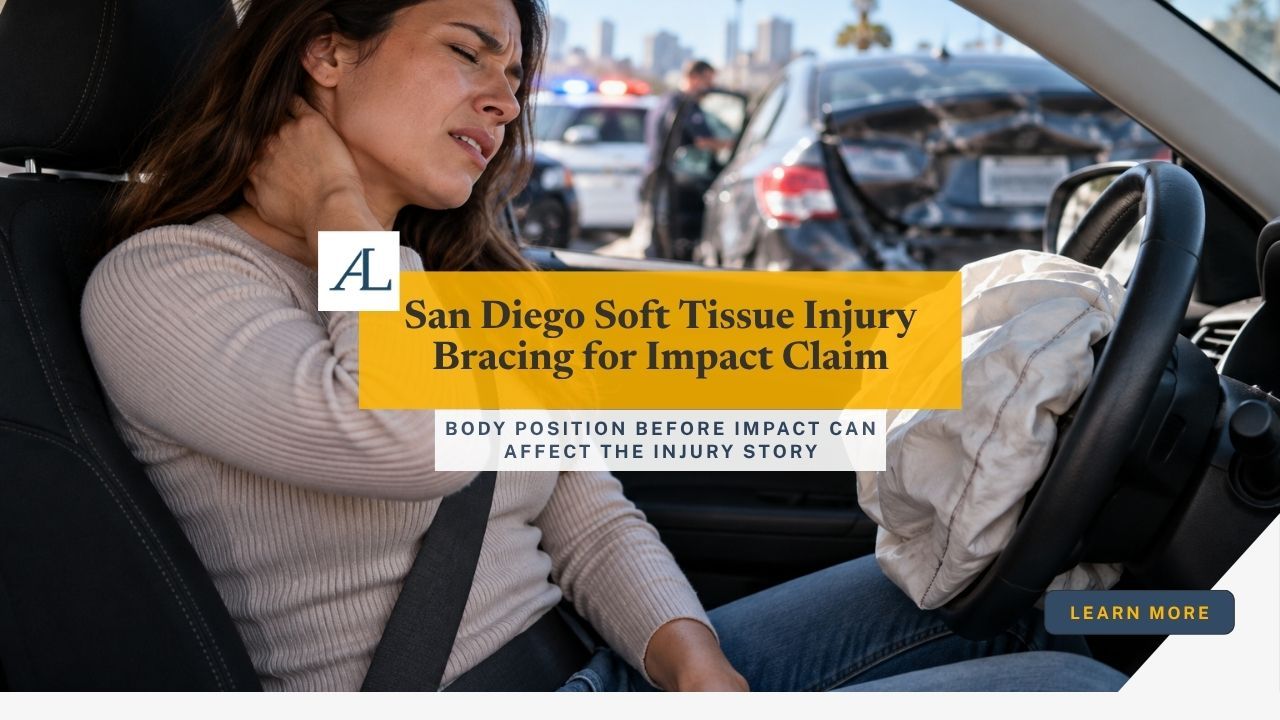
A San Diego soft tissue injury bracing for impact claim can become complicated quickly because the injured person may have been twisting, reaching, or bracing at the moment the crash happened. A sudden jolt can strain the neck, shoulders, wrists, back, and hips even when the vehicle damage looks limited or the crash does not seem dramatic at first. MedlinePlus explains that whiplash can cause pain and stiffness in the neck and surrounding areas, including the shoulders and arms, which is one reason symptoms may not be obvious right away. You can review that resource here: MedlinePlus whiplash.
When a crash leaves you or someone you love hurt, choosing the right legal representation matters. An experienced San Diego car accident lawyer at Avrek Law Firm can help preserve evidence, document the injury, and communicate with insurers while the claim is still developing.
Call 866-598-5548, start a live chat, or request a free case review today. There are no upfront fees, and you do not pay unless we win.
Why Occupant Position Before Impact May Matter
A San Diego soft tissue injury bracing for impact claim often turns on where the occupant was positioned before the crash. A driver may have both hands on the steering wheel, may be leaning into a turn, or may be reaching for the gear shift. A passenger may be turned toward the center console, holding a bag, looking at a phone, or bracing against the seat. Those small movements can change how the body absorbs force when the collision happens.
That matters because soft tissue injuries are not always caused by a direct blow alone. A sudden brake, a sharp turn, a sideswipe, or a rear-end impact can throw the body in a direction it was not prepared for. The claim should therefore focus on body position, vehicle movement, and the medical symptoms that followed, not only on the vehicle damage outside the car.
Hands on the Steering Wheel, Dashboard, Door, or Seat
Where the hands were placed before the impact can matter in a San Diego soft tissue injury bracing for impact claim. A driver gripping the wheel tightly may strain the wrists, shoulders, or neck when the vehicle jolts. A passenger with a hand on the dash, door, or seat may absorb force through the arm, shoulder, or upper back. If the person instinctively braced, that movement may have helped prevent a worse injury while still causing a strain or sprain.
These details should be described carefully in the claim because they help explain why the injury may not look severe from the outside even though it affects daily function.
Twisting, Reaching, or Turning Immediately Before the Collision
Twisting, reaching, or turning just before the crash can also affect a San Diego soft tissue injury bracing for impact claim. A person may have been leaning to retrieve something, checking traffic, adjusting controls, or turning to speak to someone in the car. When impact happens during that movement, the neck, shoulder, back, or hip may absorb force in an awkward position.
That is especially important because the injury may be worse on one side of the body than the other. If the person was reaching with one arm or twisting their torso, the claim should document that detail so the medical record and the crash mechanics line up.
Differences Between Driver-Side and Passenger-Side Body Movement
Driver-side and passenger-side body movement can be different in a San Diego soft tissue injury bracing for impact claim. A driver may react by turning the wheel, pushing against the seatback, or bracing both arms. A passenger may brace against the seat, dash, or door, or may be turned in a different direction when the crash happens. Those differences can affect which muscles, joints, and soft tissue areas are strained.
The claim should explain whether the injured person was the driver or passenger and how that position affected the injury. If two people in the same vehicle were hurt differently, their body positions may help explain why one had a shoulder injury while the other had more back or neck pain.
Medical Records for Shoulder, Wrist, Neck, and Back Symptoms
A San Diego soft tissue injury bracing for impact claim is strongest when the medical record shows a clear progression from the crash to the symptoms that followed. Soft tissue injuries are often treated conservatively, but that does not make them minor. Emergency care, urgent care, primary care, physical therapy, and specialist referrals can all help prove the injury was significant enough to require treatment.
The outline for this blog focuses on shoulder, wrist, neck, and back symptoms, along with grip, lifting, driving, and range-of-motion restrictions.
Emergency Care, Urgent Care, and Primary Care Notes
Emergency room and urgent care records are often the first medical documents in a San Diego soft tissue injury bracing for impact claim. They may show initial pain complaints, exam findings, medications, discharge instructions, and follow-up recommendations. Even if imaging does not show a fracture, those notes can help establish that the person reported pain soon after the crash.
Primary care notes are also important because many soft tissue injuries require follow-up care after the first visit. A doctor may document stiffness, decreased range of motion, muscle spasms, headaches, or continued soreness that did not improve after the initial treatment.
Therapy, Specialist Referrals, and Diagnostic Testing
Physical therapy is a common part of a San Diego soft tissue injury bracing for impact claim. Therapy notes can show how the injury affected range of motion, strength, balance, pain levels, and daily function. They can also show that the person needed multiple sessions instead of just one doctor visit.
Specialist referrals may be needed if symptoms do not improve. A doctor may send the injured person to orthopedics, pain management, neurology, or another provider for a deeper evaluation. Diagnostic testing can also matter if the injury is not visible on the first exam but the pain continues.
Grip, Lifting, Driving, and Range-of-Motion Restrictions
Grip strength, lifting ability, driving comfort, and range of motion are often documented in a San Diego soft tissue injury bracing for impact claim. If the injured person cannot lift a child, turn their neck, hold a steering wheel comfortably, or carry items with the injured arm, that limitation should be written down by a provider.
Those restrictions matter because they affect work, errands, childcare, and daily independence. A soft tissue injury can be invisible to others while still disrupting nearly every part of the day.
Evidence That Can Help Explain How the Occupant Moved
A San Diego soft tissue injury bracing for impact claim should be supported by evidence that explains how the occupant moved during the crash. That evidence can help show why the body was strained in the way it was, and it can help insurers understand that the injury happened during a real collision event rather than from ordinary soreness.
The outline for this blog highlights interior contact marks, airbag deployment, seatbelt position, vehicle damage, direction of impact, dashcam footage, passenger statements, and scene photos.
Interior Contact Marks, Airbag Deployment, and Seatbelt Position
Interior contact marks can be useful in a San Diego soft tissue injury bracing for impact claim because they may show where the body hit inside the vehicle. A mark on the steering wheel, dashboard, door, or seatback may help explain why the shoulder, wrist, neck, or back was injured. Airbag deployment may also help show the force of the crash.
Seatbelt position matters too. If the seatbelt crossed the shoulder or chest in a way that caused strain, that should be documented. The more the interior evidence matches the injury pattern, the stronger the claim may be.
Vehicle Damage and Direction of Impact
Vehicle damage can help explain the direction of impact in a San Diego soft tissue injury bracing for impact claim. Side damage, rear damage, front-end damage, or pushed-in panels can all help show how the body moved at the time of collision. A vehicle may not look totaled and still have caused enough force to injure the occupant.
The claim should preserve photos of the vehicle before repairs, along with final resting positions if the crash scene still shows them. That evidence can help show whether the occupant was pushed forward, sideways, or into another part of the car.
Dashcam Footage, Passenger Statements, and Scene Photos
Dashcam footage can be especially helpful in a San Diego soft tissue injury bracing for impact claim because it may show traffic conditions, braking, lane changes, or the crash itself. Passenger statements may also help explain what the injured person was doing right before impact. Scene photos can show road conditions, lane markings, traffic signals, skid marks, debris, and vehicle positions.
These pieces of evidence can be critical when an insurer argues the injuries were unrelated or minor. The more the scene proof matches the body movement, the easier it becomes to support the claim.
Insurance Challenges in Bracing-Related Soft Tissue Claims
Insurance companies often challenge a San Diego soft tissue injury bracing for impact claim because the injuries can be hard to see and easy to question. They may argue the pain is unrelated, that the person already had joint problems, or that the treatment gap shows the crash was not serious. Those arguments are common, but they are not the end of the claim.
The focus should stay on the medical timeline, the body position, and the evidence showing how the occupant moved.
Claims That the Symptoms Are Unrelated to the Collision
Insurers may say the symptoms in a San Diego soft tissue injury bracing for impact claim came from something other than the crash. They may point to a prior workout injury, old neck pain, or ordinary soreness and argue the collision was not responsible. The injured person should be ready to show that the symptoms began after the crash and were documented by providers.
If the medical record shows the pain started after the impact and got worse over time, that can help prove causation.
Questions About Delayed Treatment or Prior Joint Pain
Delayed treatment is another common issue in a San Diego soft tissue injury bracing for impact claim. If the injured person waited to see a doctor, the insurer may argue the pain was not serious. In reality, many people try to wait it out before seeking care. Prior joint pain may also become an issue if the insurer wants to compare the current symptoms to an older condition.
That is why the medical record should clearly distinguish between pre-crash pain and the new symptoms that followed the collision.
Settlement Offers Before Therapy and Recovery Are Complete
A quick settlement can be risky in a San Diego soft tissue injury bracing for impact claim because soft tissue symptoms may continue for days, weeks, or longer. If the insurer offers money before therapy is complete, the injured person may not yet know whether the pain will fully resolve or whether more care will be needed.
Once a release is signed, the claim is usually over. It is important to understand the treatment plan, the daily impact, and the likely recovery timeline before settling.
Deadlines and Reporting After a San Diego Traffic Event
A San Diego soft tissue injury bracing for impact claim should be reviewed quickly because evidence and deadlines are not the same thing. The traffic event may be over in seconds, but the medical records, video, and witness information may disappear much sooner than the filing period.
California DMV says the SR-1 report generally must be filed within 10 days if someone is injured or killed, or if property damage is over $1,000. You can review that requirement here: California DMV SR-1 Accident Reporting.
California law also gives many personal injury claims a general two-year limitations period. California Code of Civil Procedure Section 335.1 is the statute injured people often rely on for that deadline. Even so, the practical challenge is often evidence loss long before the filing deadline arrives.
Frequently Asked Questions About a San Diego Soft Tissue Injury Claim
Can bracing for impact really cause soft tissue injuries?
Yes. A San Diego soft tissue injury bracing for impact claim can arise even when there is no major vehicle damage because the body can absorb force through the shoulders, neck, back, wrists, and hips when the person braces or twists.
What evidence helps most in these cases?
Medical records, therapy notes, scene photos, interior contact evidence, seatbelt position, dashcam footage, and passenger statements are often the most useful. Those items can help explain how the body moved and why the injury happened.
What if the pain showed up later?
Delayed pain is common. In a San Diego soft tissue injury bracing for impact claim, symptoms may become worse hours or days later, especially after adrenaline wears off.
Why do insurers question soft tissue claims so much?
Because the injuries are often not visible on imaging and may depend heavily on symptom history. Insurers may look for prior pain, treatment gaps, or evidence they can use to reduce the claim.
Do I need a lawyer for this kind of claim?
Yes, especially if the insurer is minimizing the injury or offering a quick settlement. A San Diego car accident lawyer can help organize the medical and crash evidence and protect the claim’s value.
Call or Contact Avrek Law Firm 24/7 for a Free Consultation and Pay Nothing Unless We Win
A San Diego soft tissue injury bracing for impact claim can become difficult when the insurance company questions the pain, points to limited vehicle damage, or tries to blame a prior condition. These cases often depend on prompt medical records, therapy notes, interior vehicle evidence, symptom timelines, and proof showing how the occupant moved during the collision.
Avrek Law Firm helps injured drivers and passengers after serious crashes throughout San Diego. Our team can move quickly to preserve evidence, document the injury impact, and pursue compensation for medical bills, lost income, pain and suffering, future care, and long-term recovery needs.
If you or someone you love was injured after bracing for impact in a San Diego crash, Avrek Law Firm is ready to help.
Call 866-598-5548, start a chat, or complete our online form today for a free, no-obligation consultation. There are no upfront fees, and you do not pay unless we win.
Serving the San Diego Community
Avrek Law Firm represents injured people throughout San Diego and surrounding communities. Local context matters in a San Diego soft tissue injury bracing for impact claim because the roadway, traffic pattern, and collision type can shape the evidence.
A sudden stop or side-impact crash on I-5, I-8, the 805, the 15, or busy roads near Downtown San Diego, Mission Valley, Pacific Beach, La Jolla, North Park, Chula Vista, or the East County corridors may involve different traffic speeds, witness opportunities, and camera sources. The location of the crash can help explain how the body moved and why the injury developed after the impact.
A San Diego car accident lawyer can help make sure the evidence is preserved before it is lost, and a San Diego injury lawyer can help document the full impact of the injuries on work, mobility, and daily life.
- 📩 Submit a request through our online form
- 📞 Call 866-598-5548 now to speak with our team
- 💬 Start a live chat for immediate assistance
There are no upfront fees, and you don’t pay unless we win.