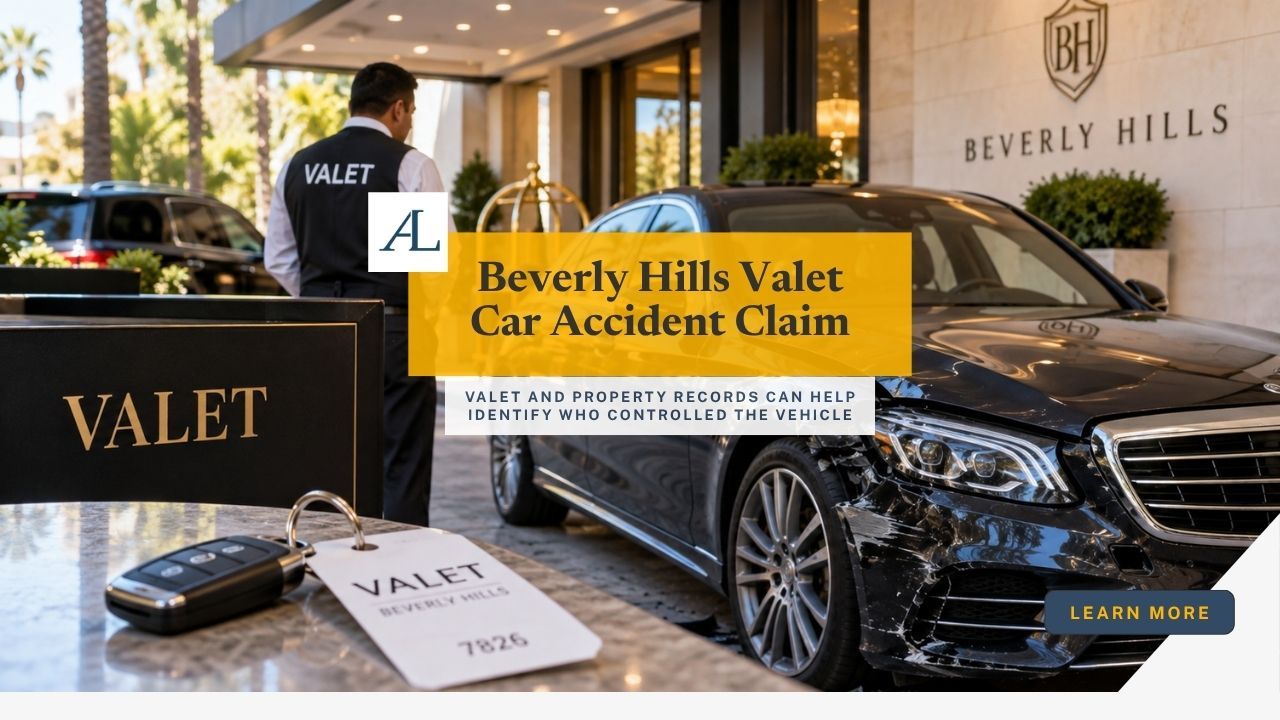
A Beverly Hills valet car accident claim can become complicated quickly because the person driving the vehicle may not be its owner, the valet company may operate separately from the property, and several insurance representatives may begin investigating the same collision. A hotel guest, restaurant customer, shopper, pedestrian, cyclist, passenger, or another driver may be injured while a valet employee is parking, retrieving, repositioning, or returning a customer’s vehicle. Determining who controlled the car at the exact moment of impact can affect which records must be preserved and which parties and policies should be reviewed.
Unlike a typical two-driver collision, a Beverly Hills valet car accident claim may involve a vehicle owner who was not behind the wheel, an employee who had possession of the keys, a valet company responsible for staffing and training, and a hotel, restaurant, medical building, retail property, or parking operator that controlled the location. The property may have dictated where vehicles were received, stored, moved, and returned. A separate security company may hold the surveillance footage, while another business may maintain the garage or driveway where the crash occurred.
The location of the collision may also change the investigation. A valet may damage another vehicle while moving through a garage, strike someone in a driveway, back across a sidewalk, collide with traffic while entering a public street, or cause an impact while bringing a customer’s car to the pickup area. Each scenario raises different questions about vehicle control, sightlines, employee instructions, key handoffs, and available witnesses. A strong Beverly Hills valet car accident claim should reconstruct the complete valet transaction rather than looking only at the final moment of impact.
When a valet-related collision leaves you injured, choosing the right legal representation matters. An experienced Beverly Hills auto accident lawyer at Avrek Law Firm can help identify who was driving, preserve valet and property records, investigate every potentially responsible party, and handle communications with multiple insurers. Avrek’s Beverly Hills pages provide local resources for injured people dealing with disputed fault, insurance questions, medical expenses, missed work, and vehicle losses.
Call 866-598-5548, start a live chat, or request a free case review today. There are no upfront legal fees, and you do not pay unless we win.
Why a Beverly Hills Valet Car Accident Claim Requires a Control Timeline
A Beverly Hills valet car accident claim should begin with a precise control timeline. The vehicle owner may have driven onto the property, stopped at a valet stand, handed over the keys, received a ticket, and entered a business. The valet employee may then have moved the vehicle through a driveway, parking lane, ramp, garage, alley, or public street. Later, a different employee may have retrieved the same vehicle and returned it to the pickup area. The person driving at the time of the crash may not be the person who originally accepted the keys.
That timeline matters because an insurer may try to simplify the event by saying only that the vehicle was “with the valet.” The more useful questions are who accepted the vehicle, who received the key, who assigned the parking space, who was driving during the collision, what task that person was performing, and which company controlled the work. Time-stamped tickets, key logs, staffing records, security footage, text messages, and incident reports may help answer those questions.
Whether the Vehicle Was Being Parked, Retrieved, or Moved Within the Property
The first issue in a Beverly Hills valet car accident claim is identifying what the valet driver was doing. A parking collision may occur as the employee moves the customer’s vehicle away from the drop-off lane. A retrieval collision may happen as the valet brings the car back through a garage or driveway. A repositioning crash may occur when an employee moves several parked cars to create space, retrieve a blocked vehicle, or manage traffic during a busy period.
The task can affect which employees witnessed the event and what records exist. A parking ticket may show when the vehicle was accepted, while a retrieval request sent by text or app may show when the customer asked for the car. A key-management system may identify which employee removed the key. Garage video may show the vehicle traveling between levels, and curbside video may capture its return. These records can establish whether the crash happened during active valet work rather than after the vehicle had been returned to the owner.
The exact location should also be documented. A Beverly Hills valet car accident claim involving an impact inside a private garage may require records from the garage operator and property manager. A collision at the driveway entrance may involve cameras facing the sidewalk and street. If the valet entered public traffic before impact, the police report, nearby business cameras, traffic signals, and statements from outside drivers may become especially important.
The vehicle owner should avoid assuming that the valet company will preserve every useful record automatically. A business may retain the ticket but allow video to be overwritten. A supervisor may prepare an internal incident report without giving the customer a copy. Early written preservation requests can help protect the records that show exactly what the valet was doing when the collision occurred.
The Relationship Between the Valet Driver, Valet Company, and Property Operator
A Beverly Hills valet car accident claim may require investigation of several business relationships. Some properties operate their own valet service and employ the drivers directly. Others hire an outside parking company. A hotel may contract with a valet operator while separately employing security staff and garage personnel. A restaurant may validate parking at a garage controlled by another company. The name printed on the valet ticket may not identify every entity involved.
Employment, supervision, and control records can help clarify those relationships. The valet company may have hired and trained the driver, while the property set the vehicle route, loading-zone layout, customer pickup procedures, and staffing expectations. A property manager may have directed employees to use an alley, garage ramp, driveway, or temporary overflow area. If the collision resulted from both unsafe driving and a dangerous operating setup, more than one entity may need to be investigated.
Contracts between the property and valet operator may identify responsibilities for staffing, vehicle custody, insurance, incident reporting, safety procedures, cameras, and customer complaints. Those agreements do not automatically decide the injured person’s rights, but they may help show who controlled the relevant part of the operation. A Beverly Hills valet car accident claim should therefore identify the driver’s employer, the valet business, the property owner, the property operator, the garage manager, and any contractor responsible for traffic or parking operations.
This focus distinguishes the new article from Avrek’s Beverly Hills rideshare pickup accidents near hotels, restaurants, and valet zones, which centers on app status, rideshare coverage, and curbside pickup evidence. The valet-driven claim instead focuses on a business taking possession of a customer’s vehicle and assigning an employee to move it.
Vehicle Owner Instructions, Key Handoffs, and Permission Records
Permission can become an important issue in a Beverly Hills valet car accident claim because the vehicle owner intentionally hands the key to someone else, but the scope of that permission may still be disputed. The owner may have authorized the valet to park and retrieve the vehicle but not to use it for another purpose, drive it off the property unnecessarily, or allow an unauthorized employee to operate it. The facts surrounding the handoff should be documented carefully.
California Vehicle Code Section 17150 states that a vehicle owner is liable and responsible for death or injury caused by a negligent or wrongful act in the vehicle’s operation when it is being used with the owner’s express or implied permission. The statute makes ownership and permission relevant, although it does not by itself resolve every question involving policy coverage, statutory limits, the valet company’s responsibility, or the property operator’s role.
Key-handoff evidence may include the physical ticket, QR code, text confirmation, app notification, receipt, timestamp, vehicle description, license plate, parking-space assignment, and employee initials or number. A customer may also have given special instructions about the vehicle, such as how to operate a manual transmission, where to place the key, whether a mobility device was inside, or whether the vehicle had an existing mechanical concern. Those instructions may help explain what the valet knew before driving.
Avrek’s related article on California borrowed car accidents and permission questions provides broader background on vehicle ownership, express or implied permission, key exchanges, and insurance disputes when the driver is not the owner. A valet transaction is different from lending a car to a friend or relative, but both situations show why permission and vehicle control should be documented rather than assumed.
Valet and Property Records to Preserve
A Beverly Hills valet car accident claim often depends on commercial records that an injured person cannot recreate later. Valet operations may generate a ticket, digital check-in, key log, retrieval request, employee assignment, payment record, incident report, and surveillance footage. The property may separately maintain security logs, garage access records, camera footage, customer complaints, maintenance records, and reports from managers or security personnel.
These materials can disappear quickly. Video may be overwritten automatically, temporary employees may leave, and paper tickets may be discarded after a short retention period. A property may repair a damaged barrier, repaint a curb, move cones, change the traffic route, or modify the valet stand after the collision. A Beverly Hills valet car accident claim should identify and preserve these records before routine business practices alter the available evidence.
Valet Tickets, Key Logs, Staffing Records, and Incident Reports
The valet ticket can become the starting point for reconstructing a Beverly Hills valet car accident claim. It may identify the property, valet company, date, time, vehicle, license plate, ticket number, employee, and terms printed on the back. A digital valet service may send a text or app message instead of a paper ticket. Both formats should be saved in their original form, including screenshots and complete message threads.
Key logs may show when the key entered and left storage, which employee accessed it, and whether the vehicle was moved more than once. Some systems use numbered hooks, electronic cabinets, barcodes, or employee credentials. Staffing records may then show which employees were working, who supervised the shift, who assigned vehicles, and whether the driver involved was authorized to operate customer cars.
An incident report may contain the first internal description of the collision. It may identify witnesses, the employee’s statement, customer information, photographs, property damage, vehicle positions, camera locations, and the manager notified. The injured person should request a copy but should not assume the business’s report is complete or neutral. A separate personal record of what happened can help identify omissions or errors.
A Beverly Hills valet car accident claim should also preserve receipts from the hotel, restaurant, medical office, retail property, event venue, or garage. Those records may confirm why the vehicle was present, when the customer arrived, and how long the valet had possession. When several businesses share the same parking operation, a receipt may help identify which property arranged or benefited from the valet service.
Hotel, Restaurant, Garage, or Business Surveillance Footage
Surveillance footage may be among the most valuable records in a Beverly Hills valet car accident claim. A hotel may have cameras at the porte-cochère, entrance, lobby, driveway, garage ramp, loading area, and street-facing exterior. A restaurant may have cameras covering its valet stand, customer entrance, alley, and curb. A parking structure may record entry gates, payment areas, elevators, ramps, and individual levels.
The camera closest to the collision may not be the only useful one. An earlier camera may show the owner handing over the key. Another may identify which employee entered the vehicle. A garage camera may show the route and speed. A later recording may capture the employee speaking with a supervisor or moving the vehicle after impact. Synchronizing several recordings can establish the full control timeline.
The request should identify the date, approximate time, ticket number, vehicle description, license plate, employee, direction of travel, and all potentially relevant camera areas. A Beverly Hills valet car accident claim may be weakened if only the impact clip is preserved while the earlier key handoff and later response are lost. The original footage, metadata, exports, and information about who collected the recording should be protected when possible.
Valet areas can overlap with rideshare lanes, hotel entrances, restaurant queues, and pedestrian paths. Avrek’s Newport Beach valet zone pedestrian accident claims article explains why surveillance, valet tickets, employee schedules, incident reports, and scene photographs may matter when a person is injured near an active valet operation. The present Beverly Hills article uses similar evidence principles but focuses on a valet employee driving a customer’s vehicle.
Witness Information From Employees, Customers, and Other Drivers
A Beverly Hills valet car accident claim may involve witnesses who leave before the injured person realizes their importance. Valet attendants may have seen the employee accept the key, pull away, back up, enter the garage, or return after the collision. A doorman, concierge, host, server, security guard, garage attendant, or manager may have observed the vehicle route or heard an employee explain what happened.
Customers and other drivers may offer a more independent perspective. Another guest may have been waiting for a vehicle and seen the valet moving too quickly. A driver in the queue may have dashcam footage. A pedestrian may have seen the vehicle cross the sidewalk. A passenger may remember the valet entering traffic, striking an object, or reacting after impact. Names, phone numbers, email addresses, vehicle information, and short descriptions of what each witness observed should be collected promptly.
Witness accounts should remain separate. Employees should not be encouraged to develop one shared description through group discussion, and customers should be asked what they personally saw rather than what someone else told them. Differences do not necessarily mean a witness is unreliable. One person may have seen the beginning while another saw the collision or aftermath.
The police report and business incident report may contain witness information, but a Beverly Hills valet car accident claim should not rely on those documents alone. Contact details may be incomplete, employees may be identified only by first name, and a report may summarize a detailed statement in one sentence. Early follow-up allows each person’s account to be preserved before memories fade or employment changes.
Insurance Questions in a Beverly Hills Valet Car Accident Claim
A Beverly Hills valet car accident claim may generate communications from several insurance representatives. The vehicle owner may report the collision to a personal auto carrier. The valet company may notify a commercial insurer or claims administrator. The hotel, restaurant, property owner, garage operator, or management company may open a separate file. Another injured driver may also have coverage through a different carrier.
No one should assume that the first adjuster to call represents every party or has authority over the entire claim. Each representative may be investigating a different issue, such as injury liability, vehicle damage, business responsibility, property damage, or coverage. Keeping the claim numbers, adjuster names, companies, phone numbers, emails, requests, and decisions in one communication log can prevent confusion.
Policies Connected to the Vehicle Owner, Valet Operator, and Property
The owner’s auto policy is one place to begin, but it may not be the only coverage relevant to a Beverly Hills valet car accident claim. The valet operator may have insurance connected to vehicle operation or customer vehicles in its custody. The property may have separate coverage connected to its business operations, driveway, garage, employees, or contractors. Another driver involved in the collision may have a personal or commercial policy.
The actual policy language matters. An adjuster may say that another company should handle the claim, but that statement reflects the insurer’s position rather than a final legal conclusion. Policies, declarations, endorsements, reservation-of-rights letters, denial letters, contracts, and certificates of insurance may need to be reviewed together.
Vehicle ownership should also be confirmed. The person who handed over the key may be leasing the vehicle, using a company car, driving a rental, or operating a car owned by a family member. That can create additional notice and policy questions. A Beverly Hills valet car accident claim should identify the registered owner, driver who delivered the vehicle, person who authorized the valet service, valet employee, and every business involved.
The injured person should not sign a document stating that one policy is solely responsible before the coverage investigation is complete. One insurer may pay for immediate vehicle repairs while another remains responsible for part of the injury claim. Several entities may also dispute how their agreements divide responsibility between themselves.
Communications From Multiple Adjusters or Business Representatives
Multiple calls are common after a Beverly Hills valet car accident claim. A personal auto adjuster may request the owner’s statement. A valet claims representative may ask for photographs and repair estimates. A hotel manager may request a written incident description. Another insurer may seek medical records or ask whether the employee had permission to drive.
These contacts can sound cooperative while serving different interests. The injured person should ask who the caller represents, what claim number applies, whether the conversation is recorded, what information is being requested, and why it is needed. Notes should include the date, time, promises made, documents sent, and any deadlines identified.
A business representative may apologize, offer complimentary services, or say the company will “take care of everything.” Those statements should be documented, but the injured person should still obtain insurance information and preserve independent evidence. A manager’s verbal promise may not control the insurer’s later decision.
A Beverly Hills personal injury lawyer can manage these communications while the injured person focuses on treatment. Legal representation can also help prevent one representative from receiving information intended for a different part of the claim or defining the accident before the valet and property records are collected.
Recorded Statement and Release Requests Before Responsibility Is Clear
A recorded statement can create problems when the injured person does not yet know who employed the valet, which company operated the parking service, or what the surveillance footage shows. An adjuster may ask the person to estimate speed, describe the employee’s task, identify the precise impact sequence, or decide whether the property contributed. Guessing can later be treated as a firm admission.
In a Beverly Hills valet car accident claim, the injured person should distinguish between personal observations and information learned later. A vehicle owner may know when the key was handed over but not know which employee drove afterward. A pedestrian may see the impact but not the earlier valet transaction. Another driver may witness the vehicle entering the street without knowing it was being operated by a valet. Each account can be accurate without being complete.
Release requests require equal caution. A payment for visible vehicle damage may arrive before hidden damage, towing, rental expenses, medical treatment, lost income, or long-term symptoms are documented. A release described as applying to one part of the claim may contain language covering all injuries, parties, and future losses.
A Beverly Hills valet car accident claim should not be resolved until the injured person understands which party is paying, what the release covers, whether other policies may apply, and whether medical recovery is sufficiently clear. Once a broad release is signed, later-discovered losses may be difficult or impossible to pursue.
Documenting Injuries and Vehicle Losses
A Beverly Hills valet car accident claim must connect the valet transaction to both personal injuries and property losses. An injured person may be inside the customer’s vehicle when it is being returned, seated in another vehicle struck by the valet, walking through a driveway, cycling past a garage entrance, or standing near the valet stand. The injury documentation should accurately describe that position and the movement that caused the harm.
Vehicle losses should be documented separately but coordinated with the injury evidence. Damage photographs may help explain the impact direction, while medical records show what happened to the person. Towing, repair, rental, transportation, and loss-of-use records may continue to develop while treatment is underway. Neither part of the claim should be closed simply because the other is moving faster.
Medical Treatment, Work Restrictions, and Daily Activity Changes
Prompt medical care can help identify injuries and create an early record connecting them to the collision. A Beverly Hills valet car accident claim may involve neck and back injuries, fractures, head trauma, shoulder or knee injuries, soft-tissue symptoms, cuts, bruising, or emotional distress. Symptoms may also worsen after the initial adrenaline and confusion fade.
Medical records should include ambulance care, emergency treatment, urgent care, imaging, primary care, specialist referrals, therapy, medication, work restrictions, and follow-up recommendations. The injured person should describe how the collision happened without guessing about details they did not see. If the person was struck while walking, sitting, entering a vehicle, or waiting near the valet stand, that position should appear consistently in the history.
Work records may include missed shifts, reduced hours, used leave, modified duties, lost commissions, canceled appointments, or limits on driving and lifting. Daily activity documentation can show difficulty sleeping, caring for children, walking, exercising, commuting, or completing household tasks. A Beverly Hills valet car accident claim should explain how the injury changed normal life rather than reducing the case to medical bills alone.
A simple calendar or journal can help organize appointments, symptoms, medication changes, missed work, and activities the injured person could not perform. The record should be accurate and specific. Short entries created close to the event are often more useful than broad descriptions written months later.
Vehicle Damage, Repair Estimates, Towing, and Loss-of-Use Records
The vehicle should be photographed before repair. Images should show every side, the interior, airbags, seatbelts, wheels, glass, mirrors, paint transfer, dents, scrapes, broken lights, and damage to nearby objects. A Beverly Hills valet car accident claim may involve more than one contact, especially if the valet struck a parked car, wall, post, gate, curb, or another moving vehicle.
Repair estimates should be preserved with supplemental estimates and final invoices. The first visual estimate may not identify structural, suspension, electronic, sensor, wheel, alignment, or mechanical damage discovered after disassembly. If the valet company arranges inspection or repair, the owner should still obtain copies of all photographs, reports, scans, parts lists, and invoices.
Towing and storage records can establish where the vehicle was taken and who controlled it after the crash. Rental receipts, rideshare expenses, replacement transportation, parking costs, and other loss-of-use records may show the practical effect of being without the vehicle. A customer should also document personal items damaged or missing while the car was in valet custody.
Expensive or specialized vehicles may require manufacturer-approved repairs, diagnostic scans, calibrations, specialty parts, or an appropriate repair facility. The claim should preserve the vehicle’s pre-crash condition, mileage, service records, prior damage, and photographs so the insurer cannot attribute new damage to an earlier event without evidence.
A Timeline Connecting the Valet Transaction to the Collision
The final evidence package should create one continuous timeline. A Beverly Hills valet car accident claim may begin with a reservation, hotel arrival, restaurant receipt, parking validation, or business appointment. It should then show the time of vehicle delivery, key handoff, ticket creation, employee assignment, vehicle movement, collision, incident response, retrieval, towing, insurer notice, and medical treatment.
Digital records can make that timeline stronger. Text messages saying the vehicle is ready, app notifications, credit-card timestamps, location history, photographs, phone calls, parking receipts, and electronic key logs may help establish when the valet had control. Security footage can then be synchronized with those records.
The timeline should also identify what happened after impact. Did the valet notify a supervisor immediately? Was the vehicle moved before photographs were taken? Did the business contact police, security, or an insurer? Did an employee complete a report? Was the owner told about the collision before or after the car was returned? These details may affect credibility and evidence preservation.
A well-organized Beverly Hills valet car accident claim makes it harder for the involved businesses and insurers to separate the event into disconnected fragments. The timeline shows how the customer delivered an undamaged or differently damaged vehicle, how the business assumed control, what occurred while the car was being handled, and what injuries and losses followed.
What to Do After a Valet-Related Collision in Beverly Hills
Medical care and immediate safety come first. Call 911 when someone may be injured, traffic is blocked, the collision involves a pedestrian or cyclist, or the vehicles create another hazard. Do not remain in an active driveway, garage ramp, travel lane, or loading area merely to take photographs.
Once it is safe, document the driver, valet ticket, key, vehicle, license plate, employee name or number, valet company, property, supervisor, and insurance information. Photograph the vehicle positions, impact areas, garage or driveway layout, signs, cones, valet stand, camera locations, lighting, sidewalks, curbs, gates, barriers, and nearby businesses. A Beverly Hills valet car accident claim may depend on showing the entire operating area, not just one dent.
Ask the property and valet company to preserve the ticket, digital check-in, key log, employee assignment, staffing schedule, incident report, surveillance video, access records, payment information, customer communications, and photographs. Obtain witness contact information from employees, customers, drivers, passengers, security personnel, and pedestrians. Do not rely solely on a manager’s promise that the company will keep everything.
Report the collision to the appropriate insurers, but avoid guessing during recorded conversations. Keep copies of every letter, email, form, estimate, medical record, receipt, and claim number. Before authorizing repairs, disposal, or a total-loss transfer, consider whether the vehicle needs an independent inspection or additional documentation.
Reporting and Deadlines for a Beverly Hills Valet Car Accident Claim
California DMV reporting requirements may apply even though the vehicle was being driven by a valet employee. The official California DMV SR-1 Accident Reporting page states that an SR-1 must be sent to DMV within 10 days when someone is injured, no matter how minor the injury, someone is killed, or property damage exceeds $1,000. DMV also states that the SR-1 is required in addition to reports made to police, CHP, or an insurance company.
A Beverly Hills valet car accident claim may involve disagreement over who should complete the report or supply the necessary information. The vehicle owner, driver, insurer, broker, or legal representative may need to coordinate so the reporting requirement is not overlooked. The report should use verified information rather than assumptions about the valet employee or business relationship.
For many California injury actions, California Code of Civil Procedure Section 335.1 provides a two-year period for an action involving injury to, or death of, an individual caused by another person’s wrongful act or neglect. Different or shorter procedures may apply in particular circumstances, so the filing deadline should be reviewed based on the actual parties and facts.
The existence of a filing period should not encourage delay. Surveillance footage, tickets, schedules, key logs, employee information, and vehicle evidence may disappear far sooner. A Beverly Hills valet car accident claim should be investigated while the businesses still have the records and witnesses still remember the event.
- 📩 Submit a request through our online form
- 📞 Call 866-598-5548 now to speak with our team
- 💬 Start a live chat for immediate assistance
There are no upfront fees, and you don’t pay unless we win.