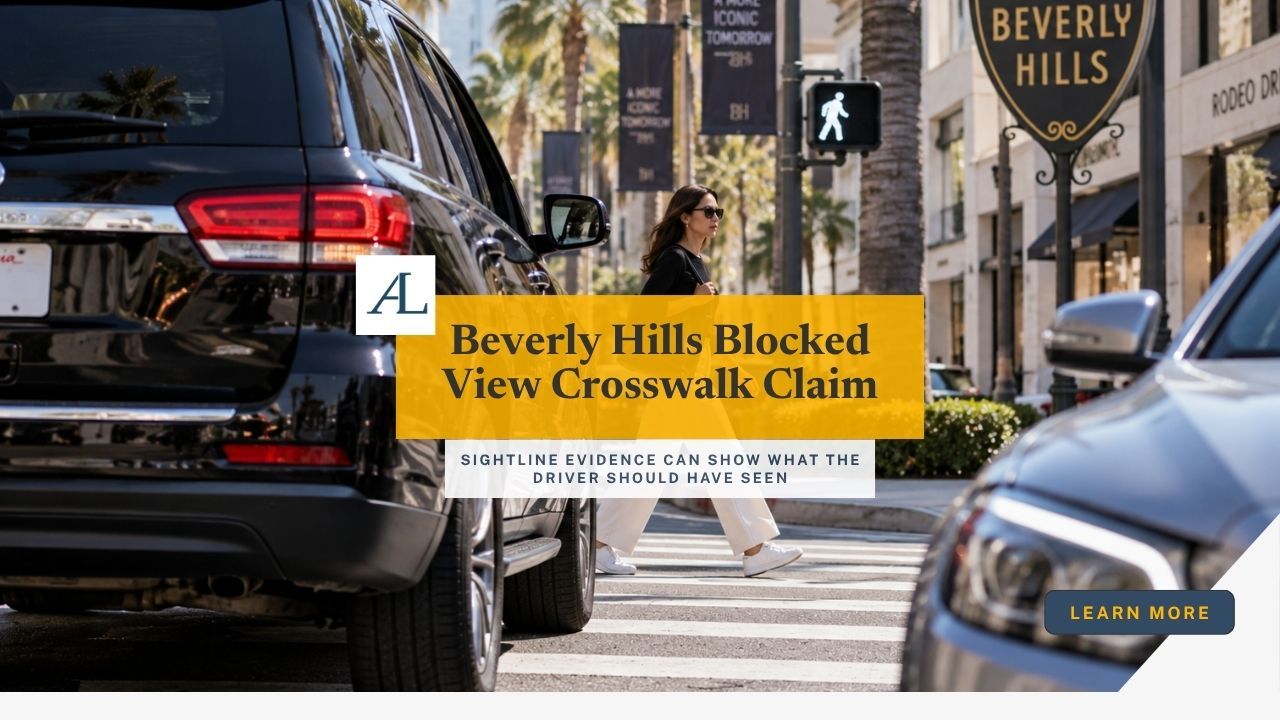
A Beverly Hills blocked view crosswalk claim can become complicated quickly because the driver who strikes the pedestrian may say another vehicle made the person impossible to see. A large SUV may stop beside a crosswalk and block the adjacent lane. A rideshare vehicle may wait near a hotel entrance. A delivery van may park near the curb. A turning car may pause within part of the crossing while another driver approaches from behind. When the pedestrian moves through the hidden portion of the crosswalk, the approaching motorist may continue without slowing and claim the person appeared without warning.
That explanation should not end the investigation. California’s official driving guidance specifically warns motorists not to pass a vehicle stopped at a crosswalk because a pedestrian may be crossing where the approaching driver cannot see them. The same guidance says drivers must use caution, reduce speed, or stop when a pedestrian is crossing with or without a marked crosswalk. Those principles make the position of the blocking vehicle, the speed of the approaching car, and the driver’s available reaction time central parts of a Beverly Hills blocked view crosswalk claim. California DMV Pedestrian and Crosswalk Guidance provides the state’s crosswalk and pedestrian-safety instructions for motorists.
The pedestrian’s path must also be reconstructed carefully. A person may have entered on a walk signal, crossed through a marked crosswalk, and remained visible until a stopped vehicle temporarily blocked the view. The approaching driver may have seen the vehicle stopped at the crossing even if the pedestrian was hidden. That visual warning can be important because a reasonable driver should consider why another vehicle has stopped before passing or continuing through the crosswalk.
A Beverly Hills blocked view crosswalk claim may involve more than the driver who made contact with the pedestrian. The vehicle creating the obstruction may need to be investigated if it stopped, parked, turned, or staged in a way that created an unusual sightline problem. A rideshare company, delivery business, valet operator, hotel, restaurant, property operator, or employer may also possess records showing why the vehicle was there and who controlled its movement. Responsibility depends on the evidence, and the mere presence of a blocking vehicle does not automatically make its driver liable.
This article focuses narrowly on collisions in which one vehicle hides a pedestrian from another motorist. For related curbside visibility issues, Avrek’s article on Beverly Hills rideshare pickup accidents near hotels, restaurants, and valet zones explains how stopped rideshare vehicles, valet activity, and crowded pickup areas can affect pedestrian and driver sightlines.
When a crosswalk collision causes serious injuries, choosing the right legal representation matters. An experienced Beverly Hills pedestrian accident lawyer at Avrek Law Firm can document the obstruction, identify camera sources, measure sightlines, preserve the involved vehicles, interview witnesses, and challenge an insurer’s claim that the pedestrian appeared unexpectedly. Avrek’s Beverly Hills pedestrian practice addresses crosswalk injuries, failure-to-yield crashes, distracted driving, and other collisions caused by negligent motorists.
Call 866-598-5548, start a live chat, or request a free case review today. There are no upfront legal fees, and you do not pay unless we win.
Reconstructing the Obstructed Line of Sight in a Beverly Hills Blocked View Crosswalk Claim
A Beverly Hills blocked view crosswalk claim should begin with a detailed reconstruction of where every vehicle and pedestrian was located before impact. A police diagram may identify the general position of the vehicles, but it may not show the exact distance between the blocking vehicle and the crosswalk, the height of the vehicle, the pedestrian’s direction of travel, or the approaching driver’s view during the final seconds.
The reconstruction should treat the sightline as a changing condition rather than a single photograph. The pedestrian may have been visible when entering the crosswalk, hidden temporarily while passing in front of or behind a stopped vehicle, and visible again shortly before impact. The approaching driver’s view may also have changed as the car moved forward. Photos, video, measurements, vehicle dimensions, signal timing, and witness accounts can help establish when the pedestrian should have become visible.
The Position of the Stopped, Parked, or Turning Vehicle
The position of the blocking vehicle can determine how much of the crosswalk was hidden. A vehicle stopped before the limit line may obstruct less of the pedestrian’s path than a vehicle stopped within the crosswalk. A tall SUV, pickup, delivery van, shuttle, or commercial vehicle may block substantially more of the crossing than a lower passenger car. If the vehicle was angled, turning, or pulled partly into another lane, the obstruction may have changed from second to second.
A Beverly Hills blocked view crosswalk claim should document the blocking vehicle’s make, model, approximate height, lane, direction, distance from the crosswalk, and final position. Photographs should show the vehicle from the approaching driver’s viewpoint whenever possible. Investigators may also need to determine whether the vehicle remained at the scene, whether it was moved before police arrived, and whether the driver gave a statement.
The reason the vehicle stopped may be equally important. It may have stopped because the pedestrian was already crossing, because traffic was backed up, because the driver was making a turn, or because a passenger was entering or exiting. A rideshare or valet vehicle may have stopped for business reasons unrelated to the signal. A delivery vehicle may have been staged near the curb. The claim should establish why the vehicle was present rather than assuming it stopped normally.
Vehicle lights and signals should also be documented. Brake lights may have warned the approaching driver that the vehicle was stopping. A turn signal may have indicated that the blocking car was preparing to move across the crosswalk. Hazard lights may have suggested that a vehicle was stopped for an unusual reason. Dashcam footage or surveillance can sometimes show those signals even when witnesses do not remember them.
The obstruction may also have existed before the pedestrian entered the crossing. A parked vehicle, shuttle, limousine, delivery van, or valet-staged car may have blocked the view for several minutes. In that situation, the approaching driver may have had repeated opportunities to recognize that visibility was limited and reduce speed before reaching the crosswalk.
Where the Pedestrian Entered and Traveled Through the Crosswalk
The pedestrian’s exact route is central to a Beverly Hills blocked view crosswalk claim. Investigators should identify which curb the person left, whether the crossing was marked or unmarked, which direction the pedestrian traveled, and where the person was located when the blocking vehicle first obstructed the view.
The pedestrian may have been walking at an ordinary pace, pushing a stroller, carrying shopping bags, using a mobility device, walking with a child, or assisting another person. Those facts can affect how long the pedestrian remained in the crosswalk and how much time the approaching driver had to recognize the hazard. They should be documented factually rather than used to make assumptions about fault.
Signal evidence may help establish when the pedestrian entered. Photographs and video may show a walk signal, countdown display, traffic-light phase, or movement of surrounding vehicles. Nearby witnesses may remember whether pedestrians began crossing together or whether traffic in one direction had already stopped.
California Vehicle Code Section 21950 requires drivers to yield to pedestrians crossing within marked crosswalks and unmarked crosswalks at intersections. It also requires a driver approaching a pedestrian in a crosswalk to exercise due care, reduce speed, or take other action necessary to safeguard the pedestrian. The statute also requires pedestrians to use due care and not step into the immediate path of a vehicle that is too close to stop safely.
An insurer may focus on the pedestrian’s first step from the curb, but the entire route matters. A person may have entered safely while the approaching vehicle was far away, then become hidden by another vehicle during the middle of the crossing. The relevant question may be whether the approaching driver reacted reasonably to the visible stopped vehicle and limited view—not whether the pedestrian could predict that someone would pass or proceed without slowing.
Digital evidence may also help establish the walking path. Phone location information, fitness tracker data, photographs, receipts, rideshare records, hotel records, or messages may show where the pedestrian was coming from and where they were going. Those records should be collected carefully and only to the extent relevant to the collision.
The Approaching Driver’s Lane, Direction, and Field of View
The approaching driver’s lane and direction can help establish what the driver could see before impact. A driver traveling in the lane next to a stopped vehicle may have a different view from someone approaching from farther away or turning through the intersection. The road’s width, curvature, grade, landscaping, parked vehicles, signs, lighting, and traffic volume may also affect the available view.
A Beverly Hills blocked view crosswalk claim should document when the stopped or blocking vehicle first became visible to the approaching driver. Even if the pedestrian remained hidden, the vehicle itself may have been a warning. A driver approaching a stopped vehicle at a crosswalk may need to slow and determine why traffic has stopped rather than pass without confirming the crossing is clear.
Driver-eye-height photographs can help recreate that perspective. Investigators may photograph the scene from a vehicle of similar height while approaching at measured distances. These photographs should be taken safely and should document the location, camera height, lens, time of day, and vehicle positions so they are not mistaken for exact scientific measurements without proper foundation.
Speed and lane movement also matter. A driver may have accelerated around a stopped vehicle, changed lanes to pass it, approached too quickly for the limited sightline, or failed to release the accelerator until the pedestrian became visible. Vehicle event data, dashcam footage, brake lights, skid or tire marks, and witness accounts may help reconstruct those actions.
The driver’s attention should be examined separately from physical visibility. A pedestrian may have been visible for several seconds, but the driver may have been looking at navigation, traffic in another lane, a phone, a passenger, or a turning vehicle. An obstruction defense should not be accepted until the investigation considers both what was physically visible and where the driver was actually looking.
Evidence That Can Support a Beverly Hills Blocked View Crosswalk Claim
Evidence in a Beverly Hills blocked view crosswalk claim should show not only that a vehicle blocked the view, but also what each person could reasonably see and when. The most useful evidence may include photographs, measurements, video, vehicle records, witness accounts, signal information, emergency calls, and the physical positions of the vehicles after impact.
This evidence should be gathered quickly. Vehicles may leave the scene, road conditions may change, temporary curbside activity may disappear, and surveillance systems may overwrite recordings within days or weeks. A crosswalk that looks open and unobstructed later may have been surrounded by hotel traffic, valet vehicles, deliveries, rideshare pickups, or event congestion when the crash occurred.
Intersection Photos, Vehicle Positions, and Sightline Measurements
Scene photographs should include wide images of the entire intersection and detailed images of the crosswalk, lane markings, limit lines, curb, signals, signs, parked vehicles, buildings, landscaping, lighting, and impact area. Photographs should be taken from the pedestrian’s approach, the approaching driver’s lane, and the blocking vehicle’s position when it is safe to do so.
The photographs should also show elevation and grade. A downhill approach may give a driver a different view from a level roadway. A curve, median, tree, sign, planter, or parked vehicle may compound the obstruction created by the stopped car. Nighttime lighting, sun glare, rain, or shadows may also affect what was visible.
Measurements can establish distances between the curb, crosswalk, blocking vehicle, impact point, and final vehicle position. The width of the lanes and crosswalk may help estimate how long the pedestrian was exposed before impact. Vehicle dimensions can help show the size of the blind area. These measurements should be documented by qualified investigators when a technical reconstruction is needed.
Damage photographs may help establish the point of impact. Damage to the front corner of the approaching vehicle may indicate a different movement than direct front-end contact. Personal property, clothing, bags, broken glasses, or marks on the roadway may help identify where the pedestrian was struck and how the person moved afterward.
If the obstruction involved a rideshare, valet, hotel shuttle, limousine, or delivery vehicle, business records may help place it at the scene. Avrek’s related article on Newport Beach valet zone pedestrian accident claims explains how valet tickets, surveillance footage, incident reports, staffing records, and curbside photographs can help reconstruct pedestrian visibility around busy hotel and restaurant entrances.
Traffic Cameras, Business Surveillance, Dashcams, and Phone Video
Video can be especially valuable in a Beverly Hills blocked view crosswalk claim because it may show the sightline changing in real time. A camera may capture the pedestrian entering the crosswalk, the first vehicle stopping, the approaching driver continuing forward, and the moment the pedestrian emerges from behind the obstruction.
Potential sources include traffic-facing cameras, hotel cameras, restaurant cameras, valet cameras, parking-garage systems, office buildings, apartment properties, retail stores, banks, doorbell cameras, dashcams, rideshare cameras, commercial vehicle cameras, and witness phones. A camera does not need to show the impact directly to be useful. It may show the vehicles approaching, the traffic signal, the pedestrian entering, or the blocking vehicle moving after the crash.
Original files should be requested whenever possible. A screen recording, social-media upload, or compressed clip may lose timestamps, audio, metadata, image quality, or portions of the sequence. The claim should document who collected the recording, where it came from, and whether the clock displayed by the system was accurate.
Businesses should receive preservation requests before routine deletion occurs. The request should identify the date, approximate time, location, vehicle descriptions, directions of travel, and every camera angle that may be relevant. Requesting only the minute of impact may miss evidence showing how long the obstruction existed or when the pedestrian entered.
A Beverly Hills blocked view crosswalk claim may also involve several videos with different perspectives. One camera may show the pedestrian. Another may show the approaching driver. A third may show the traffic light or the stopped vehicle. Those recordings should be synchronized using visible signals, brake lights, emergency calls, shadows, audio, or other shared events.
Avrek’s article on San Diego pedestrian accident claims near trolley stations and transit stops discusses similar evidence issues when buses, rideshare vehicles, shuttles, or parked cars block a driver’s view of pedestrians near crosswalks and station entrances. The Beverly Hills claim remains distinct because it focuses specifically on one vehicle hiding the pedestrian from a second driver.
Witness Accounts From Drivers, Passengers, and Nearby Pedestrians
Witnesses may see different parts of the event. The blocking vehicle’s driver may know why the vehicle stopped and whether the pedestrian was visible. A passenger may have seen the pedestrian enter the crosswalk. A nearby driver may have observed the approaching car accelerate or pass. A hotel guest, valet attendant, employee, cyclist, or pedestrian may have seen the full sequence from the sidewalk.
A Beverly Hills blocked view crosswalk claim should preserve each witness’s account separately. Witnesses should describe what they personally observed rather than discussing the collision together and adopting a shared version. Differences may reflect viewing angles rather than dishonesty.
Useful witness questions include where the person was standing or driving, which direction they faced, what first drew their attention, whether the blocking vehicle was stopped or moving, whether the pedestrian was already in the crosswalk, whether the approaching car slowed, and whether the driver used the brakes or horn.
The witness’s physical viewpoint should be photographed or mapped when possible. A person may sincerely believe they saw the entire crosswalk but have had their own view obstructed by landscaping or another car. Understanding the witness’s location helps determine which parts of the statement are strongest.
Statements made immediately after the crash may also matter. A driver may say they did not know why the other vehicle was stopped, that they never saw the pedestrian, or that they tried to pass. Those statements should be documented accurately, but they should not be interpreted without the physical and video evidence.
Insurance Disputes in a Beverly Hills Blocked View Crosswalk Claim
A Beverly Hills blocked view crosswalk claim often leads to aggressive fault disputes because the approaching driver may insist that the obstruction made the collision unavoidable. The insurer may repeat that explanation before collecting video, measuring the sightline, or interviewing independent witnesses. It may also argue that the pedestrian crossed too quickly, entered from behind a vehicle, wore hard-to-see clothing, or failed to make eye contact with the driver.
Those arguments should be tested against the evidence. A blocked view may explain why the driver did not initially see the pedestrian, but it does not necessarily explain why the driver continued at the same speed, passed a stopped vehicle, entered the crosswalk, or failed to recognize the warning created by limited visibility.
Claims That the Pedestrian Entered Unexpectedly
Insurers frequently describe pedestrians as “darting out,” “coming from nowhere,” or entering unexpectedly. Those phrases can be misleading when the person was already walking through a crosswalk but temporarily hidden by another vehicle. The claim should establish when the pedestrian left the curb, how far the person traveled, and how long the approaching driver had to respond.
A Beverly Hills blocked view crosswalk claim may show that the pedestrian entered while traffic was stopped and that only one driver continued forward. Video may reveal that the person walked at a normal pace. Witnesses may confirm that the crosswalk signal permitted crossing. Damage and final positions may establish that the impact occurred well beyond the curb.
The California DMV instructs motorists not to pass a vehicle stopped at a crosswalk because the stopped vehicle may be hiding a pedestrian. That guidance directly challenges the idea that a pedestrian emerging from behind a stopped car is automatically unexpected. The stopped vehicle itself may be the reason a careful driver should slow and prepare to stop. California DMV Pedestrian and Crosswalk Guidance explains these duties.
The pedestrian’s conduct should still be evaluated honestly. Phone use, signal status, direction of travel, pace, and entry location may be relevant. However, none of those facts should be assumed from the driver’s statement. The complete evidence should determine whether the pedestrian used reasonable care and whether the driver fulfilled the separate duty to safeguard people in the crosswalk.
Questions About Driver Attention, Speed, and Available Reaction Time
The approaching driver’s attention and speed are central to a Beverly Hills blocked view crosswalk claim. A driver may have had enough time to stop if traveling more slowly, even though the pedestrian was not visible from the full approach. The investigation should identify when the blocking vehicle became visible, when the pedestrian first emerged, when the driver reacted, and how far the vehicle traveled before impact.
Dashcam footage may show whether the driver accelerated around the stopped vehicle or maintained speed. Event data may show brake application, accelerator input, or changes in velocity where available. Tire marks, damage, video, and witness observations may help determine whether meaningful braking occurred.
Reaction time should not be analyzed in isolation. A driver who created the emergency by passing a stopped vehicle or entering a crosswalk without a clear view may not be able to rely only on the short time after the pedestrian became visible. The earlier warning—the stopped vehicle and obstructed crosswalk—may be equally important.
Distraction may also affect the available reaction time. Phone records, dashboard video, witness accounts, navigation use, rideshare activity, delivery instructions, or passenger statements may help show whether the driver was looking elsewhere. A driver who says the pedestrian was impossible to see may actually have failed to look toward the crosswalk when it became visible.
The claim should distinguish between physical visibility, perception, and response. A pedestrian can be physically visible without the driver noticing. The driver can notice the pedestrian but respond late. The vehicle can brake but still strike the person because the approach speed was too high. Each stage requires separate evidence.
Recorded Statements Before Video and Scene Evidence Are Collected
An insurer may request a recorded statement before the injured pedestrian has obtained the police report, reviewed video, or returned to the scene. The adjuster may ask where the pedestrian entered, whether another vehicle blocked the view, whether the person saw the approaching car, and whether the person could have stopped.
In a Beverly Hills blocked view crosswalk claim, the pedestrian should avoid guessing. A person who suffered a concussion, was facing the opposite direction, or focused on the stopped vehicle may not know which lane the approaching car used or how fast it traveled. Saying “I do not know” is more accurate than giving an estimate that the insurer later treats as fact.
Statements from the blocking driver should also be preserved. That person may explain that they stopped specifically for the pedestrian, which can be powerful evidence that the approaching driver should have recognized the crossing hazard. The insurer for the striking driver may not volunteer that statement unless it is requested.
Broad medical authorizations and early settlement documents should be reviewed carefully. A quick offer may arrive before video is obtained or before the medical prognosis is clear. Signing a broad release can close the claim even if later treatment, lost income, or additional responsible parties have not been evaluated.
Documenting Injuries and Losses in a Beverly Hills Blocked View Crosswalk Claim
A Beverly Hills blocked view crosswalk claim must document the collision’s effect on the pedestrian, not only the sightline dispute. A person struck in a crosswalk has little physical protection and may be injured by the vehicle, the pavement, the curb, or another object. Even a relatively low-speed impact can cause significant harm depending on the person’s age, position, movement, and landing.
The medical timeline should begin with emergency response and continue through follow-up care. Financial and daily-life records should show how the injuries affected work, mobility, transportation, household responsibilities, sleep, and independence.
Emergency Treatment, Imaging, and Follow-Up Care
Emergency records may document the pedestrian’s position, reported pain, visible injuries, mental status, transportation, imaging, medication, and discharge instructions. If paramedics or police arrived before the vehicles moved, their records may also contain information about the scene and the pedestrian’s location.
A Beverly Hills blocked view crosswalk claim may involve fractures, head injuries, facial trauma, shoulder injuries, wrist injuries, hip or knee trauma, back and neck injuries, internal injuries, soft-tissue symptoms, cuts, bruising, or emotional distress. The exact diagnosis must come from qualified medical providers.
Follow-up care may include primary care, orthopedics, neurology, physical therapy, occupational therapy, pain management, surgery, rehabilitation, or other treatment based on the injuries. The records should show whether symptoms improved, worsened, or changed over time.
Delayed symptoms should be reported promptly to a provider. Headaches, dizziness, stiffness, swelling, numbness, sleep disruption, or concentration problems may become more noticeable after the initial shock fades. The medical history should accurately explain when each symptom began and how it affected daily function.
Treatment gaps may create insurance disputes. A gap can occur because of appointment availability, transportation, work obligations, cost concerns, childcare, or the injured person’s belief that the symptoms would improve. The reason should be documented honestly rather than left unexplained.
Mobility Limits, Missed Work, and Transportation Changes
Pedestrian injuries often affect mobility and transportation. A person may have difficulty walking, standing, using stairs, driving, entering a vehicle, riding public transportation, or returning to the same route where the crash happened. Those changes should be documented through provider restrictions, therapy notes, receipts, calendars, and specific descriptions of daily limitations.
A Beverly Hills blocked view crosswalk claim may include missed work, reduced hours, modified duties, used leave, lost commissions, canceled appointments, or reduced earning capacity where supported by evidence. Employer letters, schedules, pay statements, tax records, job descriptions, and medical restrictions may help establish those losses.
Transportation costs can include rideshare trips, taxis, rental vehicles, mileage, parking for medical appointments, public transit, or assistance from family members. A person who previously walked to work or nearby businesses may need paid transportation because of pain, fear, or mobility restrictions.
Family members may also lose time from work to provide transportation, childcare, personal care, meals, or appointment support. A simple caregiving log can show what help was needed, who provided it, and how often.
Daily activity records should remain specific and balanced. Entries may describe difficulty shopping, exercising, sleeping, caring for children, preparing meals, performing household tasks, or attending social and family events. Records showing improvement as well as setbacks can create a more credible recovery timeline.
Clothing, Personal Items, and Other Physical Evidence From the Scene
Clothing and personal items may help establish the direction and force of the impact. Torn fabric, scuffed shoes, damaged glasses, a cracked phone, broken watch, damaged bag, or marks on a mobility device may show where the pedestrian was struck or how the person landed.
A Beverly Hills blocked view crosswalk claim should preserve these items before they are repaired, cleaned, or discarded. Photographs should show the condition, and the item should be stored securely when it may have evidentiary value. The person should not attempt to recreate or alter damage.
Blood, biological material, vehicle fragments, broken glass, or personal belongings may also mark the impact location. Police photographs and scene video may capture that evidence before the roadway is cleared. The absence of an item in the later scene does not mean it never existed, which is why early photographs matter.
The pedestrian’s phone may contain relevant data such as photographs, emergency calls, navigation, messages, or location history. Those records should be preserved carefully without granting an insurer unlimited access to unrelated personal information.
Physical evidence should be compared with medical records and vehicle damage. A damaged left shoe, injury to the left side, and contact marks on a vehicle’s front corner may support one collision sequence. The claim should avoid drawing technical conclusions without qualified analysis, but the evidence should be retained so the appropriate professionals can evaluate it.
What to Do After a Blocked-View Crosswalk Collision
Medical care and safety come first. Call 911 or ask someone nearby to call when the pedestrian may be injured. Move out of active traffic only when it can be done without worsening the injuries. Do not remain in the roadway simply to take photographs.
When possible, photograph the striking vehicle, blocking vehicle, license plates, drivers, damage, crosswalk, signals, limit lines, final positions, lane layout, nearby signs, lighting, curb, debris, personal property, and potential cameras. A Beverly Hills blocked view crosswalk claim may depend heavily on proving where the obstructing vehicle was positioned before everything moved.
Collect names and contact information from witnesses, including the blocking vehicle’s driver and passengers. Ask nearby businesses to preserve video, but avoid arguing about fault at the scene. Note the police agency and report number.
Seek medical evaluation and explain that the injury occurred in a pedestrian collision. Describe every symptom accurately. Save discharge papers, imaging, referrals, medication information, work restrictions, medical bills, and appointment records.
Notify insurers carefully and maintain a communication log. Record each company, claim number, adjuster, phone number, email, request, and decision. Avoid detailed recorded statements until the sightline evidence and medical issues are better understood.
Deadlines for a Beverly Hills Blocked View Crosswalk Claim
A Beverly Hills blocked view crosswalk claim should be investigated immediately because evidence may disappear much faster than the legal filing period. Video may be overwritten, vehicles may be repaired, witnesses may leave the area, and temporary curbside conditions may change within hours.
For many California personal injury actions, California Code of Civil Procedure Section 335.1 provides a two-year period for an action involving injury to, or death of, an individual caused by another person’s wrongful act or neglect. Different procedures or shorter deadlines may apply in some circumstances, including certain claims involving public entities.
The two-year period should not be treated as a reason to wait. Evidence preservation should begin while the vehicle positions, surveillance sources, witness memories, and physical scene can still be documented accurately.
Frequently Asked Questions About a Beverly Hills Blocked View Crosswalk Claim
What Evidence Matters in a Beverly Hills Blocked View Crosswalk Claim?
The most important evidence may include photographs of both vehicles, the crosswalk, lane positions, limit lines, traffic signals, the pedestrian’s path, sightline measurements, surveillance footage, dashcams, witness statements, vehicle data, emergency calls, police diagrams, medical records, and personal property from the scene.
A Beverly Hills blocked view crosswalk claim should show when the pedestrian entered, when the blocking vehicle stopped, what the approaching driver could see, and whether the driver slowed before entering the crossing.
Is a Driver Responsible if Another Vehicle Blocked the Pedestrian?
Possibly. A blocked view does not automatically excuse the approaching driver. The investigation should determine whether the driver saw another vehicle stopped at the crosswalk, whether the driver passed or continued beside it, and whether reduced speed would have provided more time to stop.
California DMV guidance specifically warns drivers not to pass a vehicle stopped at a crosswalk because a pedestrian may be hidden. The driver’s speed, attention, lane movement, and response to that warning may all matter.
Can the Driver of the Blocking Vehicle Also Be Investigated?
Yes. The blocking vehicle may need investigation if its driver stopped, parked, turned, or staged the vehicle in an unusual or unsafe position. The claim should determine why the vehicle was there, whether it was part of a rideshare, delivery, valet, shuttle, or commercial operation, and whether its placement contributed to the sightline problem.
The mere fact that a vehicle blocked the view does not automatically make its driver responsible. Liability depends on the vehicle’s conduct, position, and connection to the crash.
What if the Driver Says the Pedestrian Came Out of Nowhere?
That phrase should be checked against the evidence. The pedestrian may have been walking through the crosswalk for several seconds before becoming temporarily hidden. Video, signal timing, witness statements, and distance measurements may show that the person did not enter suddenly.
A Beverly Hills blocked view crosswalk claim should focus on the entire crossing sequence rather than only the final moment when the pedestrian emerged from behind the vehicle.
Does the Pedestrian Have to Be in a Painted Crosswalk?
Not every crosswalk is painted. California Vehicle Code Section 21950 applies to marked crosswalks and unmarked crosswalks at intersections. The precise crossing location should be documented before an insurer assumes that the pedestrian was outside a protected area.
Even when the pedestrian’s location is disputed, the driver’s separate duty to use due care remains relevant.
What if the Blocking Vehicle Was an Uber, Lyft, Valet Car, or Delivery Van?
The business activity may create additional evidence and insurance questions. App records, trip receipts, valet logs, delivery routes, dispatch messages, employee schedules, surveillance footage, and commercial insurance may help establish why the vehicle stopped and who controlled it.
The related Beverly Hills rideshare pickup accident article discusses how app-based vehicles and crowded curbside operations can create visibility problems near pedestrian routes.
Should I Give the Driver’s Insurer a Recorded Statement?
You should be careful about providing a detailed statement before video and scene evidence are collected. State only what you genuinely remember, and do not guess about vehicle speed, exact distances, signal timing, or events hidden from your view.
An adjuster may use uncertainty to argue that the pedestrian entered unexpectedly. A Beverly Hills pedestrian accident lawyer can review the available evidence and handle insurer communications.
How Long Do I Have to File a Pedestrian Accident Claim?
Many California personal injury actions are subject to the two-year period in California Code of Civil Procedure Section 335.1. Other procedures or shorter deadlines may apply depending on the parties involved.
A Beverly Hills blocked view crosswalk claim should still be investigated immediately because surveillance video, witness information, and the original vehicle positions may disappear long before the filing deadline.
Do I Need a Lawyer for a Blocked-View Crosswalk Claim?
Legal help is particularly important when two vehicles may have affected the collision, businesses control the video, the striking driver blames an obstruction, or the pedestrian suffered serious injuries.
A Beverly Hills pedestrian accident lawyer can preserve the obstruction evidence and investigate the drivers, while a Beverly Hills personal injury lawyer can organize the medical, employment, transportation, and daily-life records needed to document the full claim.
Call or Contact Avrek Law Firm 24/7 for a Free Consultation and Pay Nothing Unless We Win
A Beverly Hills blocked view crosswalk claim can become difficult when the striking driver says another vehicle hid the pedestrian, an insurer focuses only on the final moment before impact, or the vehicles are moved before the sightline is documented. These cases may depend on intersection photographs, vehicle dimensions, lane positions, crosswalk measurements, signal evidence, surveillance footage, dashcams, witness statements, medical records, and a reconstruction showing what each person could see.
Avrek Law Firm helps injured pedestrians and families investigate serious crosswalk collisions throughout Beverly Hills and the surrounding Los Angeles area. Our team can act quickly to identify both vehicles, preserve video, contact witnesses, examine business records, coordinate appropriate inspections, manage competing insurers, and document the pedestrian’s medical and financial losses.
If you or someone you love was injured because one vehicle blocked another driver’s view of a Beverly Hills crosswalk, Avrek Law Firm is ready to help.
Call 866-598-5548, start a live chat, or complete our online consultation form today for a free, no-obligation case review. There are no upfront legal fees, and you do not pay unless we win.
Serving the Beverly Hills Community
Avrek Law Firm represents pedestrians injured throughout Beverly Hills and nearby communities. Local context matters in a Beverly Hills blocked view crosswalk claim because hotels, restaurants, retail properties, valet areas, medical offices, parking structures, delivery zones, rideshare pickups, and heavy visitor traffic can create temporary sightline problems.
A collision near Wilshire Boulevard, Santa Monica Boulevard, Sunset Boulevard, Beverly Drive, Canon Drive, Crescent Drive, Rodeo Drive, hotel entrances, restaurant corridors, shopping areas, or parking-garage exits may involve surveillance controlled by several different businesses. A stopped SUV, rideshare car, valet vehicle, shuttle, or delivery van may temporarily hide someone already crossing.
A Beverly Hills pedestrian accident lawyer can help reconstruct the crosswalk and vehicle positions, while a Beverly Hills personal injury lawyer can document the broader effect on medical care, work, transportation, mobility, and daily life.
A Beverly Hills blocked view crosswalk claim should be handled with urgency. The physical obstruction may disappear as soon as the vehicles move, but photographs, measurements, video, and witness accounts can preserve what the approaching driver should have recognized.
- 📩 Submit a request through our online form
- 📞 Call 866-598-5548 now to speak with our team
- 💬 Start a live chat for immediate assistance
There are no upfront fees, and you don’t pay unless we win.